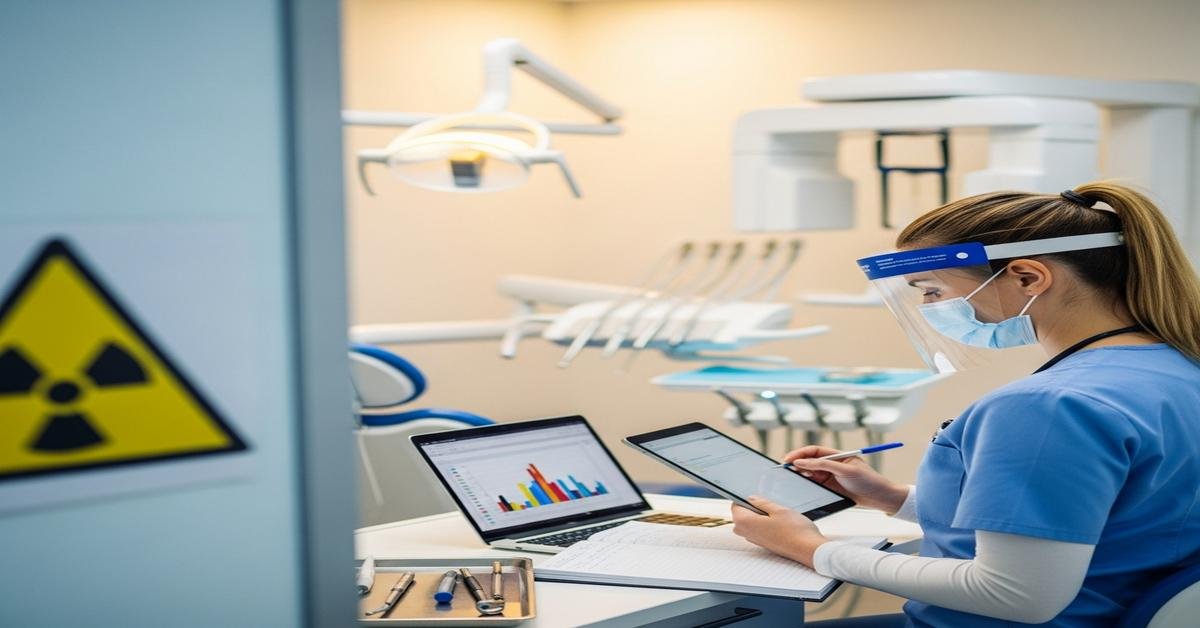
The CDA exam rewards people who know the “why” behind every guideline. This guide focuses on the highest-yield points in radiation health and infection control for dental assistants. You will see the numbers that are easy to test, the procedures that prevent common errors, and the reasoning that ties it all together. Use this as a checklist while you study and while you practice.
How to Think for the CDA: Strategy First
Memorization helps, but reasoning scores more points. Ask yourself for every topic: What harms are we preventing? What control breaks the chain? What number proves it is safe? If you know that, you can answer variants of the same question.
- Names and numbers: Learn limits, temperatures, times, and angles. These are high-yield.
- Cause and effect: Link the control to the risk. This helps when options look similar.
- Best practice: Know what is recommended even if shortcuts seem common in clinics.
Radiation Biology You Must Know
Why we limit dose: ionizing radiation can damage DNA. Effects come in two categories.
- Stochastic effects: Cancer risk. No threshold. Any dose adds some risk. This is why ALARA (As Low As Reasonably Achievable) is the rule.
- Deterministic effects: Tissue damage (e.g., skin erythema, cataracts). There is a threshold. Dental doses are far below these levels, but the concept explains why we use shielding.
Who is more sensitive? Cells that divide rapidly and are less specialized are more radiosensitive. Examples: lymphocytes, bone marrow, reproductive cells, intestinal mucosa. Muscle and nerve cells are more resistant. This matters for patient selection and justifying exposures in children.
Units you may see:
- Absorbed dose: Gray (Gy). (1 Gy = 100 rad)
- Equivalent/effective dose: Sievert (Sv). (1 Sv = 100 rem)
Dose Limits and Practical Numbers
Numbers are testable because they define “safe.”
- Occupational effective dose limit: 50 mSv/year (5 rem).
- Cumulative occupational limit: 10 mSv × age in years (1 rem × age).
- Public (non-occupational) limit: 1 mSv/year (0.1 rem).
- Declared pregnant worker: 5 mSv for entire pregnancy, with not more than 0.5 mSv per month. This protects the embryo/fetus during rapid growth.
Patient Protection: The Big Wins
The exam focuses on measures that sharply cut dose without losing diagnostic value.
- Collimation: Use rectangular collimation when possible. It can reduce patient dose by ≈60% compared with round. The maximum diameter for round collimation at the skin surface is 2.75 inches (7 cm). This matters because a smaller beam means less tissue exposed.
- Filtration: Removes low-energy x-rays that would only add skin dose. Required total filtration is:
- 1.5 mm aluminum for machines operating < 70 kVp.
- 2.5 mm aluminum for ≥ 70 kVp.
- Receptors: Use F-speed film or digital sensors. F-speed cuts dose by about 60% versus D-speed; digital can reduce even more. Less exposure time means less dose.
- PID length and shape: A long (16-inch) PID reduces beam divergence and skin dose compared to an 8-inch PID. Rectangular + long PID is the best combo for dose reduction.
- Lead apron + thyroid collar: Use for all intraoral exposures. The thyroid is radiosensitive, especially in children.
- Technique selection: Prefer the paralleling technique. It creates less distortion and fewer retakes than bisecting angle, so it prevents extra exposures.
- Selection criteria: Take radiographs only when there is a diagnostic need. No “routine” films without justification. This is the heart of ALARA.
Operator Protection: Position and Shielding
Most assistant exposure comes from scatter. Distance and angle matter because scatter travels forward from the patient.
- Stand at least 6 feet (2 meters) away and at an angle of 90–135 degrees to the primary beam. This position places you outside the main scatter path.
- Never hold the receptor or tubehead during exposure. Use positioning devices and beam alignment holders to avoid hand exposure and retakes.
- Barriers and walls: Take exposures from behind a protective barrier whenever possible. Drywall and leaded glass provide scatter shielding.
- Dosimetry badges: Wear and return them as scheduled. They verify that controls are working. If readings rise, something in the workflow needs correction.
- Pregnant staff: With standard precautions and proper monitoring, duties can continue. The fetal limit numbers guide safe assignment and positioning.
Image Quality: Retake Prevention
Every retake doubles dose to that region. Most errors are predictable and easy to prevent.
- Horizontal angulation: Incorrect angulation causes overlapping contacts. Align the central ray through the contact areas. For bitewings, use the aiming ring to sight contacts before exposure.
- Vertical angulation: Too positive = foreshortening. Too negative = elongation. Bitewings commonly use about +10 degrees. For paralleling periapicals, vertical angulation is set by the holder to minimize distortion.
- Receptor placement: Missed apices occur when the receptor is not seated deeply or is tilted. Place toward the midline, then gently move lingually to seat fully. Use cotton rolls for tori.
- Cone-cutting: Happens when the PID is misaligned with the receptor. Use beam alignment devices and ensure the PID opening fully covers the aiming ring.
- Motion blur: Patient movement softens detail. Support the headrest, instruct the patient to stay still, and stabilize the receptor.
Processing mistakes (film): These cause non-diagnostic images.
- Underdeveloped (light image): Cool developer, short time, or exhausted solution. Fix by checking temperature (ideal ~68°F/20°C) and time (≈5 minutes manual development).
- Overdeveloped (dark): Hot solution or too long in developer. Control with a thermometer and timer.
- Light leaks/safelight fog: Grey haze and loss of contrast. Use the coin test and correct distances and filters.
Digital sensors/PSP plates: Use barrier sleeves to prevent contamination. Avoid bending PSP plates. Process promptly to reduce fading.
Quality Assurance in Radiography
Quality assurance prevents cumulative errors and unnecessary exposures.
- Darkroom tests: Coin test for safelighting; light-leak test with the lights off to spot leaks. These protect film from fogging.
- Stepwedge: Expose a stepwedge daily or weekly to a reference receptor. Density shifts indicate developer or exposure drift, prompting maintenance.
- Chemistry maintenance (manual/automatic): Replenish developer and fixer daily as directed and replace every 2–4 weeks or per manufacturer. Exhausted solutions cause retakes.
- Thermometer and timer: Control temperature and time because chemical reactions depend on both.
- Equipment checks: Inspect PID stability, collimation, exposure switches, and holders. Loose equipment causes cone-cuts and repeats.
Infection Control Fundamentals: Stop the Chain
The chain of infection needs a pathogen, a source, a portal, a mode, and a susceptible host. Break any link and transmission drops.
- Standard Precautions: Treat all blood and body fluids (except sweat) as potentially infectious. This avoids missed risks.
- Spaulding classification:
- Critical items: Penetrate tissue/bone (elevators, scalers). Heat sterilize.
- Semi-critical: Contact mucosa (mirrors, impression trays). Heat sterilize when possible. If heat-sensitive, high-level disinfect.
- Non-critical: Contact intact skin (BP cuffs). Clean and low- or intermediate-level disinfect as indicated.
PPE and Hand Hygiene
Barriers work only when used in the right order. The sequence prevents self-contamination.
- Donning (before care): Gown → mask/respirator → protective eyewear/face shield → hand hygiene → gloves. You clean hands right before gloves so the inside stays clean.
- Doffing (after care): Gloves → hand hygiene → eyewear/face shield → gown → mask → hand hygiene. Remove the dirtiest item (gloves) first, then clean hands to avoid spreading contaminants.
Hand hygiene basics:
- Use alcohol-based hand rub (60–95% alcohol) when hands are not visibly soiled.
- Use soap and water for 20 seconds when visibly soiled, after restroom use, or after glove removal if hands are contaminated.
- No artificial nails; keep nails short. Microbes hide under long or artificial nails.
Masks and eye protection: Choose ASTM level based on splash/spray risk. Use protective eyewear with side shields for both team and patient. Eyes are a mucous membrane and need protection from droplets and debris.
Sharps Safety and Exposure Response
Needlesticks are preventable. Most occur during recapping or disposal.
- Recapping: Use a one-handed scoop technique or a recapping device. Never pass an uncapped needle.
- Sharps containers: Place near point of use, puncture-resistant, leakproof, and close when 3/4 full. Overfilled containers increase injuries.
- Post-exposure steps: Wash needlesticks with soap and water; flush splashes to mucous membranes with water. Report, document source-patient status if possible, get baseline labs, and start post-exposure prophylaxis promptly (ideally within hours). Early action reduces infection risk.
Hepatitis B: Complete the vaccine series and check antibody titer 1–2 months later. A protective anti-HBs level is ≥10 mIU/mL. If protected, no HBV prophylaxis is needed after exposure.
Instrument Processing Workflow: Dirty to Clean
Workflow prevents cross-contamination by keeping directions one-way.
- Receiving/cleaning area: Put on heavy-duty utility gloves, mask, eye protection, and gown. Use an ultrasonic cleaner or instrument washer. These reduce sharps injuries compared to hand scrubbing.
- Rinsing and drying: Dry instruments before packaging. Moisture interferes with sterilization and can tear packaging.
- Packaging: Use pouches or wraps with external process indicators and internal chemical indicators. Indicators confirm exposure to sterilizing conditions.
- Sterilization:
- Steam autoclave (gravity): ~121°C (250°F) at 15 psi for ~30 minutes.
- Prevacuum steam: ~132–135°C (270–275°F) for ~3–10 minutes.
- Chemical vapor: ~132°C (270°F) for ~20 minutes.
- Dry heat: Follow manufacturer (often 160–170°C for 60–120 minutes). Dry heat requires longer time because air transfers heat slowly.
- Monitoring:
- Mechanical: Time, temperature, and pressure gauges each cycle.
- Chemical: Internal and external indicators each package, each cycle.
- Biological (spore) testing: Weekly, and after repairs or new loads. Use Geobacillus stearothermophilus for steam/chemical vapor and Bacillus atrophaeus for dry heat. Spore tests prove actual sterilization.
- Storage: Event-related, not time-related. Packages remain sterile until opened, wet, or damaged. Handle with clean, dry hands.
Cold sterilization caveat: High-level disinfectants like glutaraldehyde require long immersion to sterilize and leave no sterile barrier after removal. Reserve for true heat-sensitive items only, and rinse thoroughly. Heat is preferred whenever possible because it is reliable and trackable.
Environmental Infection Control: Surfaces and Water
Control focuses on where contamination lands, how long it stays wet with disinfectant, and how waterlines are maintained.
- Surface categories:
- Clinical contact surfaces: Frequently touched (light handles, chair switches). Use surface barriers or clean and disinfect between patients.
- Housekeeping surfaces: Floors and walls. Clean routinely; disinfect when visibly contaminated.
- Disinfectant levels:
- High-level: For heat-sensitive semi-critical items (immersion). Not for surfaces.
- Intermediate-level: EPA-registered hospital disinfectant with tuberculocidal claim (e.g., iodophors, certain phenolics, sodium hypochlorite products). Use on clinical contact surfaces after cleaning.
- Low-level: For non-critical, non-bloody surfaces. No TB claim.
- Contact time: Keep the surface visibly wet for the full labeled contact time (often 1–10 minutes). If it dries early, re-wet. This ensures microbe kill claims are met.
- Barriers: Use on items difficult to clean (switches, touchscreens). Replace between patients. Barriers prevent fluid from reaching the surface, saving turnover time and reducing chemical use.
Dental unit waterlines (DUWLs): Biofilm forms inside narrow plastic tubing. Patients can be exposed during procedures.
- Goal: ≤500 CFU/mL heterotrophic bacteria (drinking water standard) for routine care.
- Controls: Self-contained reservoirs, periodic chemical treatment (“shock” and maintenance), in-line filters, and routine monitoring.
- Flushing: Purge lines for ~2 minutes at the start of the day and 20–30 seconds between patients. Flushing reduces planktonic counts and clears retraction.
HVE and evacuation lines: Use HVE for aerosol-generating procedures. Clean evacuation lines at least daily with a non-foaming cleaner. This keeps suction effective and reduces biofilm.
Radiology-Specific Infection Control
Radiology areas often get overlooked, but receptors and tubeheads are high-touch surfaces.
- Digital sensors: Cover with an FDA-cleared barrier sleeve and secure it. After removal, clean and disinfect the sensor with a manufacturer-approved agent. Do not heat sterilize most sensors—they will be damaged.
- PSP plates: Use disposable barriers. After use, remove the barrier without touching the plate surface, then follow manufacturer instructions for cleaning before scanning. Discard contaminated plates if they cannot be safely disinfected.
- Film holders and positioning devices: Heat sterilize between patients. They contact mucosa and are semi-critical.
- Control panel, tubehead, and chair controls: Barrier or intermediate-level disinfection between patients. These are clinical contact surfaces.
- Hand hygiene and glove changes: Perform hand hygiene before donning gloves and after glove removal. Change gloves between patients and when torn or contaminated.
Respiratory Hygiene and When to Defer Care
Dentistry generates aerosols. Controls protect your team and other patients.
- Respiratory hygiene: Offer masks or tissues to coughing patients, and separate them when possible.
- Airborne disease: Do not treat patients with suspected or active TB in routine dental settings. Refer for medical care. This prevents clinic-wide exposure.
- Mask choice: For routine care, use a surgical mask matched to splash risk. For aerosol-generating procedures on patients with suspected airborne infection risk, a fit-tested respirator is needed—or defer dental care.
Waste and Amalgam Handling
- Regulated medical waste: Items saturated with blood/body fluids go into red biohazard bags. This prevents leakage and exposure during transport.
- Sharps: Needles, scalpel blades, and orthodontic wires go in approved sharps containers. Never recap by hand.
- Amalgam: Use amalgam separators and dispose of amalgam waste per local rules. Do not put amalgam in sharps containers or red bags. Mercury requires special handling.
High-Yield Quick Checks and Memory Hooks
- 2.75 inches rule: Max round beam at skin. Smaller beam = less scatter = less dose.
- Filtration cutoff: < 70 kVp → 1.5 mm Al; ≥ 70 kVp → 2.5 mm Al.
- Stand 6 feet away at 90–135°: Avoid the primary scatter path.
- Weekly spore testing: The only proof of sterilization is killing spores.
- Indicators: External shows processed; internal shows penetration; neither alone proves sterilization.
- DUWL goal: ≤500 CFU/mL; flush 2 min at day start; 20–30 sec between patients.
- Rad protection: Rectangular collimator + long PID + F-speed/digital + paralleling = fewer retakes and less dose.
- Anti-HBs ≥10 mIU/mL: Protected after HBV vaccine series.
- Bitewing vertical angulation: About +10° to open contacts and capture crestal bone.
Practice Scenarios to Lock It In
- You see overlapping contacts on bitewings: Cause is incorrect horizontal angulation. Realign the PID so the central ray passes through the interproximal spaces using the aiming ring as a guide. This prevents repeat exposures.
- Your weekly spore test fails: Remove the sterilizer from service. Review mechanical and chemical indicators, load pattern, packaging, and cycle selection. Re-test after corrective action. Do not use the sterilizer until a passing biological indicator confirms sterility.
- A digital sensor barrier tears during removal: Treat the sensor as contaminated. Clean and disinfect with an approved product per manufacturer guidance before reuse. This avoids cross-infection.
- Dark, high-contrast films today but not yesterday: Developer is too hot or development time increased. Verify the thermometer and timer and compare with a stepwedge control. Standardizing temperature/time prevents image variability and retakes.
Final Takeaways
On the CDA, think like a risk manager. Choose the option that prevents the most harm with the fewest steps. In radiography, use collimation, filtration, longer PIDs, F-speed or digital receptors, and the paralleling technique. Position yourself 6 feet away at 90–135 degrees. In infection control, follow the Spaulding system, wear PPE in the correct order, and process instruments in a one-way flow with weekly spore testing. Keep dental water within 500 CFU/mL and disinfect clinical contact surfaces with the right contact time.
Learn the key numbers and tie each to a reason. That combination—precision plus purpose—will carry you through the exam and keep your patients and team safe every day.

