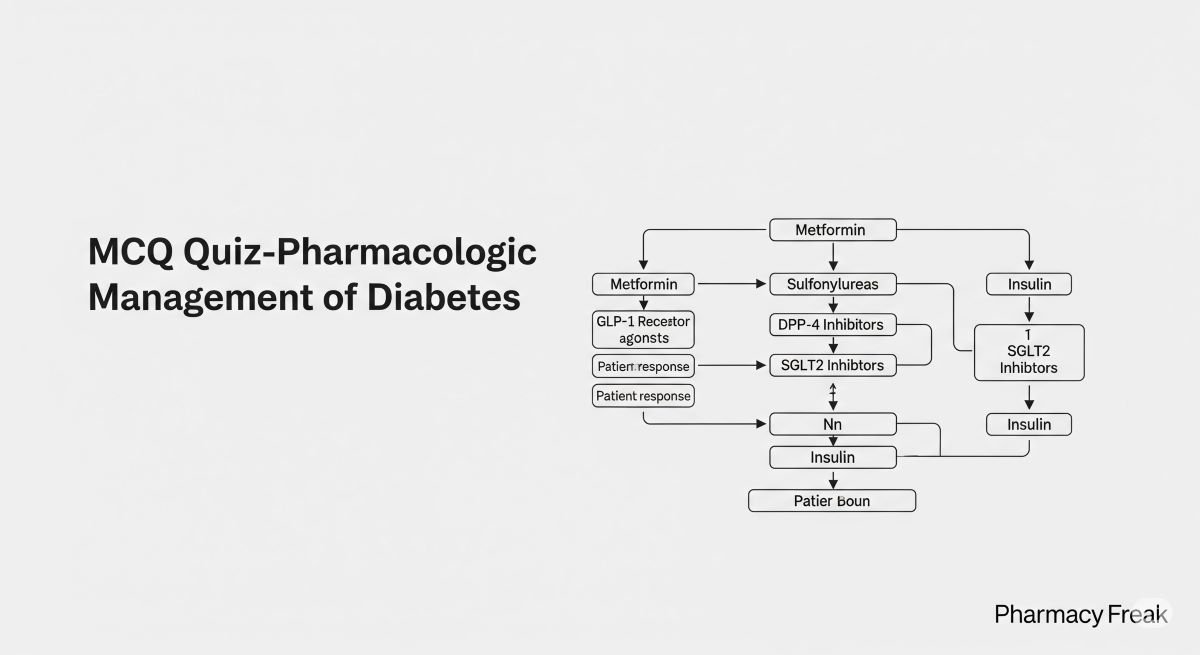
The pharmacologic management of diabetes mellitus has become increasingly complex and personalized, moving beyond a simple glucose-lowering strategy to a comprehensive approach focused on cardiovascular and renal risk reduction. Pharmacists, guided by the principles taught in the Patient Care 5 curriculum, are essential for navigating the numerous classes of oral and injectable medications. This quiz will test the clinical knowledge required to select appropriate therapies based on patient-specific factors and comorbidities, manage side effects, and achieve therapeutic goals.
1. According to most guidelines, what is the first-line pharmacologic agent for a newly diagnosed patient with Type 2 Diabetes, assuming no contraindications?
- a. Insulin
- b. A sulfonylurea
- c. Metformin
- d. An SGLT2 inhibitor
Answer: c. Metformin
2. Which class of oral diabetes medications works primarily by stimulating insulin secretion from pancreatic beta cells, regardless of glucose levels?
- a. Biguanides
- b. Thiazolidinediones (TZDs)
- c. Sulfonylureas
- d. DPP-4 inhibitors
Answer: c. Sulfonylureas
3. A patient with Type 2 Diabetes and established atherosclerotic cardiovascular disease (ASCVD) would benefit most from adding which of the following agents to their metformin?
- a. A sulfonylurea like glipizide.
- b. A GLP-1 receptor agonist with proven cardiovascular benefit, like liraglutide.
- c. A DPP-4 inhibitor like sitagliptin.
- d. Basal insulin.
Answer: b. A GLP-1 receptor agonist with proven cardiovascular benefit, like liraglutide.
4. Sodium-glucose cotransporter 2 (SGLT2) inhibitors, such as empagliflozin, lower blood glucose by:
- a. Increasing insulin sensitivity.
- b. Decreasing hepatic glucose production.
- c. Increasing the urinary excretion of glucose.
- d. Slowing gastric emptying.
Answer: c. Increasing the urinary excretion of glucose.
5. Pioglitazone is a thiazolidinedione (TZD) that is contraindicated in patients with what comorbid condition?
- a. Hypertension
- b. Asthma
- c. Symptomatic Heart Failure
- d. Gout
Answer: c. Symptomatic Heart Failure
6. The “Pharmacology of Oral Diabetes Medications” is a specific lecture in which course?
- a. PHA5787C Patient Care 5
- b. PHA5104 Sterile Compounding
- c. PHA5703 Pharmacy Law and Ethics
- d. PHA5878C Patient Care 3
Answer: a. PHA5787C Patient Care 5
7. A common and often dose-limiting side effect of metformin is:
- a. Weight gain
- b. Hypoglycemia
- c. Gastrointestinal upset (diarrhea, nausea)
- d. Edema
Answer: c. Gastrointestinal upset (diarrhea, nausea)
8. Which of the following is a long-acting (basal) insulin?
- a. Insulin lispro
- b. Insulin aspart
- c. Insulin detemir
- d. Regular insulin
Answer: c. Insulin detemir
9. GLP-1 receptor agonists are administered via which route?
- a. Oral
- b. Transdermal
- c. Subcutaneous injection
- d. Inhalation
Answer: c. Subcutaneous injection
10. A patient taking glipizide should be counseled extensively on the risk, signs, and management of:
- a. Lactic acidosis
- b. Hypoglycemia
- c. Genitourinary infections
- d. Pancreatitis
Answer: b. Hypoglycemia
11. The management of Type 1 and Type 2 Diabetes are topics within the Patient Care 5 curriculum.
- a. True
- b. False
Answer: a. True
12. Which of the following is considered a weight-neutral oral diabetes medication class?
- a. Sulfonylureas
- b. TZDs
- c. DPP-4 inhibitors
- d. Insulin
Answer: c. DPP-4 inhibitors
13. In addition to glycemic control, SGLT2 inhibitors have demonstrated benefit in patients with:
- a. Heart failure and chronic kidney disease.
- b. Severe peripheral neuropathy.
- c. Gastroparesis.
- d. Allergic rhinitis.
Answer: a. Heart failure and chronic kidney disease.
14. A basal-bolus insulin regimen is designed to mimic the natural physiologic secretion of insulin. It consists of:
- a. A long-acting insulin and a rapid-acting insulin.
- b. Only a rapid-acting insulin.
- c. Only an intermediate-acting insulin.
- d. Two different long-acting insulins.
Answer: a. A long-acting insulin and a rapid-acting insulin.
15. A patient should be counseled to take their rapid-acting insulin (e.g., lispro):
- a. Once daily at bedtime.
- b. 30 minutes before meals.
- c. With meals, or within 15 minutes before eating.
- d. In the morning only.
Answer: c. With meals, or within 15 minutes before eating.
16. A common side effect of SGLT2 inhibitors is an increased risk of:
- a. Weight gain
- b. Pancreatitis
- c. Genital mycotic infections
- d. Lactic acidosis
Answer: c. Genital mycotic infections
17. The “Pharmacology of Injectable Diabetes Medications” is a lecture covered in the Patient Care 5 curriculum.
- a. True
- b. False
Answer: a. True
18. What is the mechanism of action of DPP-4 inhibitors like sitagliptin?
- a. They increase urinary glucose excretion.
- b. They increase insulin sensitivity.
- c. They prevent the breakdown of endogenous incretin hormones like GLP-1.
- d. They stimulate insulin secretion directly.
Answer: c. They prevent the breakdown of endogenous incretin hormones like GLP-1.
19. Which oral diabetes medication should be held before receiving IV iodinated contrast dye?
- a. Glipizide
- b. Pioglitazone
- c. Sitagliptin
- d. Metformin
Answer: d. Metformin
20. An active learning session on diabetes is part of the Patient Care 5 course.
- a. True
- b. False
Answer: a. True
21. A patient with a history of pancreatitis should use which class of medications with caution?
- a. Metformin
- b. Sulfonylureas
- c. GLP-1 receptor agonists and DPP-4 inhibitors
- d. TZDs
Answer: c. GLP-1 receptor agonists and DPP-4 inhibitors
22. Which of the following is NOT a benefit of GLP-1 receptor agonists?
- a. A1c reduction
- b. Weight loss
- c. Low risk of hypoglycemia
- d. Reduction in blood pressure
Answer: c. Low risk of hypoglycemia
23. Insulin glargine should not be mixed in the same syringe with which other type of insulin?
- a. Insulin lispro
- b. Insulin aspart
- c. Regular insulin
- d. All of the above
Answer: d. All of the above
24. An active learning session on diabetes is part of which course?
- a. PHA5787C Patient Care 5
- b. PHA5163L Professional Skills Lab 3
- c. PHA5781 Patient Care I
- d. PHA5782C Patient Care 2
Answer: a. PHA5787C Patient Care 5
25. A patient with Type 1 Diabetes requires:
- a. At least one oral medication.
- b. Lifelong insulin therapy.
- c. A GLP-1 receptor agonist as monotherapy.
- d. Diet and exercise alone.
Answer: b. Lifelong insulin therapy.
26. The “Rule of 15” for treating hypoglycemia involves:
- a. Consuming 15 grams of protein.
- b. Consuming 15 grams of a simple carbohydrate.
- c. Injecting 15 units of insulin.
- d. Waiting 15 minutes before taking any action.
Answer: b. Consuming 15 grams of a simple carbohydrate.
27. A key counseling point for a patient starting an SGLT2 inhibitor is to:
- a. Restrict fluid intake.
- b. Maintain adequate hydration and be aware of the signs of a UTI.
- c. Take the medication at bedtime.
- d. Expect weight gain.
Answer: b. Maintain adequate hydration and be aware of the signs of a UTI.
28. Which sulfonylurea has a long-acting, active metabolite that can accumulate in renal impairment, and should be avoided in the elderly?
- a. Glipizide
- b. Glimepiride
- c. Glyburide
- d. Gliclazide
Answer: c. Glyburide
29. The main goal of pharmacologic therapy in diabetes is to:
- a. Lower A1c to prevent long-term microvascular and macrovascular complications.
- b. Use the highest number of medications possible.
- c. Eliminate the need for blood glucose monitoring.
- d. Cause weight loss.
Answer: a. Lower A1c to prevent long-term microvascular and macrovascular complications.
30. The management of diabetes complications is a lecture within the Patient Care 5 curriculum.
- a. True
- b. False
Answer: a. True
31. When is it appropriate to initiate dual therapy at the time of diagnosis of Type 2 Diabetes?
- a. When the patient’s A1c is ≥ 1.5% above their glycemic target.
- b. For every patient.
- c. When the patient refuses metformin.
- d. When the fasting blood glucose is > 150 mg/dL.
Answer: a. When the patient’s A1c is ≥ 1.5% above their glycemic target.
32. The primary mechanism of action of thiazolidinediones (TZDs) is:
- a. Increasing insulin secretion.
- b. Increasing peripheral insulin sensitivity by acting as a PPARγ agonist.
- c. Blocking glucose reabsorption.
- d. Inhibiting DPP-4.
Answer: b. Increasing peripheral insulin sensitivity by acting as a PPARγ agonist.
33. The pharmacist’s role in diabetes management includes:
- a. Educating patients on how to use their glucometer and injectable medications.
- b. Screening for drug interactions and contraindications.
- c. Counseling on lifestyle modifications.
- d. All of the above.
Answer: d. All of the above.
34. Long-term use of metformin is associated with a risk of deficiency in which vitamin?
- a. Vitamin C
- b. Vitamin D
- c. Vitamin B12
- d. Vitamin K
Answer: c. Vitamin B12
35. A patient on a basal-bolus regimen should be taught to adjust their bolus (mealtime) insulin based on:
- a. Their fasting blood glucose.
- b. The amount of carbohydrates in their meal.
- c. The time of day.
- d. Their blood pressure.
Answer: b. The amount of carbohydrates in their meal.
36. Which class of medication is generally considered weight neutral or may cause slight weight loss?
- a. Sulfonylureas
- b. TZDs
- c. Insulin
- d. Metformin
Answer: d. Metformin
37. When choosing a second-line agent to add to metformin for a patient with T2DM and heart failure, which class should be prioritized?
- a. A sulfonylurea
- b. A TZD
- c. An SGLT2 inhibitor with proven HF benefit.
- d. Basal insulin.
Answer: c. An SGLT2 inhibitor with proven HF benefit.
38. The medicinal chemistry of diabetes medications is a topic within the Patient Care 5 curriculum.
- a. True
- b. False
Answer: a. True
39. Which of the following is NOT a rapid-acting insulin?
- a. Lispro
- b. Aspart
- c. Glulisine
- d. NPH
Answer: d. NPH
40. An active learning session covering diabetes is part of which course module?
- a. Module 1: Diabetes Mellitus
- b. Module 3: Women’s Health
- c. Module 4: Medication Safety
- d. Module 8: Men’s Health
Answer: a. Module 1: Diabetes Mellitus
41. The primary side effect that limits the titration of GLP-1 receptor agonists is:
- a. Hypoglycemia
- b. Gastrointestinal intolerance (nausea)
- c. Headache
- d. Injection site reactions
Answer: b. Gastrointestinal intolerance (nausea)
42. Which oral diabetes medication works by slowing the intestinal absorption of carbohydrates?
- a. Acarbose (an alpha-glucosidase inhibitor)
- b. Metformin
- c. Glipizide
- d. Sitagliptin
Answer: a. Acarbose (an alpha-glucosidase inhibitor)
43. A patient with T2DM and CKD with albuminuria should be on what medication for renal protection, regardless of their blood pressure?
- a. A beta-blocker
- b. An ACE inhibitor or ARB
- c. Amlodipine
- d. Hydrochlorothiazide
Answer: b. An ACE inhibitor or ARB
44. What is the role of a pharmacist in a “sick day” plan for a patient with diabetes?
- a. To advise the patient to stop all their diabetes medications.
- b. To counsel on more frequent blood glucose monitoring and when to seek medical attention.
- c. To recommend increasing their insulin dose.
- d. To tell the patient not to eat or drink anything.
Answer: b. To counsel on more frequent blood glucose monitoring and when to seek medical attention.
45. Which of the following medications primarily targets postprandial (after-meal) hyperglycemia?
- a. Insulin glargine
- b. Metformin
- c. A rapid-acting insulin like lispro
- d. Pioglitazone
Answer: c. A rapid-acting insulin like lispro
46. Counseling on medication use and devices is a key objective for pharmacy students.
- a. True
- b. False
Answer: a. True
47. A patient starting insulin therapy should also be provided with a prescription for what?
- a. Metformin
- b. Glucagon emergency kit
- c. A statin
- d. An ACE inhibitor
Answer: b. Glucagon emergency kit
48. An active learning session on diabetes is part of which course?
- a. PHA5787C Patient Care 5
- b. PHA5163L Professional Skills Lab 3
- c. PHA5781 Patient Care I
- d. PHA5782C Patient Care 2
Answer: a. PHA5787C Patient Care 5
49. The overall management of diabetes pharmacotherapy is guided by:
- a. A stepwise approach based on patient characteristics, comorbidities, and glycemic needs.
- b. Using the newest medication available for every patient.
- c. The patient’s preference only.
- d. A goal of using as few medications as possible.
Answer: a. A stepwise approach based on patient characteristics, comorbidities, and glycemic needs.
50. The ultimate goal of diabetes pharmacotherapy is to:
- a. Lower the A1c value at all costs.
- b. Prevent acute and chronic complications, improve quality of life, and ensure patient safety.
- c. Eliminate the need for lifestyle modifications.
- d. Use only injectable medications.
Answer: b. Prevent acute and chronic complications, improve quality of life, and ensure patient safety.

