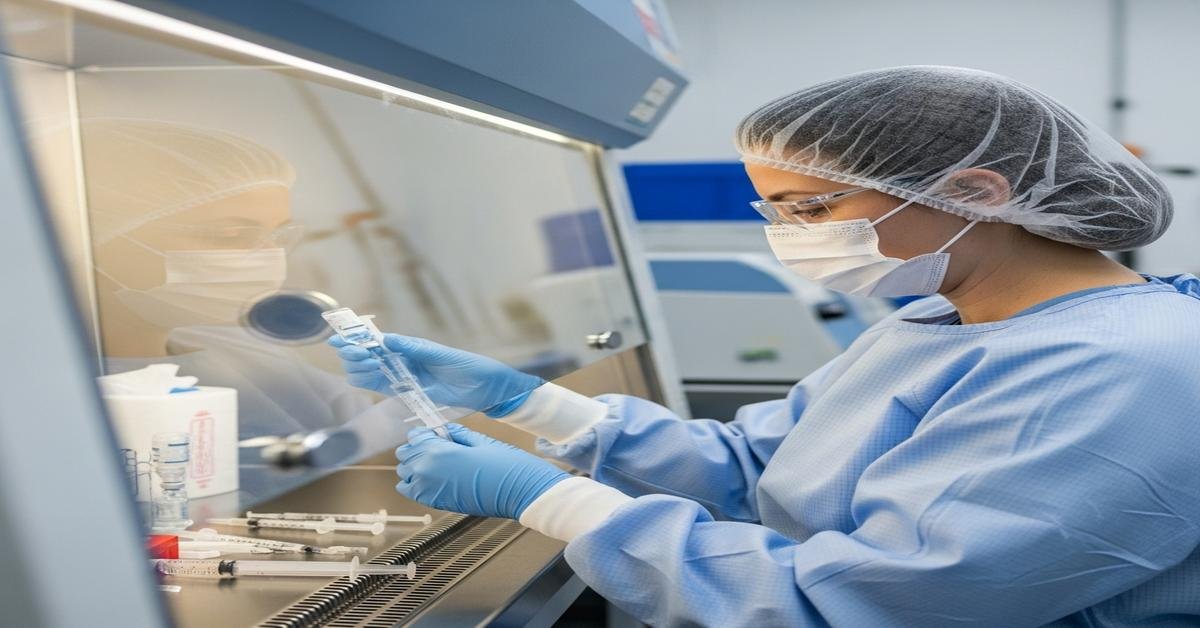
BCSCP candidates are expected to know how to protect patients and workers when handling hazardous drugs (HDs). USP <800> sits at the center of that responsibility. It defines how to receive, store, compound, transport, and dispose of HDs so exposure stays as low as reasonably achievable. This guide explains the intent behind the rules, connects USP <800> to USP <797>, and gives practical, exam‑ready examples you can apply on the job.
What USP <800> covers and why it matters
USP <800> reduces HD exposure. It does this by layering controls: engineering controls (the physical space and airflow), administrative controls (policies, training, and documentation), personal protective equipment (PPE), and work practices.
Why the layers? No single safeguard is perfect. A cabinet can capture most aerosols, but a glove tear can still expose skin. Policies can require double gloves, but a splash can reach the eyes without a face shield. Overlapping controls catch failures before people get hurt.
- Scope: Applies to employees who receive, store, compound, dispense, transport, and dispose of HDs. It also covers administration practices where pharmacy has influence (e.g., priming sets).
- Designated person: Every site must appoint a person with authority to implement and monitor compliance. This avoids “everyone owns it” becoming “no one owns it.”
- Link to USP <797>: For sterile compounding, you must meet both USP <800> (safety) and USP <797> (sterility). USP <800> may add negative pressure and venting that go beyond USP <797> alone.
The NIOSH hazardous drug list: groups and implications
USP <800> uses the NIOSH list to define which drugs are hazardous. The list is split by toxicity and manipulation risk:
- Group 1: Antineoplastics (e.g., many chemotherapy agents). Highest risk for workers. Typically require full containment during compounding.
- Group 2: Non‑antineoplastics that are hazardous (e.g., certain immunosuppressants, antivirals). Risk varies with dosage form and the work you do on them.
- Group 3: Drugs that mainly pose reproductive risk (e.g., teratogenic or fertility‑impairing agents). Affects who should handle them and which tasks need added controls.
Why group drugs? Not all HDs behave the same. Crushing a Group 3 tablet in an open mortar creates inhalation risk; counting sealed, blistered tablets by hand is low risk. The group and the manipulation dictate containment.
Assessment of risk (AoR): when you can use alternatives
USP <800> allows an assessment of risk for some Group 2 and Group 3 drugs and for certain dosage forms. If the risk is low and manipulations are limited (e.g., no crushing, splitting, or compounding from API), you may use alternative strategies instead of full containment used for antineoplastics.
- When AoR applies: Intact tablets/capsules in unit‑dose packaging, applying a topical in a sealed packet, or counting blistered tablets. The risk of aerosolization or leak is low.
- When AoR does not apply: Any API; any manipulation that can aerosolize drug (e.g., crushing tablets, opening capsules); antineoplastics that require compounding.
- What to document: Drug, dosage form, manipulation steps, exposure routes, controls chosen, and rationale. Review at least annually and whenever the process changes.
Why this matters: AoR gives flexibility while still protecting staff. It prevents over‑engineering low‑risk tasks and focuses resources on the highest risks.
Engineering controls: C‑PEC, C‑SEC, and room design
Engineering controls keep contamination from escaping into the pharmacy and prevent cleanroom contamination of sterile preparations.
- C‑PEC (containment primary engineering control): The hood or isolator that captures aerosols and vapors at the source. For sterile HDs, use an externally vented Class II biological safety cabinet (BSC) or a compounding aseptic containment isolator (CACI) designed for HDs. External venting prevents recirculating HD vapors back into the room.
- C‑SEC (containment secondary engineering control): The room housing the C‑PEC. It must be externally vented, under negative pressure to adjacent areas (at least 0.01 inch water column), and sized/ducted to maintain required air changes per hour (ACPH).
- ACPH and pressure: Typical values are:
- Sterile HD buffer room: about 30 ACPH and negative pressure to the anteroom. High ACPH dilutes contaminants faster.
- HD storage room: at least 12 ACPH with negative pressure. This limits accumulation if a container leaks.
- HD C‑SCA (containment segregated compounding area): at least 12 ACPH and negative pressure. Used when a full cleanroom suite is not feasible.
- Cleanroom vs. C‑SCA:
- Cleanroom suite: C‑PEC in a negative‑pressure buffer room with an ISO‑classified anteroom. Supports longer beyond‑use dates (BUDs) under USP <797> if all other criteria are met.
- HD C‑SCA: C‑PEC in a segregated room under negative pressure. Faster to implement but restricts BUDs to Category 1 limits.
Why negative pressure and exhaust? HD particles and vapors move from high to low pressure. Negative rooms pull contaminants inward and out through filters/exhaust instead of letting them escape into hallways or positive‑pressure cleanrooms.
PPE: what, when, and why
PPE is the last barrier between HDs and skin or mucous membranes. Choose PPE based on the task and the drug.
- Gloves: Use ASTM‑tested chemotherapy gloves. Double‑glove for compounding and administration of antineoplastics. Change every 30 minutes or per manufacturer, and after contamination or tear. HDs can permeate glove material; more frequent changes reduce that risk.
- Gowns: Disposable, impermeable, closed‑front gowns with tight cuffs. Change at least every 2–3 hours during compounding and after a spill. Cloth coats shed fibers and absorb drugs; they are not protective.
- Eye/face protection: Use when splashes or sprays are possible, especially during reconstitution or spill cleanup. A face shield over goggles protects both eyes and skin.
- Respiratory protection: Fit‑tested NIOSH‑certified N95 for airborne particles. Use an elastomeric respirator or PAPR if powders are significant, during spills, or when the C‑PEC is unavailable. Surgical masks do not protect against HD aerosols.
- Head, hair, sleeve, and shoe covers: Use two pairs of shoe covers when entering HD rooms; remove outer pair when exiting to avoid tracking contamination.
Why double gloves and impermeable gowns? Many HDs are lipophilic and can permeate single‑layer materials. Doubling and timely changes reduce breakthrough risk.
Work practices that reduce exposure
Even with great equipment, technique matters. Small changes in workflow provide big gains in safety and sterility.
- Priming and spiking: Prime IV lines with non‑HD solution before attaching to HD containers. This prevents HD leakage when expelling air.
- Negative‑pressure vial technique: Equalize pressure by withdrawing air before injecting diluent. This prevents aerosol and spray when removing the needle.
- Closed‑system transfer devices (CSTDs): Use during administration when the dosage form allows. They are recommended for compounding to reduce aerosolization. They do not replace a C‑PEC but add another layer of containment.
- De‑bagging and wiping: Remove outer wrap before placing items into the C‑PEC to keep the work zone cleaner. Wipe vials with an appropriate wipe to reduce residue on surfaces and gloves.
- Labeling and segregation: Label final containers and bins with HD warnings. Segregate HDs during transport to prevent mix‑ups and cross‑contamination.
Why these steps? Most exposure happens during small, routine actions: removing air from syringes, wiping drips, opening vials, or moving bins. Good habits block those pathways.
Cleaning: deactivate, decontaminate, clean, disinfect
HD residue accumulates on hoods, counters, and floors, even with careful compounding. A four‑step process reduces residue and maintains asepsis.
- Deactivation: Chemically neutralize HDs using an agent that renders them less harmful (often an oxidizer). This step reduces the hazard at the molecular level.
- Decontamination: Physically remove residues from surfaces using wipes and appropriate solutions. The goal is to lift the drug off the surface, not just spread it around.
- Cleaning: Remove organic and inorganic material with detergent and water. Clean surfaces allow the disinfectant to contact microbes evenly.
- Disinfection: Apply sterile 70% isopropyl alcohol (IPA) to PEC work zones to prepare for sterile compounding. Disinfection targets microbes, not HD molecules.
Why order matters: You cannot disinfect what you cannot reach. Residues and films block disinfectants. Deactivation and decontamination reduce the chemical hazard; cleaning removes films; disinfection kills microorganisms.
Spill control and waste management
Spills are rare but high risk. Preparation and practice minimize harm.
- Spill kits: Keep kits where HDs are received, stored, compounded, transported, and administered. Stock absorbent pads, HD‑rated gloves, gowns, face shield, respirator, disposal bags, and instructions.
- Response: Restrict area, don PPE, contain from the outside in, clean using deactivation/decontamination steps, and document. For large spills or volatile agents, use a respirator with appropriate cartridges or a PAPR.
- Waste segregation: Follow hazardous waste rules (e.g., RCRA). Separate bulk HD waste (e.g., partially used vials, spill debris) from trace waste (e.g., empty IV bags and tubing that held HDs and are “empty” by regulation). Improper segregation can lead to regulatory penalties and unsafe handling downstream.
- Sharps: Use puncture‑resistant containers labeled for HDs. Sharps with HD residue are managed as HD waste.
Why strict waste rules? Incineration and disposal processes differ for HDs to protect sanitation workers and the environment.
Storage, receiving, packaging, and transport
HD control starts before compounding and continues after products leave the hood.
- Receiving: Unpack HDs in neutral or negative‑pressure areas. Do not unpack in sterile compounding rooms or positive‑pressure areas. If a shipper leaks, you avoid contaminating clean spaces.
- Storage: Store antineoplastics and HD APIs in a negative‑pressure room with at least 12 ACPH. Use sealed bins to contain breakage and leaks. Refrigerated HDs require a dedicated refrigerator in the negative‑pressure room.
- Packaging and transport: Wipe exterior containers, place in sealed, labeled bags or bins, and secure during transport. Avoid pneumatic tubes for antineoplastics and liquid HDs to prevent aerosolization and spills from breakage.
- Hazard communication: Maintain safety data sheets (SDS). Post HD signs at entry points. Clear signage prevents accidental exposure by uninformed staff.
Environmental and personnel monitoring
Testing confirms controls are working and detects problems early.
- Wipe sampling for HD residue: Establish a baseline, then test at least every 6 months and after spills or major changes. Sample likely hot spots: C‑PEC interior, work surfaces near the C‑PEC, floors in front of the hood, and areas where HDs are received/unpacked. No level is “safe,” so look for downward trends and investigate positives.
- Environmental monitoring for sterility (USP <797>): Air and surface microbial sampling follow <797> schedules. HD status does not change microbial criteria, but negative pressure and higher ACPH can affect sampling sites and airflows.
- Glove fingertip and media‑fill: Personnel competency tests verify aseptic skill. These do not measure HD exposure risk but ensure sterile technique is sound inside the C‑PEC.
Why test? You cannot manage what you do not measure. Data guides corrective actions and justifies your practices to regulators and accreditors.
Personnel training and medical surveillance
People are central to USP <800>. Training gives them skills; medical surveillance looks after their health.
- Training: Provide initial and at least annual training on receiving, storage, compounding technique, PPE, spill response, cleaning, waste, and transport. Validate with observation and competency assessments. Document everything.
- Fit testing: Perform initial and annual fit testing for tight‑fitting respirators (e.g., N95). Without fit, filtration claims are meaningless.
- Medical surveillance: Offer baseline and periodic assessments for workers who routinely handle HDs. Include reproductive risk counseling. Early detection of health changes can trigger job modification or exposure review.
Why surveillance? Some HD effects are cumulative or delayed. Surveillance connects workplace exposure to health outcomes and helps refine controls.
Documentation, roles, and quality assurance
USP <800> is specific about written procedures because consistent practice prevents gaps.
- SOPs: Maintain current, accessible procedures for every HD step: receiving, storage, compounding, cleaning, spill response, waste, transport, and emergency response. Review at least annually.
- Designated person duties: Oversee compliance, training, environmental sampling, incident investigations, and corrective actions. Report findings to leadership to secure resources for fixes.
- Deviations and CAPA: When monitoring fails or contamination is detected, perform a root‑cause analysis, correct the issue, and verify with follow‑up testing. This closes the loop.
Why the paperwork? In high‑risk, low‑frequency events (like spills), people need clear steps under stress. Documentation also proves compliance and supports continuous improvement.
USP <800> and USP <797>: BUDs and compounding categories
USP <800> does not set BUDs. It sets the safety conditions under which you compound. BUDs come from USP <797> categories and sterility testing.
- Category 1 CSPs: Compounded in a segregated compounding area. Short BUDs (for example, up to 12 hours at controlled room temperature and 24 hours refrigerated, depending on details). This includes CSPs made in an HD C‑SCA.
- Category 2 CSPs: Compounded in a cleanroom suite with all <797> requirements. Longer BUDs are allowed when environmental control and testing criteria are met.
- Category 3 CSPs: Facilities that meet additional controls and perform more extensive testing may assign extended BUDs per <797> criteria. HD status does not automatically disqualify, but all <800> containment requirements still apply.
Key point: If you compound sterile HDs in a C‑SCA, you are limited to Category 1 BUDs. To extend BUDs, you need a compliant cleanroom suite plus all sterility, stability, and packaging criteria under <797>.
High‑yield BPS exam points and scenarios
- Know the NIOSH groups and AoR: Be able to justify when an intact Group 3 tablet can be counted with simple PPE and when opening that same capsule requires a C‑PEC.
- Engineering controls: Remember: sterile HD compounding must be in a C‑PEC that is externally vented and inside a negative‑pressure C‑SEC. Typical room targets: 30 ACPH for HD buffer rooms; 12 ACPH for storage and C‑SCAs; negative pressure of at least 0.01 inch water column.
- Cleanroom vs. HD C‑SCA: C‑SCA limits BUDs to Category 1. Choosing a C‑SCA speeds implementation but restricts inventory and scheduling flexibility.
- PPE specifics: Double chemo gloves and impermeable gowns for antineoplastics; change frequency matters. N95 is for particulates; use PAPR/elastomeric when aerosols or spills exceed N95’s capability.
- Spill rules: Do not use pneumatic tubes for liquid HDs or antineoplastics. Spill response requires area control, appropriate respirator, and deactivation/decontamination steps, followed by documentation and medical evaluation as needed.
- Closed‑system transfer devices: Required for administration when possible; recommended for compounding. They reduce, not eliminate, exposure and do not replace engineering controls.
- Environmental wipe sampling: Establish baseline; test at least every 6 months and after changes. Investigate and correct positives; re‑sample to confirm control.
- Receiving and storage: Unpack HDs in neutral/negative areas, never in positive‑pressure spaces. Antineoplastics and APIs in a negative‑pressure room with adequate ACPH; dedicated HD refrigerator inside that room.
- Labeling and transport: HD warnings on bins and patient labels; seal final products; wipe exteriors. Segregate from non‑HD items to prevent cross‑contamination.
- Cleaning flow: Deactivate → Decontaminate → Clean → Disinfect. Know why each step exists and that only the last step targets microbes.
- Waste segregation: Differentiate trace vs. bulk HD waste. Sharps with HD residue go into HD‑designated sharps containers.
- Training and surveillance: Annual training and competencies are required. Offer medical surveillance to workers with routine exposure and document counseling on reproductive risks.
Bringing it all together: USP <800> is practical safety science. It expects you to engineer your space to contain HDs, train your people to work cleanly and safely, equip them with the right PPE, and check that the system is working with monitoring and documentation. For the BPS exam, tie every rule to its “why,” and use concrete scenarios to decide which control is required. That mindset will carry you in the test room and in real‑world practice.

