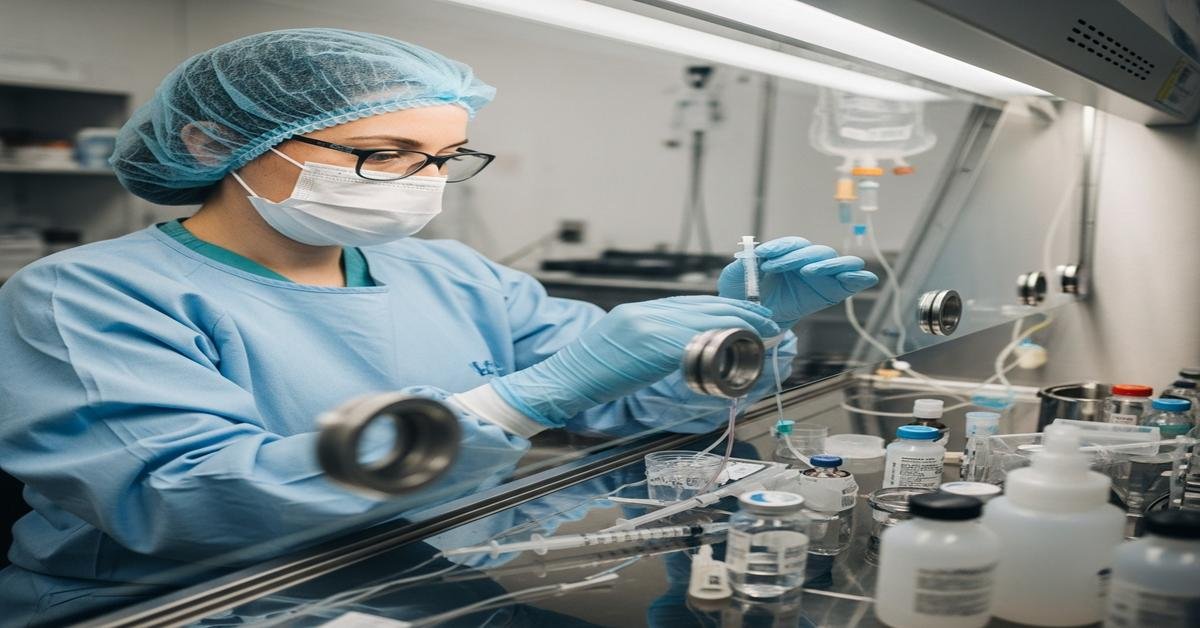
Sterile compounding is high-stakes work. One missed step can harm a patient. That’s why many hospitals and infusion centers look for the PTCB Compounded Sterile Preparation Technician (CSPT) credential. It signals you know USP standards, aseptic technique, and real-world IV room workflow. Below, you’ll learn why CSPT is considered the gold standard for IV technicians, how to prepare for the exam, what USP 797/800 updates matter, and how the certification can boost your salary and career.
What CSPT Is and Why Employers Value It
CSPT is PTCB’s advanced credential focused on sterile compounding. It sits on top of your CPhT. While CPhT proves general pharmacy competence, CSPT tells employers you can safely make IVs, TPNs, and other compounded sterile preparations (CSPs) under current USP standards. That means fewer errors, fewer compliance gaps, and better patient outcomes.
Hospitals, infusion pharmacies, and 503A compounding pharmacies favor CSPT because:
- Safety is non-negotiable. Sterile compounding errors lead to infections or dosing mistakes. CSPT signals you follow aseptic technique and quality checks every time.
- USP 797 and 800 change. Staff who keep up with revisions reduce the risk of citations and shutdowns during inspections.
- Standardization matters. CSPT creates a common baseline across hires, so training is faster and quality is consistent.
Who Should Pursue CSPT
Consider CSPT if you:
- Work in a hospital IV room, home infusion, oncology infusion center, or a compounding pharmacy.
- Want formal validation of sterile technique, calculations, and documentation skills.
- Plan to move into lead tech, QA/QC, cleanroom coordinator, or educator roles.
- Work in a state or health system that prefers or requires advanced sterile compounding credentials.
Eligibility at a Glance
PTCB sets the rules, which can change. Always check the current handbook. In general, you’ll need:
- An active PTCB CPhT.
- Recent, verifiable sterile compounding training and/or supervised experience. Many candidates qualify through a recognized sterile compounding program, employer verification of hands-on hours, or a combination of both.
- Supervisor attestation of competence. This usually confirms your aseptic skills, documentation habits, and compliance with USP 797/800.
Tip: If your site has a structured competency program (gloved fingertip sampling, media fill, technique observation, cleaning logs), document it well. It often supports CSPT eligibility and renewal.
Exam Snapshot
The CSPT exam is computer-based and focuses on applied practice. Expect mostly multiple-choice questions, many of them scenario-driven. The blueprint emphasizes:
- USP 797 (2023 revision) requirements and practical application.
- USP 800 hazardous drugs handling in sterile environments.
- Aseptic technique and cleanroom behavior.
- Calculations and compatibility for parenteral products.
- Workflow, documentation, labeling, and quality assurance.
What this means: Memorization helps, but you must show judgment. You’ll be asked what to do when a glove touches a non-sterile surface, how to assign a BUD, or how to fix a mislabeled batch record.
What the Exam Really Tests
Here’s how the core domains show up in real exam scenarios:
- USP 797 fundamentals: Categorizing CSPs (Category 1, 2, and when Category 3 applies), BUD limits, personnel qualification (gloved fingertip and media-fill), and environmental monitoring expectations.
- Aseptic technique: First air, needle angles, critical site protection, proper order of garbing, glove disinfection, and how to remediate touch contamination.
- Hazardous drugs (USP 800): C-PEC/C-SEC setup, negative pressure, PPE layering, transport, and waste handling.
- Calculations: Dilutions, concentrations, flow rates, osmolarity, mEq, reconstitution, isotonicity and sodium chloride equivalents (E-value), and overfill adjustments.
- Quality and documentation: Master formulation records, batch records, syringe and bag labeling, final checks, release vs quarantine, and deviation handling.
USP 797 (2023) Essentials You Must Know
The 2023 official update reshaped many rules. Focus on what affects daily work:
- Categories replaced old “risk levels.”
- Category 1: Compounded in an SCA (segregated compounding area) with a PEC (e.g., LAFW or CAI). Short BUDs (often ≤12 hours room temp, ≤24 hours refrigerated).
- Category 2: Compounded in a full cleanroom suite (ISO 7 buffer, ISO 7/8 ante). Longer BUDs than Category 1 when conditions are met. Typical limits many sites use for aseptically processed, sterile-start ingredients without sterility testing are around 4 days room temp, 10 days refrigerated, 45 days frozen.
- Category 3: Optional pathway for extended BUDs when extra controls are met (e.g., more frequent personnel qualification and environmental monitoring, and appropriate sterility/endotoxin testing and container-closure integrity testing).
- Immediate-use CSPs: For urgent care outside a cleanroom; administration must start quickly (commonly within 1 hour). Not for batching or storage.
- Personnel qualification: Initial garbing and hand hygiene, successful gloved fingertip sampling before compounding, and media-fill testing. Ongoing competency is required at defined intervals (more frequent for extended BUD programs).
- Environmental monitoring:
- Surface sampling is done regularly (commonly monthly) and after major changes.
- Viable air sampling is done at least semiannually and with room changes.
- Certification of PECs and cleanrooms is typically every 6 months.
- Single- and multi-dose container rules:
- Single-dose containers (SDCs): If punctured in ISO 5, they may be used for a limited time (commonly up to 6 hours). If punctured outside ISO 5, use promptly (commonly within 1 hour) and do not store.
- Multi-dose vials (MDVs): Default beyond-use after first puncture is 28 days unless the manufacturer says otherwise, and storage/handling must still preserve sterility.
- Cleaning and disinfection: Clean from cleanest to dirtiest, top to bottom, back to front; don’t spray HEPA filters; use sterile water to remove residues before sterile 70% IPA on surfaces.
Why this matters: BUDs, monitoring, and personnel competency drive the safety and legality of your work. The exam checks if you can apply these rules to real situations.
Hazardous Drugs and USP 800
You must know how hazardous drug (HD) sterile compounding differs:
- Engineering controls: Use a C-PEC (e.g., Class II BSC or CACI) vented externally in a negative-pressure C-SEC.
- PPE: Chemotherapy-tested double gloves, disposable chemo gown, eye/face protection as needed, and shoe covers dedicated for HD rooms.
- Workflow: Segregate HD receiving, storage, and waste. Use CSTDs when required or recommended by your site. Deactivate, decontaminate, clean, then disinfect.
- Spills and waste: Know the kit contents, steps, and documentation after a spill or exposure.
Core Skills Every IV Tech Must Master
These are non-negotiable for daily practice and the exam:
- Garbing in the correct order: Shoe covers, head/beard cover, face mask; handwashing and nail cleaning; gown; alcohol-based hand rub; sterile gloves; sanitize gloves with sterile 70% IPA and repeat often.
- Aseptic manipulations: Keep critical sites in first air, work at least 6 inches inside the PEC, avoid coring (bevel up; 45° entry then upright), use filter needles for ampuls, and pressurize vials correctly to prevent spray-back.
- Labeling: Include patient (or batch) ID, drug name/strength, diluent, volume, route, required warnings (e.g., “Chemotherapy”), storage, and BUD. For syringes, apply labels without obscuring graduations.
- Documentation and checks: Master formulation record, compounding log/batch record, lot numbers and expirations, line clearance, in-process checks, and final visual inspection.
Calculations You Will See
1) Dilution to a target concentration
You have 2 g of drug in 100 mL and need 1 g/100 mL. Remove 50 mL of the stock (which contains 1 g) and QS to 100 mL with diluent. Now you have 1 g in 100 mL.
2) IV flow rates
Order: 1,000 mL over 8 hours. Pump rate = 1,000 mL ÷ 8 h = 125 mL/h. With a 15 gtt/mL set: gtts/min = 125 × 15 ÷ 60 ≈ 31 gtts/min.
3) Osmolarity (mOsm/L)
1 L contains 9 g NaCl (MW ~58.5; dissociates to 2 particles). mOsm/L = (g/L ÷ MW) × number of particles × 1,000 = (9 ÷ 58.5) × 2 × 1,000 ≈ 307 mOsm/L (about isotonic).
Practice also: Alligation, mEq (e.g., Na+, K+ salts), reconstitution with powder displacement, overfill corrections for large-volume parenterals, and compatibility-driven diluent changes.
A 6-Week, No-Drama Study Plan
- Week 1: Print the exam blueprint. Skim USP 797 key sections (categories, BUDs, personnel qualification, environmental monitoring) and USP 800 basics. Review cleanroom terminology and equipment.
- Week 2: Deep dive aseptic technique: garbing order, first air, critical sites, common contamination points. Practice with checklists. Start daily 20-minute calc drills.
- Week 3: BUD decision-making. Single-dose vs multi-dose rules. Immediate-use CSPs. Documentation essentials (MFR, batch records, labels). Do 2–3 full practice sets of calc problems.
- Week 4: Hazardous drugs: C-PEC/C-SEC, PPE, CSTDs, spill response. Environmental monitoring: surface and air sampling, action levels, and remediation steps.
- Week 5: Full-length practice exam. Review every missed item. Revisit weak topics. Ask a pharmacist or lead IV tech to observe your technique and offer feedback.
- Week 6: Light review. Drill high-yield facts (BUDs, garbing order, SDC/MDV rules). Two more timed practice blocks. Sleep, hydrate, and set up test-day logistics.
Test-Day Strategy
- Read the question stem first. Identify what is being asked (e.g., BUD, next step, calculation) before scanning details.
- Use “sterile common sense.” If an answer conflicts with first air or cleanroom behavior, it’s likely wrong.
- Estimate before calculating. A quick ballpark prevents unit errors and catches impossible answers.
- Flag and move. Don’t burn time. Return after banking easy points.
Common Pitfalls and How to Avoid Them
- Misapplying BUDs. Remember category, environment, and process drive BUDs. If unsure, choose the shorter, safer BUD.
- Touch contamination. If you touch a non-sterile surface with a sterile glove, stop and re-sanitize or reglove. Don’t “work through it.”
- Wrong container choice. Some drugs need glass (adsorption/absorption issues) or special diluents. Don’t ignore compatibility clues.
- Label omissions. Missing route, BUD, or storage turns a safe product into a reject. Use a final label checklist.
- Poor vial pressurization. Over-pressurizing causes sprays, contamination, and dose loss. Practice equalizing pressure.
- Math unit slips. Keep a standard setup for mEq, osmolarity, and flow rates. Write units at each step.
Salary and Career Impact
Where CSPT moves the needle:
- Hospitals and infusion centers often pay more for IV room roles, especially evenings, nights, and weekends.
- CSPT holders frequently see a pay bump compared with non-certified peers doing the same work. Many employers offer a differential for advanced credentials or sterile compounding competency.
- Major metro markets and academic medical centers tend to pay at the higher end. Oncology and TPN-heavy sites also trend higher.
- Career mobility: CSPT opens doors to lead IV tech, cleanroom coordinator, QA/QC tech, educator, or buyer roles—often with salary increases.
A practical way to value CSPT: If CSPT earns you even a modest hourly differential, the certification typically pays for itself quickly. Add shift differentials, and the return improves further.
How to Keep Your CSPT Active
Renewal requires you to maintain your CPhT and complete sterile compounding continuing education. Expect to document USP 797/800-related learning and, at many sites, to keep your in-house competencies current (e.g., gloved fingertip sampling, media-fill, and observation of technique). Keep copies of your CE certificates, competency results, and any remediation steps. This records trail protects both your credential and your practice.
Quick Reference: High-Yield Facts to Memorize
- Garbing order. The exact sequence and when to disinfect gloves.
- First air and critical sites. Nothing blocks HEPA airflow to sterile points.
- Category 1 vs 2 vs 3 concepts. Where compounded, typical BUD expectations, and extra requirements for extended BUDs.
- SDC/MDV rules. SDCs punctured in ISO 5 have limited time; outside ISO 5 they must be used promptly. MDVs default to 28 days unless stated otherwise.
- Immediate-use constraints. For urgent situations; not for batching or storage.
- HD essentials (USP 800). Negative pressure, externally vented C-PEC, chemo PPE, CSTDs where applicable.
- Environmental monitoring cadence. Routine surface sampling and semiannual air sampling; 6-month cleanroom/PEC certification.
- Label and documentation minimums. Patient/batch ID, ingredients, volumes, route, warnings, storage, BUD; complete batch records.
Final Take
CSPT proves you can apply USP standards under pressure and produce safe sterile preparations every time. It’s trusted by employers because it blends knowledge with real-world practice. If you build a structured study plan, drill your calculations, and practice aseptic technique until it’s automatic, the exam is very passable. The payoff is meaningful: stronger job prospects, higher earning potential, and more control over your pharmacy career.

