Customer perception of quality MCQs With Answer is a focused quiz resource for M.Pharm students preparing for exams in Quality Management Systems (MQA 102T). This collection emphasizes how patients, prescribers and regulators perceive pharmaceutical quality — covering service dimensions, expectation-disconfirmation, measurement tools (SERVQUAL, NPS), and factors unique to pharma such as stability, packaging, labeling and safety communications. Questions are designed to deepen understanding of subjective versus objective quality, methods to capture voice of customer, and strategies to improve perceived quality in drug development, manufacturing and post-market surveillance. Use these MCQs to test recall, apply concepts to real-world pharma scenarios, and refine exam readiness.
Q1. Which of the following best describes “perceived quality” in the pharmaceutical context?
- Measured potency and purity determined by laboratory assays
- Customer or stakeholder judgment about a product’s overall excellence
- Regulatory compliance status reported in inspection reports
- Manufacturer’s internal quality control documentation
Correct Answer: Customer or stakeholder judgment about a product’s overall excellence
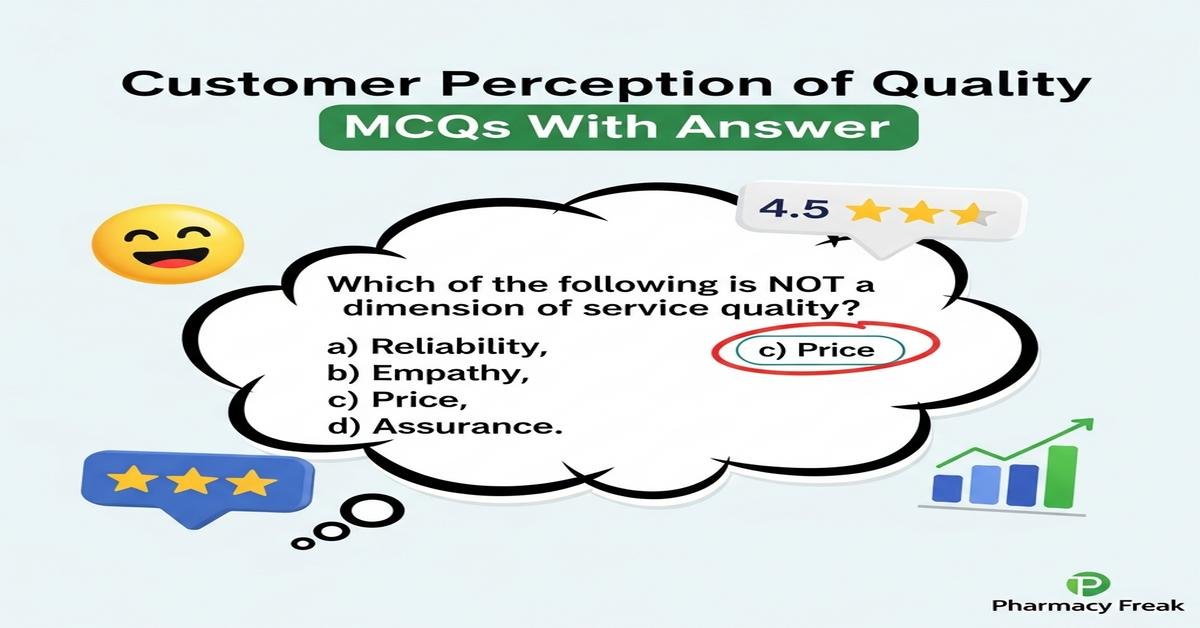
Q2. The SERVQUAL model measures service quality using five dimensions. Which of the following is NOT one of these dimensions?
- Reliability
- Assurance
- Affordability
- Empathy
Correct Answer: Affordability
Q3. In expectation-disconfirmation theory, a “positive disconfirmation” occurs when:
- Experience matches expectations exactly
- Experience falls short of expectations
- Experience exceeds expectations
- Expectations are undefined
Correct Answer: Experience exceeds expectations
Q4. Which metric is commonly used to gauge customer loyalty and likelihood to recommend a pharmaceutical product or service?
- Customer Satisfaction Index (CSI)
- Net Promoter Score (NPS)
- Internal Audit Score
- Failure Mode Frequency
Correct Answer: Net Promoter Score (NPS)
Q5. Which factor most directly affects patients’ perceived quality of an oral solid dosage form at the point of use?
- Analytical method validation reports
- Tablet appearance, ease of swallowing, and labeling clarity
- Stability data under ICH conditions only
- Manufacturer’s annual sales volume
Correct Answer: Tablet appearance, ease of swallowing, and labeling clarity
Q6. The gap between customer expectations and management perceptions of those expectations is identified as which SERVQUAL gap?
- Gap 1
- Gap 2
- Gap 3
- Gap 4
Correct Answer: Gap 1
Q7. Which approach is most appropriate to capture the “voice of the customer” in pharmaceutical quality management?
- Only laboratory stability studies
- Structured patient interviews, HCP feedback and user testing
- Relying exclusively on sales data
- Internal manufacturing batch records review
Correct Answer: Structured patient interviews, HCP feedback and user testing
Q8. Price-quality inference is a perceptual phenomenon where customers:
- Assume higher-priced products are of better quality
- Always choose the cheapest available product
- Ignore price when assessing quality
- Rely only on regulatory approvals for quality assessment
Correct Answer: Assume higher-priced products are of better quality
Q9. In pharma post-market surveillance, which of the following impacts customer perception most rapidly after a quality failure?
- Timely, transparent recall and communication to stakeholders
- Delayed internal CAPA documentation
- Filing a follow-up regulatory inspection report only
- Increasing marketing spend without acknowledging the issue
Correct Answer: Timely, transparent recall and communication to stakeholders
Q10. “Tangibles” as a dimension of service quality refers to:
- The emotional empathy shown by staff
- Physical evidence such as packaging, facilities and printed materials
- Regulatory documentation accuracy
- Clinical trial efficacy endpoints
Correct Answer: Physical evidence such as packaging, facilities and printed materials
Q11. Which design feature in patient information leaflets most improves perceived quality and comprehension?
- Dense regulatory language without headings
- Clear headings, plain language, icons and dosage diagrams
- Small font size to fit more content on a single page
- Removal of contraindications to reduce perceived risk
Correct Answer: Clear headings, plain language, icons and dosage diagrams
Q12. Perceived risk in pharmaceuticals influences quality perception. Which dimension is a primary contributor to perceived risk?
- Bioavailability and safety concerns
- Company logo color
- Manufacturer’s employee count
- Number of distributors
Correct Answer: Bioavailability and safety concerns
Q13. Which statistical consideration is most important when interpreting customer satisfaction survey results?
- Number of questions on the survey only
- Sample size, representativeness and margin of error
- Number of pages in the product dossier
- Manufacturer’s global footprint
Correct Answer: Sample size, representativeness and margin of error
Q14. The Kano model classifies quality attributes. Which Kano category represents features that cause delight when present but are not expected?
- Must-be attributes
- One-dimensional attributes
- Attractive (delighters)
- Indifferent attributes
Correct Answer: Attractive (delighters)
Q15. How does consistent regulatory compliance contribute to customer perception of quality?
- It guarantees perfect products with zero complaints
- It reinforces trust and reduces perceived risk among stakeholders
- It primarily increases production speed
- It has no effect on patient perceptions
Correct Answer: It reinforces trust and reduces perceived risk among stakeholders
Q16. Which practice most reduces measurement bias in patient satisfaction surveys for a generics product?
- Using leading questions that promote a positive view
- Ensuring anonymity, using validated questions and random sampling
- Surveying only patients who returned products
- Collecting responses only from pharmacy staff
Correct Answer: Ensuring anonymity, using validated questions and random sampling
Q17. In pharma service quality, “responsiveness” primarily means:
- Speed and willingness to help customers and resolve issues
- Number of independent laboratories used
- Length of the clinical trial program
- Frequency of internal management meetings
Correct Answer: Speed and willingness to help customers and resolve issues
Q18. A consistent discrepancy between expected and perceived quality due to packaging changes is best addressed by:
- Ignoring customer feedback because packaging is cosmetic
- Engaging customers during redesign, usability testing, and clear communication
- Changing formulations to match old packaging
- Reducing production quality to compensate
Correct Answer: Engaging customers during redesign, usability testing, and clear communication
Q19. Which indicator would best reflect improvements in perceived quality after implementing a patient-centric counseling program?
- Increase in internal CAPA closure rate only
- Improved patient satisfaction scores, reduced complaints, higher adherence
- Decrease in raw material cost
- Higher number of production shifts
Correct Answer: Improved patient satisfaction scores, reduced complaints, higher adherence
Q20. Which statement best differentiates objective quality from perceived quality in pharmaceuticals?
- Objective quality is stakeholder opinion; perceived quality is lab-based measurement
- Objective quality comprises measurable attributes (purity, potency); perceived quality is the customer’s subjective evaluation
- Both terms are identical and interchangeable
- Perceived quality is legally enforceable evidence, objective quality is marketing term
Correct Answer: Objective quality comprises measurable attributes (purity, potency); perceived quality is the customer’s subjective evaluation

