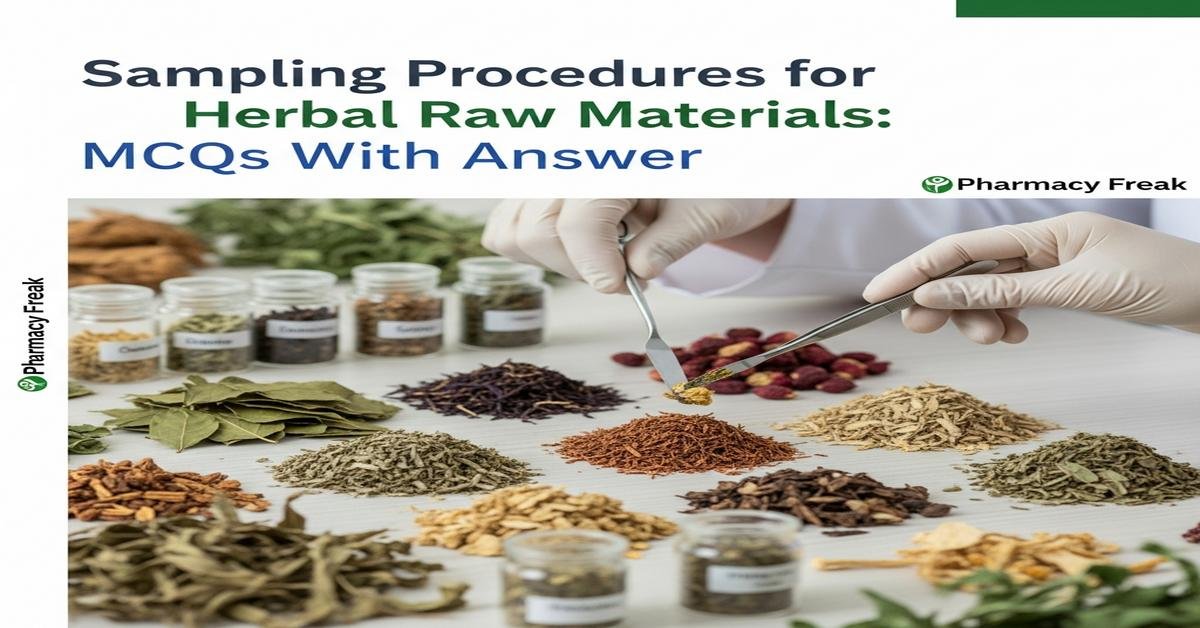
Sampling procedures for herbal raw materials MCQs With Answer
This quiz collection is designed specifically for M.Pharm students studying Herbal and Cosmetic Analysis (MPA 204T). It focuses on sampling procedures for herbal raw materials, covering theoretical principles, practical techniques and regulatory aspects used to obtain representative, reliable samples for identity, purity, potency and safety testing. Questions emphasize heterogeneity, statistical sampling, composite and incremental sampling, sub-sampling methods, chain-of-custody, storage and sample integrity, and decision-making based on pharmacopoeial and GMP guidelines. Use these MCQs to reinforce classroom learning, prepare for exams and ensure a deeper, application-oriented understanding of how proper sampling underpins valid analytical results in herbal drug quality control.
Q1. What is the primary objective of a proper sampling procedure for herbal raw materials?
- To take as few samples as possible to save analytical cost
- To obtain a specimen that is representative of the entire lot or consignment
- To minimize paperwork and documentation during sampling
- To ensure the sample is visually appealing for display
Correct Answer: To obtain a specimen that is representative of the entire lot or consignment
Q2. Which definition best describes a ‘sampling unit’ in the context of herbal raw material sampling?
- The total quantity of material in a consignment
- The smallest identifiable portion that can be separately sampled from the lot
- The analytical laboratory where the sample is tested
- The paperwork accompanying the shipment
Correct Answer: The smallest identifiable portion that can be separately sampled from the lot
Q3. When a lot is heterogeneous, which sampling approach increases the likelihood of a representative sample?
- Taking a single grab sample from the packer’s preferred location
- Systematic or stratified random sampling across different parts of the lot
- Sampling only the top layer of a bulk pile
- Composite sampling from one corner of the batch
Correct Answer: Systematic or stratified random sampling across different parts of the lot
Q4. Which sub-sampling method is most appropriate for reducing large bulk herbal material to a manageable laboratory sample while minimizing segregation?
- Coning and quartering
- Hand-picking the best looking particles
- Using a riffle (dividing) splitter
- Shaking the bulk container and taking surface material
Correct Answer: Using a riffle (dividing) splitter
Q5. Composite sampling of herbal raw materials is most useful primarily for which purpose?
- Maximizing the sensitivity to detect a single contaminated unit
- Estimating the average content (e.g., mean active constituent) of a lot with fewer analyses
- Preserving the original lot without taking any material
- Ensuring chain-of-custody is not required
Correct Answer: Estimating the average content (e.g., mean active constituent) of a lot with fewer analyses
Q6. Which documentation is essential to record at the time of sampling a herbal raw material lot?
- Sampler name, date/time, lot number, sample location, sample size and conditions
- Only the lot number and the sampler name
- Only the analytical results once available
- Just a photograph of the lot
Correct Answer: Sampler name, date/time, lot number, sample location, sample size and conditions
Q7. For estimating a lot mean within a specified margin of error E, which formula is commonly used to calculate required sample size (n) when population standard deviation (σ) is known?
- n = (Z × σ / E)²
- n = (E / Z × σ)²
- n = Z + σ + E
- n = σ / (Z × E)
Correct Answer: n = (Z × σ / E)²
Q8. Which sampling tool should be avoided because it may introduce metallic contamination into herbal samples?
- Stainless steel scoops
- Plastic scoops made of inert polymers
- Galvanized metal scoops
- Clean glass containers
Correct Answer: Galvanized metal scoops
Q9. In a chain-of-custody record for herbal samples, which entry is NOT typically required?
- Transfer signatures each time custody changes
- Unique sample identification number
- Analytical results of the sample
- Date and time of each transfer
Correct Answer: Analytical results of the sample
Q10. During transportation, which condition is most important to maintain to preserve the chemical integrity of many herbal raw materials?
- High humidity above 80% to keep plant tissues moist
- Controlled cool, dry conditions, protected from sunlight and excessive heat
- Continuous freezing at -20°C for all herbal materials
- Exposure to open air to allow ventilation
Correct Answer: Controlled cool, dry conditions, protected from sunlight and excessive heat
Q11. Why is moisture content critical in sampling and testing of herbal raw materials?
- High moisture only affects appearance, not stability or safety
- Moisture strongly influences microbial growth, enzymatic degradation and assay variability
- Moisture content is irrelevant if the sample is ground
- Lower moisture always increases potency of actives
Correct Answer: Moisture strongly influences microbial growth, enzymatic degradation and assay variability
Q12. According to good sampling practice, how should samples for pesticide residue analysis be collected from a large heterogeneous herbal lot?
- One composite sample made from many incremental samples representative of the lot
- A single grab sample from the outermost pallet only
- Samples from the producer’s side only to avoid contamination
- Only samples of the largest pieces to ensure easy analysis
Correct Answer: One composite sample made from many incremental samples representative of the lot
Q13. When planning a sampling scheme for a bulk herbal consignment stored in sacks, which is the best practice?
- Randomly select sacks and take incremental samples from top, middle and bottom of each chosen sack
- Sample only the top-most sacks because they are easiest to access
- Open one sack, take the whole sack as the sample and ignore others
- Take samples only from empty sacks as a control
Correct Answer: Randomly select sacks and take incremental samples from top, middle and bottom of each chosen sack
Q14. Which regulatory guideline principally governs sampling and quality control of herbal raw materials used in pharmaceutical preparations?
- Good Agricultural and Collection Practices (GACP) and GMP guidance combined with relevant pharmacopoeial monographs
- Only local customs without reference to pharmacopoeia
- Food service sampling guidelines
- ISO 9001 alone without pharmacopoeial input
Correct Answer: Good Agricultural and Collection Practices (GACP) and GMP guidance combined with relevant pharmacopoeial monographs
Q15. Which statement about composite samples is TRUE?
- Compositing always increases the probability of detecting rare contaminants
- Composite samples are useful to estimate mean constituent levels but may dilute trace contaminants below detection
- Composite sampling eliminates the need for documentation
- Composite samples should never be used for potency testing
Correct Answer: Composite samples are useful to estimate mean constituent levels but may dilute trace contaminants below detection
Q16. For herbal materials, when is stratified random sampling particularly recommended?
- When the lot is homogeneous and uniform
- When the lot comprises distinct strata (e.g., different cultivars, drying batches or locations) with potentially different quality
- Only for synthetic chemical APIs
- When sampling is done by untrained personnel
Correct Answer: When the lot comprises distinct strata (e.g., different cultivars, drying batches or locations) with potentially different quality
Q17. Which sample reduction technique is most appropriate for powdered herbal samples to minimize segregation and bias?
- Riffle splitting using a properly designed splitter
- Pouring repeatedly from one container into another without mixing
- Collecting only the clumps and ignoring fines
- Using a single scoop from the center of the container
Correct Answer: Riffle splitting using a properly designed splitter
Q18. During what plant stage is sampling typically recommended for many herbal drugs destined for consistent constituent levels?
- At any random stage because constituents are constant
- At the defined phenological stage specified in monographs (e.g., flowering or fruiting stage)
- Only after seeds have fully dispersed
- Immediately after harvesting irrespective of stage
Correct Answer: At the defined phenological stage specified in monographs (e.g., flowering or fruiting stage)
Q19. What is the main reason to perform duplicate or replicate samples during sampling of herbal raw material lots?
- To increase paperwork and administrative burden
- To assess sampling and analytical variability and improve confidence in results
- To keep one sample as a display item in the warehouse
- To confuse auditors
Correct Answer: To assess sampling and analytical variability and improve confidence in results
Q20. How does increasing the desired statistical confidence level (e.g., from 95% to 99%) affect the required sample size for estimating a mean with fixed precision?
- The required sample size decreases because higher confidence needs fewer data
- The required sample size remains unchanged because confidence level is irrelevant
- The required sample size increases because a larger Z-value is used in the sample-size formula
- The required sample size becomes zero because high confidence makes sampling unnecessary
Correct Answer: The required sample size increases because a larger Z-value is used in the sample-size formula

