Introduction:
This quiz set on the Concept of Three-Tier Documentation System is created for M.Pharm students specializing in Quality Control & Quality Assurance. It explains the hierarchical structure of documentation used in pharmaceutical quality systems, covering policies, procedures, work instructions, records, and their roles in compliance with GMP. Questions probe understanding of document types, control mechanisms (revision, approval, distribution, retention), linkage to batch records, electronic systems, change control, training, and audit implications. These MCQs are designed to test conceptual clarity and application of documentation principles essential for regulatory inspections, risk management, and maintaining product quality in a pharmaceutical environment.
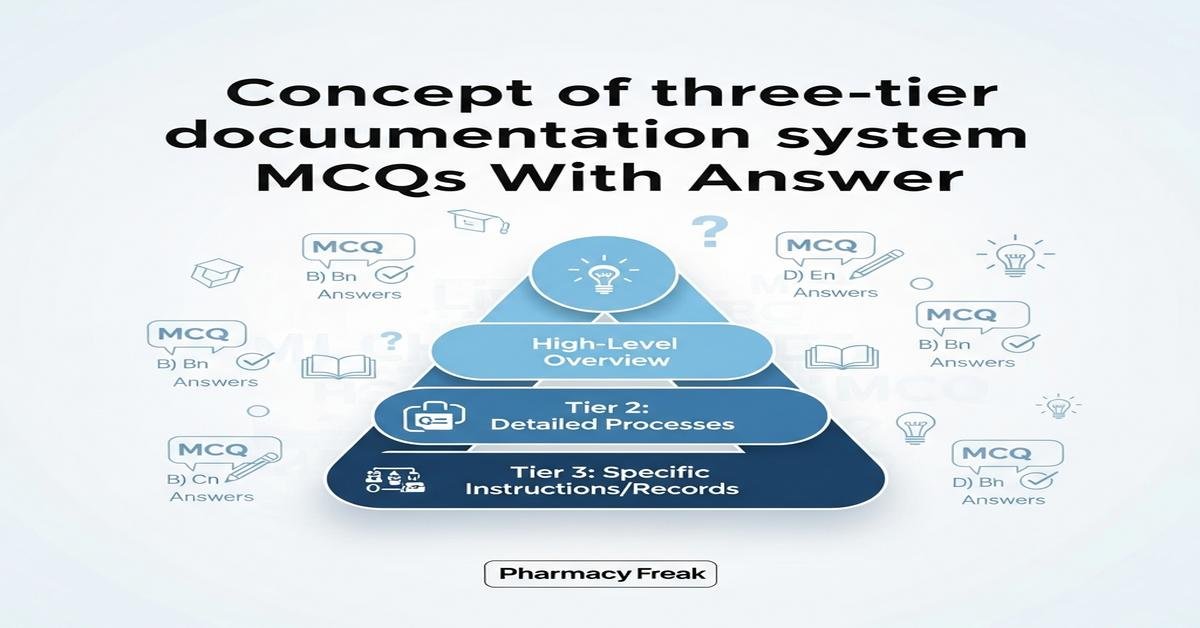
Q1. What is the primary purpose of a three-tier documentation system in pharmaceutical quality management?
- To reduce the number of documents by merging records and procedures
- To provide a hierarchical framework that ensures clarity of policy, procedural control, and execution-level instructions/records
- To replace quality personnel with automated documentation
- To store all documents electronically without version control
Correct Answer: To provide a hierarchical framework that ensures clarity of policy, procedural control, and execution-level instructions/records
Q2. Which document type typically belongs to Tier 1 in a three-tier system?
- Work instructions for an analytical test
- Batch production records
- Quality Manual or Quality Policy
- Equipment logbooks
Correct Answer: Quality Manual or Quality Policy
Q3. Which of the following is an example of a Tier 2 document?
- Company quality objectives and corporate quality policy
- Standard Operating Procedures (SOPs) describing how activities should be performed
- Individual sample analysis result sheets
- Archived master batch records
Correct Answer: Standard Operating Procedures (SOPs) describing how activities should be performed
Q4. What typically constitutes Tier 3 documentation?
- Regulatory marketing authorizations
- High-level quality policy statements
- Work instructions, logbooks, batch records, forms and records generated during routine operations
- Corporate strategic plans
Correct Answer: Work instructions, logbooks, batch records, forms and records generated during routine operations
Q5. Which control is essential to maintain integrity across the three documentation tiers?
- Ad-hoc changes without approval to save time
- Strict version control, controlled distribution, approval and change control procedures
- Allowing anyone to modify documents at any time
- Keeping only electronic copies without audit trails
Correct Answer: Strict version control, controlled distribution, approval and change control procedures
Q6. During an inspection, auditors request the procedure that explains how to revise an SOP. Which tier would that SOP reside in?
- Tier 1
- Tier 2
- Tier 3
- Tier 0 (outside the system)
Correct Answer: Tier 2
Q7. How should cross-references between tiers be handled in a compliant documentation system?
- Not allowed because they create complexity
- They should be explicit, controlled, and traceable so that tiered documents link consistently
- Only verbal cross-references are acceptable
- Use undocumented local practices for linking
Correct Answer: They should be explicit, controlled, and traceable so that tiered documents link consistently
Q8. Which document would most likely specify the acceptance criteria for an analytical method?
- Quality Manual (Tier 1)
- Analytical SOP or Method Validation Protocol (Tier 2)
- Daily equipment logbook (Tier 3)
- Employee training certificate
Correct Answer: Analytical SOP or Method Validation Protocol (Tier 2)
Q9. What is the role of Tier 3 documents in demonstrating GMP compliance?
- They define corporate strategy
- They provide operational evidence (records) showing that procedures were executed and requirements were met
- They are optional and rarely inspected
- They replace Tier 2 procedures entirely
Correct Answer: They provide operational evidence (records) showing that procedures were executed and requirements were met
Q10. Which practice is most appropriate for controlling obsolete documents in a three-tier system?
- Destroying all copies immediately without record
- Retain obsolete documents with clear marking, archive with access control and retention defined by policy
- Allowing continued use until someone notices
- Keep them active and unmarked in the production area
Correct Answer: Retain obsolete documents with clear marking, archive with access control and retention defined by policy
Q11. In change control, which tier level typically initiates a change request for a high-level quality policy update?
- Tier 3
- Tier 2
- Tier 1
- External contractors only
Correct Answer: Tier 1
Q12. For electronic documentation systems implementing the three-tier model, which feature is critical to demonstrate compliance?
- Ability to export files in any format with no controls
- Audit trail, user access control, versioning and validated system functionality
- Unlimited administrative access to all users
- No requirement for system validation
Correct Answer: Audit trail, user access control, versioning and validated system functionality
Q13. Who is primarily responsible for ensuring SOPs (Tier 2) are reviewed and approved according to schedule?
- External auditors
- Document control function together with process owners and QA approval
- Junior operators only
- IT department without QA involvement
Correct Answer: Document control function together with process owners and QA approval
Q14. Which item best exemplifies a Tier 2 to Tier 3 linkage?
- Quality manual referencing a marketing strategy
- An SOP (Tier 2) referencing specific batch record fields or work instructions (Tier 3) to be completed
- An archived financial report
- A supplier brochure
Correct Answer: An SOP (Tier 2) referencing specific batch record fields or work instructions (Tier 3) to be completed
Q15. What is the expected retention strategy for Tier 3 batch records after product expiry, according to GMP principles?
- Immediate disposal after production
- Retention for a defined period (commonly at least 1–5 years after expiry) as per regulatory requirements and company policy
- Retention only until next inspection
- Retention indefinitely with no access controls
Correct Answer: Retention for a defined period (commonly at least 1–5 years after expiry) as per regulatory requirements and company policy
Q16. During deviation investigations, which documentation tier will contain the root cause analysis procedure?
- Tier 3 records only
- Tier 1 corporate policy document
- Tier 2 SOP on deviation handling and CAPA
- Personal notes of the investigator
Correct Answer: Tier 2 SOP on deviation handling and CAPA
Q17. When implementing a new validated analytical method, where should the method validation report be filed?
- Tier 2 procedural folder
- Tier 3 records repository associated with the laboratory and method master file
- Discarded after method is live
- Only within the instrument software without backup
Correct Answer: Tier 3 records repository associated with the laboratory and method master file
Q18. Which statement about training records within the three-tier system is correct?
- Training records are Tier 1 documents
- Training records should be documented as Tier 3 records linked to relevant SOPs and stored with controlled access
- Training does not need to be linked to procedures
- Training records can be informal verbal confirmations
Correct Answer: Training records should be documented as Tier 3 records linked to relevant SOPs and stored with controlled access
Q19. How should external regulatory documents (e.g., pharmacopeias, regulatory guidelines) be managed in the three-tier system?
- Ignored because they are not internal documents
- Referenced in Tier 2 procedures and managed via a controlled document list or master file process
- Printed and left unsigned in production areas
- Only tracked informally by operational staff
Correct Answer: Referenced in Tier 2 procedures and managed via a controlled document list or master file process
Q20. What is a common pitfall when organizations attempt to implement a three-tier documentation system?
- Over-defining roles and responsibilities
- Misclassification of documents, leading to duplicated or conflicting instructions across tiers
- Maintaining strict approval workflows
- Ensuring clear traceability between tiers
Correct Answer: Misclassification of documents, leading to duplicated or conflicting instructions across tiers

