Introduction:
This collection of multiple-choice questions focuses on purchase specifications and raw material stores management—critical areas in Quality Control and Quality Assurance for M.Pharm students. The quiz covers supplier qualification, material specifications, sampling and testing, storage conditions, inventory control methods, quarantine and release procedures, documentation (COA, MSDS), and regulatory expectations such as GMP and GDP. Questions are designed to test both theoretical understanding and applied decision-making used in pharmaceutical raw material control and warehouse management, preparing students for professional roles in QA/QC, regulatory inspections, and industry audits by emphasizing traceability, risk control, and compliant handling of starting materials.
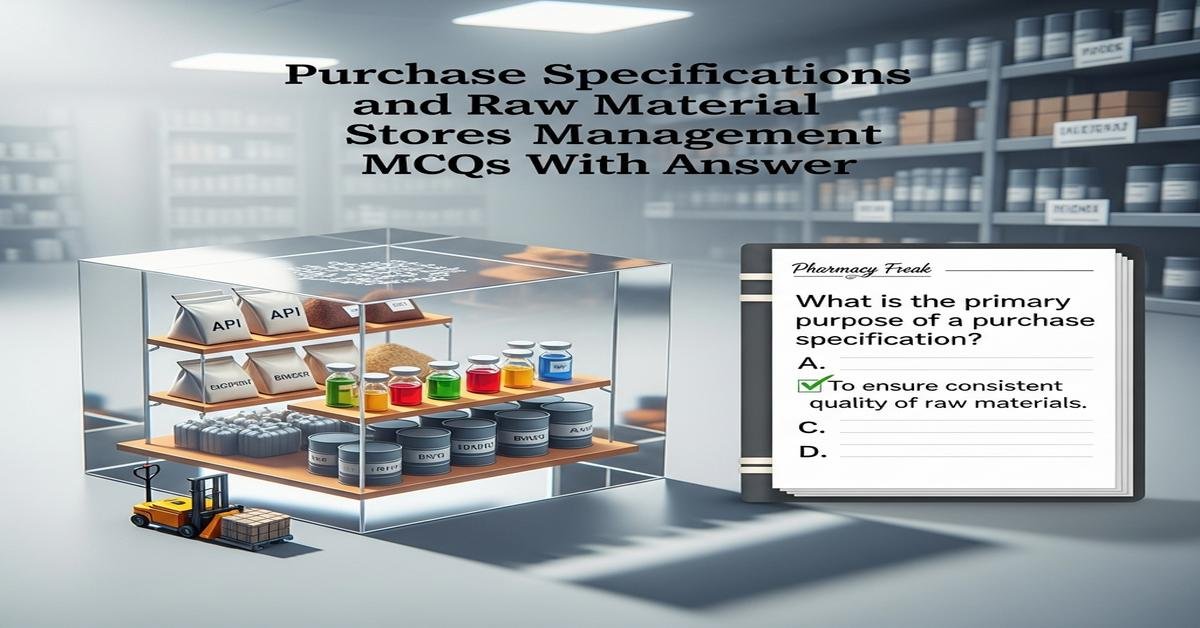
Q1. What is the primary purpose of a purchase specification for a pharmaceutical raw material?
- To provide storage location within the warehouse
- To document the manufacturing process of the raw material
- To define acceptance criteria, tests, and quality requirements for procurement
- To list the suppliers only
Correct Answer: To define acceptance criteria, tests, and quality requirements for procurement
Q2. During supplier qualification, which document most directly confirms the quality attributes of supplied lots?
- Material Safety Data Sheet (MSDS)
- Certificate of Analysis (COA)
- Purchase order copy
- Invoice
Correct Answer: Certificate of Analysis (COA)
Q3. Which inventory control method prioritizes items based on annual consumption value to optimize control efforts?
- FIFO (First-In-First-Out)
- ABC analysis
- FEFO (First-Expiry-First-Out)
- Just-in-Time (JIT)
Correct Answer: ABC analysis
Q4. What is the correct action when a received raw material lot arrives without a COA and is critical for production?
- Quarantine the lot until COA is obtained or testing performed
- Release material for immediate use based on appearance
- Return to supplier without further investigation
- Use half the lot and hold the remainder
Correct Answer: Quarantine the lot until COA is obtained or testing performed
Q5. Which of the following best describes FEFO in raw material stores?
- Materials are used in order of arrival date
- Materials with earliest expiry are used first regardless of arrival date
- Materials are selected randomly
- Materials are used based on supplier preference
Correct Answer: Materials with earliest expiry are used first regardless of arrival date
Q6. For a regulated API, which retention sample practice is most appropriate?
- No retention required after release
- Keep a representative retained sample from each batch for specified retention period
- Store retention samples only for controlled substances
- Dispose of samples after 7 days
Correct Answer: Keep a representative retained sample from each batch for specified retention period
Q7. Which document must be reviewed to understand hazards and handling precautions for a chemical raw material?
- Certificate of Analysis (COA)
- Material Safety Data Sheet (MSDS) / Safety Data Sheet (SDS)
- Purchase Order
- Batch Manufacturing Record (BMR)
Correct Answer: Material Safety Data Sheet (MSDS) / Safety Data Sheet (SDS)
Q8. In a quarantine system, what status label should be applied to newly received but untested raw materials?
- Released
- Rejected
- Quarantined / On Hold
- Consumed
Correct Answer: Quarantined / On Hold
Q9. Which sampling principle ensures sample represents the entire lot and minimizes bias?
- Convenience sampling
- Judgmental sampling
- Randomized, statistically justified sampling
- Sampling from only the top layer of containers
Correct Answer: Randomized, statistically justified sampling
Q10. What is a key objective of temperature mapping studies in raw material storage areas?
- To map supplier locations
- To identify temperature distribution and hot/cold spots to ensure storage compliance
- To measure noise levels in the warehouse
- To determine daily stock movement
Correct Answer: To identify temperature distribution and hot/cold spots to ensure storage compliance
Q11. Which practice helps prevent cross-contamination in a raw material warehouse handling potent APIs?
- Storing all materials together regardless of potency
- Using dedicated segregated areas and appropriate containment for potent materials
- Labeling only the high-value materials
- Allowing open transfer between sections
Correct Answer: Using dedicated segregated areas and appropriate containment for potent materials
Q12. What is the first regulatory expectation when an out-of-specification (OOS) result is received for a critical raw material?
- Use the material while issuing a deviation
- Initiate an investigation, quarantine the lot and assess impact on released batches
- Discard the entire stock without documentation
- Ignore the result if COA was provided
Correct Answer: Initiate an investigation, quarantine the lot and assess impact on released batches
Q13. Which inventory classification is based on criticality to production (not monetary value)?
- ABC analysis
- VED analysis (Vital, Essential, Desirable)
- First-In-First-Out
- Economic Order Quantity
Correct Answer: VED analysis (Vital, Essential, Desirable)
Q14. What information should a good purchase specification always include?
- Only supplier name and price
- Quality attributes, test methods, acceptance criteria, storage conditions, and batch size
- Marketing claims of the supplier
- Warehouse staff names
Correct Answer: Quality attributes, test methods, acceptance criteria, storage conditions, and batch size
Q15. When is a vendor audit most appropriately conducted?
- Only after a critical failure is detected
- During supplier qualification and periodically as part of re-evaluation
- Only when price negotiations fail
- Whenever a new production batch is started
Correct Answer: During supplier qualification and periodically as part of re-evaluation
Q16. What is the role of a COA reconciliation during raw material receiving?
- To verify that supplier’s COA matches internal acceptance criteria and received material identity
- To check vehicle delivery times
- To ensure warehouse shelving is correct
- To calculate employee salaries
Correct Answer: To verify that supplier’s COA matches internal acceptance criteria and received material identity
Q17. Which practice is recommended for controlling shelf life of excipients stored in bulk?
- Ignoring expiry dates and using oldest stock first
- Implementing FEFO, monitoring re-test dates, and maintaining stability data where applicable
- Mixing old and new lots freely
- Labeling all excipients with a generic expiry of 5 years
Correct Answer: Implementing FEFO, monitoring re-test dates, and maintaining stability data where applicable
Q18. In case of a suspected counterfeit raw material, which immediate action should QA take?
- Use the material to save production time
- Place material in quarantine, notify procurement and regulatory affairs, and initiate investigation
- Return to supplier without documentation
- Mix it with authentic material
Correct Answer: Place material in quarantine, notify procurement and regulatory affairs, and initiate investigation
Q19. Which record is essential to demonstrate traceability of raw materials to finished batches?
- Purchase requisition only
- Material identification labels and batch-specific inventory ledger linking lot numbers to production batches
- Supplier promotional brochures
- Employee attendance register
Correct Answer: Material identification labels and batch-specific inventory ledger linking lot numbers to production batches
Q20. What is a critical element of good documentation practice (GDP) in raw material stores?
- Handwritten notes with ambiguous entries left unreviewed
- Complete, legible records with dated signatures, version control and traceable amendments
- Erasing mistakes without records
- Using verbal approvals only
Correct Answer: Complete, legible records with dated signatures, version control and traceable amendments

