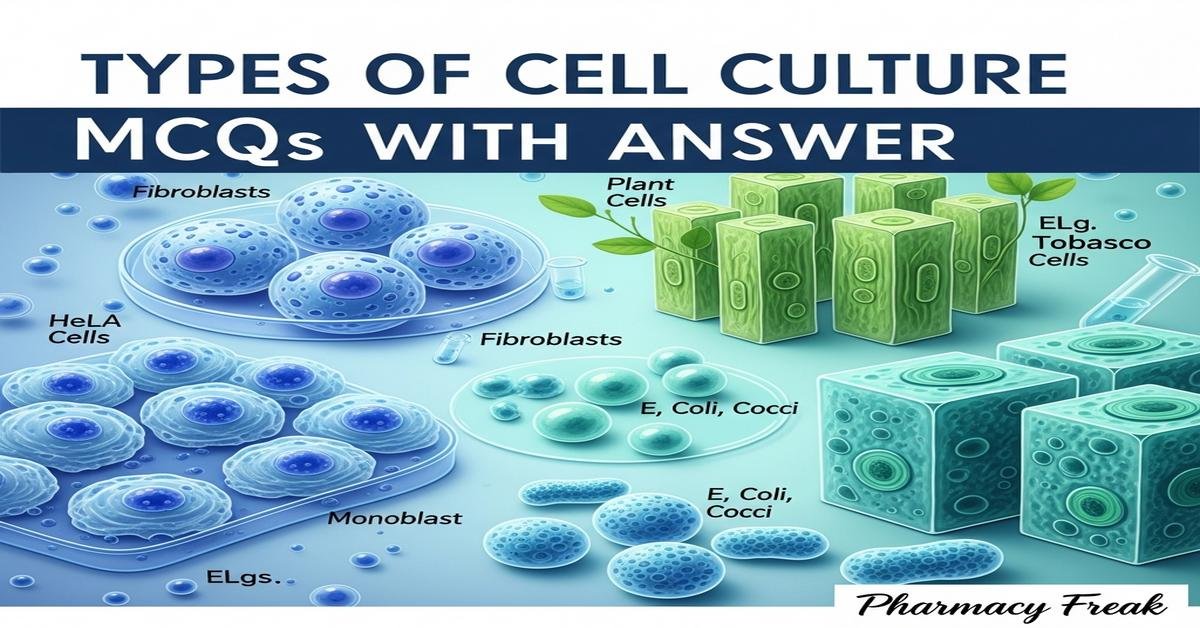
Introduction: Types of cell culture MCQs With Answer
This question set focuses on the various types and technical aspects of cell culture relevant to M.Pharm students studying Modern Bio-Analytical Techniques (MPA 202T). It covers primary cultures, continuous/immortalized cell lines, suspension versus adherent systems, 3D culture models (spheroids, organoids, scaffolds), co-culture strategies, and specialized culture methods such as feeder layers and serum-free systems. Questions also address practical considerations: passaging, cryopreservation, contamination (including mycoplasma), cell authentication, and growth kinetics. Designed for exam preparation and applied understanding, these MCQs emphasize mechanisms, selection criteria, and applications in drug testing and translational research.
Q1. Which characteristic best distinguishes a primary cell culture from an immortalized cell line?
- Unlimited proliferative capacity in vitro
- Derived directly from tissues and limited replicative lifespan
- Requires viral transformation for maintenance
- Grows only in suspension culture
Correct Answer: Derived directly from tissues and limited replicative lifespan
Q2. Which cell culture type is most appropriate to model tumor invasiveness and anchorage-independent growth?
- Primary hepatocyte monolayer
- Immortalized fibroblast adherent culture
- Spheroid or soft agar colony (anchorage-independent) culture
- Feeder-layer dependent embryonic stem cell culture
Correct Answer: Spheroid or soft agar colony (anchorage-independent) culture
Q3. What is the principal advantage of 3D organoid cultures over conventional 2D monolayer cultures for drug screening?
- Simpler imaging protocols and single-layer access
- Better recapitulation of tissue architecture, cell–cell and cell–matrix interactions
- Lower reagent consumption per experiment
- Faster cell proliferation rates in all cell types
Correct Answer: Better recapitulation of tissue architecture, cell–cell and cell–matrix interactions
Q4. Which method is most commonly used to dissociate adherent tissues into single cells for primary culture?
- Pulse centrifugation without enzymes
- Enzymatic digestion with trypsin/ collagenase often combined with mechanical trituration
- Direct seeding without dissociation
- Freeze–thaw cycles to lyse extracellular matrix
Correct Answer: Enzymatic digestion with trypsin/ collagenase often combined with mechanical trituration
Q5. Microcarrier-based culture systems are primarily used for which purpose?
- Maintaining primary neurons in 2D monolayers
- Expanding adherent cells at large scale in suspension bioreactors
- Selective elimination of contaminated cultures
- Inducing differentiation of pluripotent stem cells
Correct Answer: Expanding adherent cells at large scale in suspension bioreactors
Q6. Which of the following best describes a co-culture system?
- Culture containing only a single homogeneous cell type
- Culture with two or more different cell types grown together to study interactions
- Culture grown exclusively in serum-free medium
- Culture maintained at hypoxic conditions only
Correct Answer: Culture with two or more different cell types grown together to study interactions
Q7. What is a major reason for using serum-free defined media in cell culture for pharmacological assays?
- To increase batch-to-batch variability in experiments
- To eliminate xenogeneic components and reduce undefined growth factors that can confound assay results
- To promote bacterial growth for contamination testing
- To prevent cells from adhering to culture vessels
Correct Answer: To eliminate xenogeneic components and reduce undefined growth factors that can confound assay results
Q8. Which assay is most often used to determine cell viability and distinguish live from dead cells before experiments?
- Soft agar colony formation
- Trypan blue exclusion with hemocytometer counting
- STR profiling for authentication
- Transmission electron microscopy
Correct Answer: Trypan blue exclusion with hemocytometer counting
Q9. Which contamination is particularly insidious in cell culture because it does not change turbidity and is difficult to detect microscopically?
- Fungal hyphae contamination
- Bacterial contamination visible by cloudiness
- Mycoplasma contamination
- Algal contamination
Correct Answer: Mycoplasma contamination
Q10. What is the purpose of cell line authentication (e.g., STR profiling) in research and pharmaceutical studies?
- To determine the optimal culture medium composition
- To confirm identity and avoid cell line misidentification or cross-contamination
- To increase cell doubling time artificially
- To sterilize cultures prior to experiments
Correct Answer: To confirm identity and avoid cell line misidentification or cross-contamination
Q11. Which parameter describes the time required for a cell population to double in number under given culture conditions?
- Lag phase
- Doubling time / generation time
- Senescence index
- Plating efficiency
Correct Answer: Doubling time / generation time
Q12. Anchorage-dependent cells require which of the following for normal proliferation?
- High oxygen tension only
- Attachment to extracellular matrix or substrate
- Absence of serum in the medium
- Continuous shaking to prevent adhesion
Correct Answer: Attachment to extracellular matrix or substrate
Q13. Which of the following culture systems is best suited for long-term maintenance of hematopoietic stem cells ex vivo?
- Adherent fibroblast monolayer without growth factors
- Feeder-layer or stromal co-culture with defined cytokines
- Soft agar colony assay without cytokines
- High-serum 2D epithelial culture
Correct Answer: Feeder-layer or stromal co-culture with defined cytokines
Q14. Which cryoprotectant is most commonly used to prevent ice crystal formation during freezing of mammalian cells?
- Glycerol at 50% final concentration
- Dimethyl sulfoxide (DMSO) at around 5–10% final concentration
- Pure ethanol
- Sodium chloride solution
Correct Answer: Dimethyl sulfoxide (DMSO) at around 5–10% final concentration
Q15. Contact inhibition is a property typically observed in:
- Transformed cancer cell lines showing uncontrolled growth
- Primary normal cells that stop proliferating upon confluence
- Cells grown in soft agar
- Cells cultured in rotating bioreactors only
Correct Answer: Primary normal cells that stop proliferating upon confluence
Q16. Which factor is most critical when choosing between adherent culture and suspension culture for a given cell type?
- Whether the cell type is naturally anchorage-dependent or grows freely in suspension
- The color of the culture medium
- The geographic origin of the cell donor
- Whether phenol red is present in the medium
Correct Answer: Whether the cell type is naturally anchorage-dependent or grows freely in suspension
Q17. Which technique is commonly used to quantify cell proliferation in drug response studies and is amenable to high-throughput screening?
- STR profiling
- MTT/MTS or resazurin-based metabolic assays
- Electron microscopy counts
- Soft agar colony counting by eye
Correct Answer: MTT/MTS or resazurin-based metabolic assays
Q18. Which statement best explains why phenol red is sometimes omitted from culture media during estrogenic activity testing?
- Phenol red promotes bacterial contamination
- Phenol red has weak estrogenic activity and can interfere with hormone assays
- Phenol red increases the viscosity of the medium
- Phenol red prevents cell adhesion to plastic
Correct Answer: Phenol red has weak estrogenic activity and can interfere with hormone assays
Q19. Which culture approach is most suitable to study paracrine signalling between two cell types without direct cell–cell contact?
- Mixed direct co-culture on same surface
- Transwell (insert) co-culture allowing soluble factor exchange but no contact
- Soft agar co-embedding
- Seeding cells in complete isolation with no shared medium
Correct Answer: Transwell (insert) co-culture allowing soluble factor exchange but no contact
Q20. When adapting cells from serum-containing medium to a defined serum-free formulation, the recommended strategy is:
- Immediate full replacement of serum with serum-free medium overnight
- Gradual adaptation by stepwise reduction of serum concentration while supplementing with defined factors
- Switching to water-based culture for 24 hours then adding serum-free medium
- Freezing cells before changing medium
Correct Answer: Gradual adaptation by stepwise reduction of serum concentration while supplementing with defined factors

