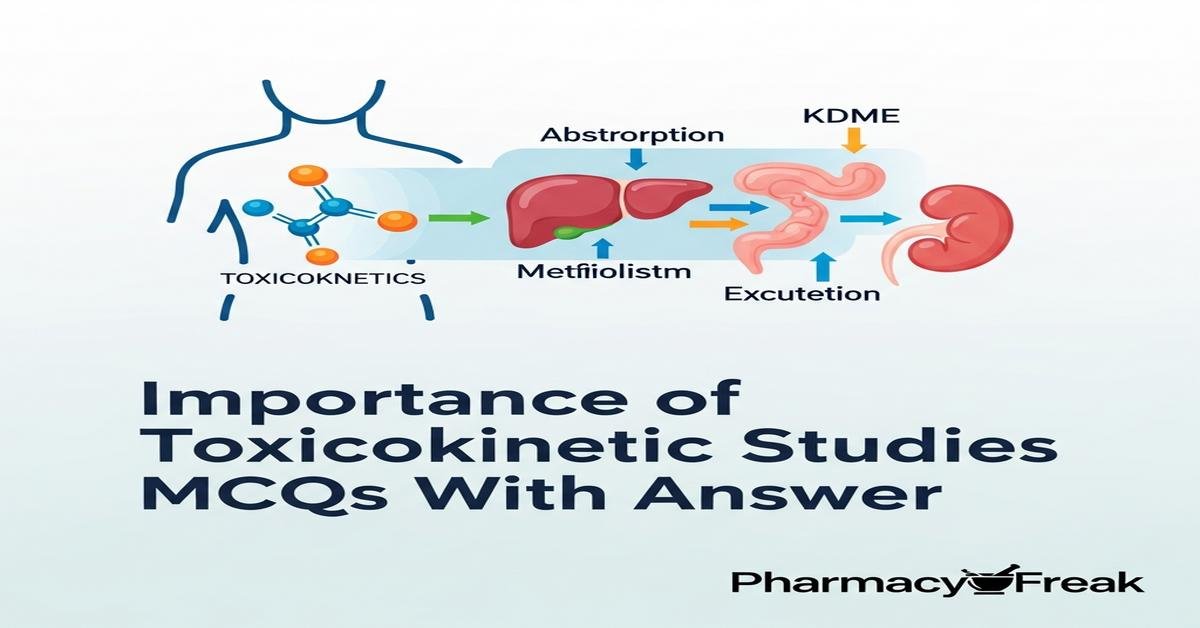
Introduction: Importance of toxicokinetic studies MCQs With Answer
Toxicokinetic studies are essential in M.Pharm training to understand how toxicants are absorbed, distributed, metabolized and eliminated (ADME) and how these processes influence toxicity. This blog presents targeted multiple-choice questions that cover principles of toxicokinetics, study design, interpretation of parameters (clearance, half-life, volume of distribution, bioavailability), modeling approaches (compartmental, non-compartmental, PBPK), species scaling, and application in risk assessment and regulatory toxicology. The questions emphasize practical reasoning for experimental planning, data analysis and integration of toxicokinetic data with toxicodynamics. These MCQs and answers are designed to strengthen conceptual clarity and prepare students for examinations and real-world study design challenges.
Q1. Which statement best describes the primary purpose of toxicokinetic studies?
- To identify the molecular target of a toxicant
- To determine the relationship between exposure and internal dose over time
- To evaluate only the toxic effects at the organ level
- To replace toxicodynamic studies in hazard assessment
Correct Answer: To determine the relationship between exposure and internal dose over time
Q2. Which toxicokinetic parameter most directly reflects the efficiency of removal of a compound from plasma?
- Volume of distribution (Vd)
- Elimination half-life (t1/2)
- Total body clearance (Cl)
- Peak plasma concentration (Cmax)
Correct Answer: Total body clearance (Cl)
Q3. Volume of distribution (Vd) is best interpreted as:
- The physical volume of the plasma compartment only
- The apparent volume that relates amount of drug in the body to plasma concentration
- The volume of extracellular fluid in the body
- The tissue binding constant for a compound
Correct Answer: The apparent volume that relates amount of drug in the body to plasma concentration
Q4. Which scenario most likely indicates significant enterohepatic recirculation of a toxicant?
- Rapid single peak and immediate decline of plasma concentration
- Multiple secondary peaks in plasma concentration vs. time profile
- Constant plasma concentration with no elimination
- Complete absence of biliary excretion
Correct Answer: Multiple secondary peaks in plasma concentration vs. time profile
Q5. Non-compartmental analysis (NCA) is advantageous because it:
- Requires specification of the number of compartments
- Provides model-independent estimates like AUC and clearance
- Cannot estimate terminal half-life
- Is only applicable to intravenous dosing
Correct Answer: Provides model-independent estimates like AUC and clearance
Q6. Interspecies scaling of toxicokinetic data commonly uses which physiological basis?
- Body surface area and metabolic rate scaling (allometry)
- Matching organ histology only
- Using identical doses across species without adjustment
- Assuming identical plasma protein binding in all species
Correct Answer: Body surface area and metabolic rate scaling (allometry)
Q7. Plasma protein binding affects toxicokinetics primarily by altering which of the following?
- The intrinsic chemical structure of the toxicant
- The unbound fraction available for distribution, metabolism and elimination
- The color and odor of the compound
- Only the renal excretion with no impact on metabolism
Correct Answer: The unbound fraction available for distribution, metabolism and elimination
Q8. Which design element is most critical when planning toxicokinetic sampling for rapidly eliminated compounds?
- Sampling only at 24 hours post-dose
- Frequent early time-point sampling after dosing
- Collecting samples exclusively at steady state
- Avoiding measurement of plasma concentration
Correct Answer: Frequent early time-point sampling after dosing
Q9. A toxicant shows flip-flop kinetics. This means:
- The absorption rate is faster than elimination rate
- The absorption rate is slower than elimination rate, making absorption the rate-limiting step
- There is no absorption after oral dosing
- Clearance cannot be estimated under any condition
Correct Answer: The absorption rate is slower than elimination rate, making absorption the rate-limiting step
Q10. Physiologically based pharmacokinetic (PBPK) models are particularly useful because they:
- Ignore organ-specific blood flow and only use single-compartment assumptions
- Use physiologic compartments and mechanistic parameters allowing extrapolation across species and routes
- Require no experimental data for parameterization
- Are always simpler than compartmental models
Correct Answer: Use physiologic compartments and mechanistic parameters allowing extrapolation across species and routes
Q11. Which toxicokinetic metric is commonly used to relate systemic exposure to dose and is central to risk assessment?
- Area under the plasma concentration-time curve (AUC)
- Number of metabolic enzymes present
- Only the peak concentration regardless of time
- The colorimetric assay used for detection
Correct Answer: Area under the plasma concentration-time curve (AUC)
Q12. Induction of hepatic metabolizing enzymes by a co-administered chemical is expected to cause which toxicokinetic change?
- Decrease in clearance and prolonged half-life
- Increase in clearance and decrease in systemic exposure
- No change in metabolism but increased absorption
- Absolute bioavailability becoming zero
Correct Answer: Increase in clearance and decrease in systemic exposure
Q13. When integrating toxicokinetics with toxicodynamics (TK/TD), which approach strengthens causal inference about toxicity?
- Using only nominal administered dose without internal exposure data
- Relating internal unbound concentrations to pharmacological/toxic effects over time
- Ignoring time-course and focusing on single time-point observations
- Assuming all tissues experience identical target concentrations
Correct Answer: Relating internal unbound concentrations to pharmacological/toxic effects over time
Q14. In a repeated-dose toxicity study, toxicokinetic data can help interpret which of the following?
- Whether observed toxicity is due to accumulation or time-dependent sensitivity
- Only the histopathological findings without exposure context
- Pharmacogenomic sequences exclusively
- The solubility of the test compound in water
Correct Answer: Whether observed toxicity is due to accumulation or time-dependent sensitivity
Q15. Bioavailability (F) is defined as:
- The fraction of administered dose that reaches systemic circulation in unchanged form
- The fraction of dose metabolized in the gut
- The rate of elimination after intravenous dosing only
- The volume in which the drug distributes within tissues
Correct Answer: The fraction of administered dose that reaches systemic circulation in unchanged form
Q16. Which biomonitoring matrix is often most informative for assessing recent systemic exposure to a lipophilic persistent toxicant?
- Hair only, with no need for blood
- Adipose tissue or blood lipid-adjusted concentrations
- Urine with no lipid correction
- Saliva that does not reflect lipophilicity
Correct Answer: Adipose tissue or blood lipid-adjusted concentrations
Q17. A major limitation of single-dose toxicokinetic studies when predicting chronic toxicity is:
- They always overestimate accumulation
- They may not capture enzyme induction, saturation, or nonlinear kinetics occurring on repeated dosing
- They provide definitive information on lifetime risk
- They eliminate the need for toxicodynamic evaluation
Correct Answer: They may not capture enzyme induction, saturation, or nonlinear kinetics occurring on repeated dosing
Q18. Which analytical consideration is most critical for reliable toxicokinetic data?
- Using a validated bioanalytical method with known accuracy, precision, sensitivity and stability
- Measuring only metabolites regardless of parent compound
- A single calibrator without quality controls
- Ignoring lower limit of quantification (LLOQ)
Correct Answer: Using a validated bioanalytical method with known accuracy, precision, sensitivity and stability
Q19. In risk assessment, application of human toxicokinetic data reduces uncertainty primarily by:
- Removing the need for any animal testing
- Providing direct measures of internal dose and inter-individual variability to refine exposure-response estimates
- Guaranteeing that no adverse effects will occur
- Replacing exposure assessment entirely
Correct Answer: Providing direct measures of internal dose and inter-individual variability to refine exposure-response estimates
Q20. Which outcome indicates nonlinear (saturable) kinetics has occurred at higher doses?
- AUC increasing proportionally with dose across the tested range
- Clearance remaining constant irrespective of dose
- AUC increasing more than proportionally with dose and decreased clearance at higher doses
- Half-life shortening as dose increases due to faster elimination
Correct Answer: AUC increasing more than proportionally with dose and decreased clearance at higher doses

