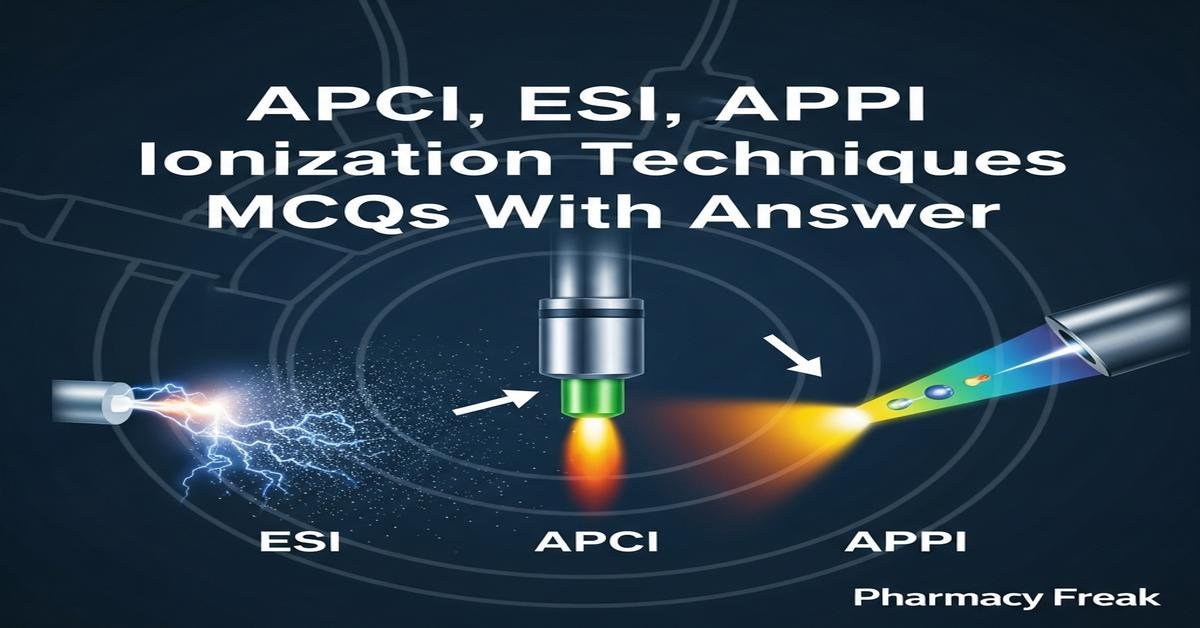
Introduction: This quiz collection on APCI, ESI and APPI ionization techniques is designed for M.Pharm students studying Advanced Instrumental Analysis (MPA 201T). It summarizes core concepts, practical source parameters and comparative strengths of the three atmospheric pressure ionization methods used in LC–MS. Questions focus on ionization mechanisms (proton transfer, charge residue, photoionization), typical analyte classes suited to each technique, source components (vaporizer, corona needle, nebulizer, VUV lamp), common interferences (ion suppression, adducts), and optimization strategies (dopants, solvents, voltages, temperatures). These MCQs will help reinforce understanding needed for method selection, troubleshooting and analytical method development in pharmaceutical analysis.
Q1. Which statement best describes the fundamental ionization process in electrospray ionization (ESI)?
- The gas-phase molecules are ionized by a corona discharge creating reagent ions.
- Liquid droplets formed by a charged spray undergo solvent evaporation leading to multiply charged analyte ions via charge residue and ion evaporation mechanisms.
- High-energy photons directly eject electrons to form molecular radical cations.
- Thermal vaporization followed by collision-induced ionization in vacuum produces fragment ions.
Correct Answer: Liquid droplets formed by a charged spray undergo solvent evaporation leading to multiply charged analyte ions via charge residue and ion evaporation mechanisms.
Q2. Atmospheric pressure chemical ionization (APCI) primarily ionizes analytes by which mechanism?
- Direct photoionization using a VUV lamp.
- Formation of charged droplets and multiple charging.
- Vaporization of the LC effluent followed by corona discharge-induced reagent ion chemistry and proton transfer to analytes.
- Electron impact in a high vacuum to produce radical cations.
Correct Answer: Vaporization of the LC effluent followed by corona discharge-induced reagent ion chemistry and proton transfer to analytes.
Q3. Which component is essential for APPI to ionize nonpolar analytes efficiently?
- High-voltage capillary for spray formation.
- Dopant and a VUV (vacuum ultraviolet) lamp to generate photoionization and charge transfer.
- Corona needle to produce reagent ions via discharge.
- Strong acidic mobile phase additive only.
Correct Answer: Dopant and a VUV (vacuum ultraviolet) lamp to generate photoionization and charge transfer.
Q4. Which ionization technique is generally most suitable for large, highly polar biomolecules (peptides/proteins)?
- APCI
- APPI
- ESI
- Electron ionization (EI)
Correct Answer: ESI
Q5. For small, nonpolar drug-like molecules with low polarity, which atmospheric pressure ionization technique often gives the best response?
- ESI in positive mode without dopant
- APCI with corona off
- APPI with appropriate dopant and VUV lamp
- Direct infusion ESI with high organic modifier
Correct Answer: APPI with appropriate dopant and VUV lamp
Q6. Which source parameter is most directly associated with ion generation in APCI?
- Spray capillary voltage used for droplet charging
- Corona discharge current applied to a needle downstream of the vaporizer
- Photon flux of a UV lamp placed at the inlet
- Collision gas pressure in the collision cell
Correct Answer: Corona discharge current applied to a needle downstream of the vaporizer
Q7. What is the primary role of a dopant in APPI?
- To stabilize the spray and reduce droplet size.
- To act as a proton source for protonation of all analytes.
- To absorb VUV photons and generate radical cations or reagent ions that transfer charge to analytes, enhancing ionization of nonpolar species.
- To suppress matrix effects by forming non-ionizable complexes.
Correct Answer: To absorb VUV photons and generate radical cations or reagent ions that transfer charge to analytes, enhancing ionization of nonpolar species.
Q8. Which ionization technique is typically described as the “softest” with the least in-source fragmentation for intact molecular masses?
- Electron ionization (EI)
- APCI
- ESI
- Atmospheric pressure photoionization with no dopant
Correct Answer: ESI
Q9. Regarding liquid chromatography flow rates, which statement is correct?
- ESI tolerates very high LC flow rates (>1 mL/min) better than APCI.
- APCI generally tolerates moderately higher LC flow rates than ESI because analyte vaporization occurs prior to ionization.
- APPI cannot be used with LC because it requires gas-phase samples only.
- ESI and APCI have identical flow rate tolerances and behave the same.
Correct Answer: APCI generally tolerates moderately higher LC flow rates than ESI because analyte vaporization occurs prior to ionization.
Q10. Which phenomenon is most commonly observed in ESI that complicates spectrum interpretation for small molecules?
- Extensive radical cation formation (M+•) dominating the spectrum
- Multiple charging to the point of indistinguishable isotopic patterns
- Formation of sodium, potassium and solvent adducts leading to multiple peaks for one analyte
- Complete absence of protonated molecular ions
Correct Answer: Formation of sodium, potassium and solvent adducts leading to multiple peaks for one analyte
Q11. Which ion type is most characteristic of APPI ionization of neutral aromatic compounds when no proton transfer occurs?
- Multiply protonated species [M+nH]n+
- Negative deprotonated ions [M−H]− only
- Radical cations (M+•) or charge transfer species resulting from photoionization
- Only sodium adducts
Correct Answer: Radical cations (M+•) or charge transfer species resulting from photoionization
Q12. Which factor most contributes to ion suppression in ESI analyses of biological samples?
- Using a VUV lamp instead of a corona needle
- High concentrations of salts, phospholipids or detergents in the sample or mobile phase competing during droplet desolvation
- Presence of dopant molecules with low ionization energy
- Operating at extremely low desolvation temperatures
Correct Answer: High concentrations of salts, phospholipids or detergents in the sample or mobile phase competing during droplet desolvation
Q13. Which mobile phase additive is most commonly used to improve positive-mode ESI sensitivity for protonation of analytes?
- 0.1% formic acid
- 1% sodium chloride
- 10 mM EDTA
- 0.5% trifluoroacetic acid (TFA) at high concentration
Correct Answer: 0.1% formic acid
Q14. The corona needle in an APCI source is used to:
- Create charged droplets by electrostatic spraying of the LC effluent.
- Generate a plasma/discharge that produces reagent ions which initiate analyte ion chemistry.
- Provide VUV photons for direct photoionization.
- Serve as a heated capillary for desolvation without electrical function.
Correct Answer: Generate a plasma/discharge that produces reagent ions which initiate analyte ion chemistry.
Q15. Which source component is typically heated in APCI but is not a requirement in conventional ESI?
- Capillary inlet kept at ambient temperature
- Vaporizer or nebulizer/discussion region to convert LC effluent to gas-phase molecules
- VUV lamp housing
- Collision cell heater
Correct Answer: Vaporizer or nebulizer/discussion region to convert LC effluent to gas-phase molecules
Q16. Which ionization method is best for thermally labile, highly polar small molecules that require minimal fragmentation?
- APCI with high vaporizer temperature
- ESI, because it ionizes from liquid without high-temperature vaporization and is soft
- APPI with high-energy photons
- Electron impact ionization
Correct Answer: ESI, because it ionizes from liquid without high-temperature vaporization and is soft
Q17. Which of the following is a commonly used dopant for APPI to facilitate charge transfer?
- Sodium chloride
- Toluene (or toluene-derived dopants)
- Formic acid
- EDTA
Correct Answer: Toluene (or toluene-derived dopants)
Q18. Increasing which parameter in an ESI source commonly increases the average charge state of protein/peptide ions?
- Lowering the capillary/spray voltage to zero
- Increasing spray voltage and/or decreasing solvent surface tension (more organic content)
- Replacing volatile buffers with nonvolatile salts
- Turning off the desolvation gas
Correct Answer: Increasing spray voltage and/or decreasing solvent surface tension (more organic content)
Q19. For improving sensitivity for small hydrophobic pharmaceutical compounds in LC–MS, which strategy is most appropriate?
- Switch from APPI to EI to improve sensitivity
- Use APPI with a suitable dopant and optimized VUV lamp to enhance ionization of hydrophobic analytes
- Only use high-concentration nonvolatile salts in the mobile phase
- Reduce source temperature to ambient for APCI
Correct Answer: Use APPI with a suitable dopant and optimized VUV lamp to enhance ionization of hydrophobic analytes
Q20. Which atmospheric pressure ionization technique typically uses a pneumatic nebulizer and drying gas to assist droplet formation and desolvation?
- Electron ionization (EI)
- ESI
- Matrix-assisted laser desorption ionization (MALDI)
- Ion mobility spectrometry without a spray
Correct Answer: ESI

