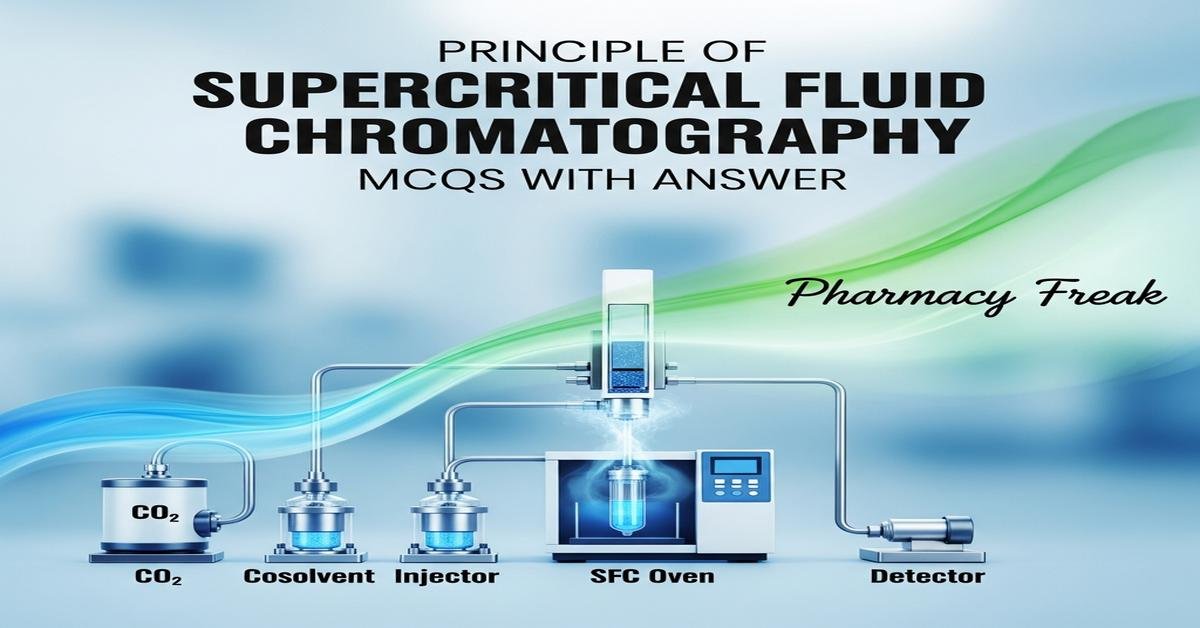
Introduction: Principle of Supercritical Fluid Chromatography MCQs With Answer
Supercritical fluid chromatography (SFC) combines advantages of gas and liquid chromatography by using a supercritical fluid—most commonly carbon dioxide—as the mobile phase. For M.Pharm students, mastering SFC principles is vital for applications in chiral separations, pharmaco-chemical profiling, and impurity analysis of non-volatile and thermally labile compounds. This quiz set focuses on underlying thermodynamics, transport phenomena, role of modifiers, stationary phase selection, instrumentation (including backpressure regulators and detectors), and practical method development strategies. These MCQs are designed to deepen conceptual understanding and support exam preparation for Advanced Instrumental Analysis (MPA 201T) with emphasis on problem-solving and critical reasoning in SFC.
Q1. Which property of a supercritical fluid primarily accounts for its liquid-like solvation power combined with gas-like mass transfer characteristics?
- High viscosity
- Near-critical compressibility and tunable density
- Low diffusivity
- High surface tension
Correct Answer: Near-critical compressibility and tunable density
Q2. Which mobile phase is most commonly used in analytical SFC due to its convenient critical temperature and inertness?
- Supercritical nitrogen
- Supercritical methane
- Supercritical carbon dioxide (CO2)
- Supercritical water
Correct Answer: Supercritical carbon dioxide (CO2)
Q3. Why are organic modifiers (e.g., methanol) added to CO2 in SFC?
- To increase mobile phase viscosity and decrease mass transfer
- To enhance solubility of polar analytes and modify elution strength
- To raise the critical temperature of CO2 significantly
- To decrease detector sensitivity
Correct Answer: To enhance solubility of polar analytes and modify elution strength
Q4. How does increasing column pressure (at constant temperature) typically affect retention in SFC?
- Decreases mobile phase density and increases retention
- Has no effect on density or retention
- Increases mobile phase density and generally decreases retention for nonpolar solutes
- Causes stationary phase swelling leading to unpredictable retention
Correct Answer: Increases mobile phase density and generally decreases retention for nonpolar solutes
Q5. Which detector is considered most universal and commonly coupled to SFC for volatile and semi-volatile analytes with minimal mobile phase interference?
- Refractive index detector
- Evaporative light scattering detector (ELSD)
- Mass spectrometer (MS)
- Fluorescence detector
Correct Answer: Mass spectrometer (MS)
Q6. What is the principal role of a backpressure regulator (BPR) in an SFC system?
- To inject sample into the column
- To maintain the mobile phase in the supercritical region by controlling outlet pressure
- To heat the column oven
- To act as a detector
Correct Answer: To maintain the mobile phase in the supercritical region by controlling outlet pressure
Q7. In SFC, which stationary phase class is most frequently exploited for enantiomeric separations?
- Reverse-phase C18
- Chiral stationary phases (e.g., polysaccharide-based)
- Ion-exchange resins
- Size-exclusion packing
Correct Answer: Chiral stationary phases (e.g., polysaccharide-based)
Q8. Which retention mechanism best describes typical interactions in normal-phase–like SFC separations on polar stationary phases?
- Hydrophobic partitioning into a liquid stationary phase
- Gas–solid adsorption only
- Adsorption and polar interactions (dipole, H-bonding) with the stationary phase
- Ionic exchange between analyte and stationary phase
Correct Answer: Adsorption and polar interactions (dipole, H-bonding) with the stationary phase
Q9. What is the expected effect of increasing organic modifier fraction (e.g., methanol) in CO2 on retention times for polar analytes?
- Retention times increase due to stronger adsorption
- Retention times decrease because mobile phase elution strength increases
- No change in retention times
- Only peak shapes change, not retention
Correct Answer: Retention times decrease because mobile phase elution strength increases
Q10. Which property of supercritical CO2 contributes to improved mass transfer and higher efficiency compared with HPLC mobile phases?
- Higher viscosity than aqueous solvents
- Lower diffusion coefficients
- Higher diffusivity and lower viscosity
- Stronger solvent–solute binding
Correct Answer: Higher diffusivity and lower viscosity
Q11. When coupling SFC to electrospray MS, why are modifier additives such as ammonium formate or formic acid often used?
- To cause CO2 to polymerize before MS
- To improve ionization efficiency and stabilize charged species in the electrospray source
- To decrease analyte volatility
- To block the ion source completely
Correct Answer: To improve ionization efficiency and stabilize charged species in the electrospray source
Q12. Which of the following is a major limitation of SFC compared to UHPLC for very polar, ionic compounds?
- Excessive detector compatibility
- Poor solubility of strongly polar/ionic analytes in CO2-rich mobile phase without large modifier amounts
- Too high sensitivity for trace analysis
- Inability to use chiral columns
Correct Answer: Poor solubility of strongly polar/ionic analytes in CO2-rich mobile phase without large modifier amounts
Q13. Which parameter is most directly changed during pressure-programmed SFC to affect retention without changing temperature?
- Stationary phase chemistry
- Mobile phase density and solvating power
- Column length
- Detector wavelength
Correct Answer: Mobile phase density and solvating power
Q14. What is the typical effect on chromatographic selectivity when using a polar additive (e.g., water or ethanol) as co-solvent in CO2 SFC?
- Selectivity always becomes identical to reversed-phase HPLC
- Polar additives can change hydrogen-bonding interactions and alter selectivity between closely related analytes
- No change; only retention magnitude changes
- Column degrades immediately
Correct Answer: Polar additives can change hydrogen-bonding interactions and alter selectivity between closely related analytes
Q15. Which van’t Hoff-like behavior is observed when plotting ln(k) vs. 1/T in SFC for analytes where density changes are small?
- A straight line indicating enthalpy-dominated retention similar to LC
- A parabolic curve due to pressure fluctuations only
- No correlation due to supercritical fluctuations
- Random scatter unrelated to thermodynamics
Correct Answer: A straight line indicating enthalpy-dominated retention similar to LC
Q16. Which column format provides the highest sample throughput and is most common in preparative SFC?
- Capillary achiral columns (nano-scale)
- Short analytical columns (50 mm) only
- Packed wide-bore preparative columns
- Open-tubular columns with bonded phase
Correct Answer: Packed wide-bore preparative columns
Q17. How does SFC typically compare to HPLC in terms of environmental impact for large-scale separations?
- SFC generally uses larger volumes of toxic organic solvents
- SFC can reduce organic solvent consumption because CO2 replaces much of the solvent, lowering waste
- SFC always produces more hazardous waste
- Both techniques have identical environmental footprints
Correct Answer: SFC can reduce organic solvent consumption because CO2 replaces much of the solvent, lowering waste
Q18. Which practice improves peak shape for basic analytes in SFC when using silica-based stationary phases?
- Removing all modifiers and running pure CO2
- Adding small amounts of basic modifiers (e.g., triethylamine) to suppress tailing
- Reducing column temperature to below critical temperature
- Increasing flow rate to maximize tailing
Correct Answer: Adding small amounts of basic modifiers (e.g., triethylamine) to suppress tailing
Q19. Which physical parameter of a supercritical fluid most strongly correlates with solvent strength in SFC?
- Surface tension
- Number of double bonds in CO2
- Density of the supercritical fluid
- Column inner diameter
Correct Answer: Density of the supercritical fluid
Q20. In method development, why is gradient elution used in SFC even though CO2 density can be pressure-programmed?
- Gradient elution with modifier percentage changes provides more flexible control of elution strength and selectivity for complex mixtures
- Pressure changes are illegal on instruments
- Gradient elution is required to maintain supercritical phase
- Pressure-programming is always inferior and cannot affect retention
Correct Answer: Gradient elution with modifier percentage changes provides more flexible control of elution strength and selectivity for complex mixtures

