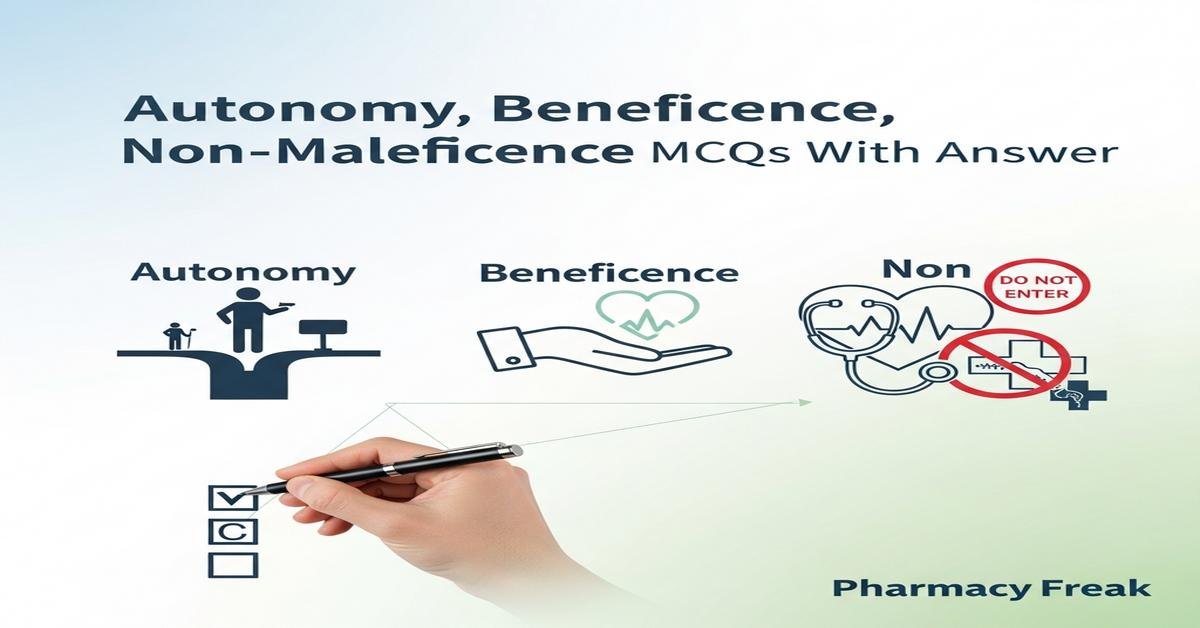
Introduction: Autonomy, beneficence, and non-maleficence are foundational ethical principles that guide clinical research and pharmaceutical practice. For M.Pharm students, understanding these principles is essential for designing ethically sound studies, obtaining valid informed consent, protecting vulnerable participants, and balancing benefit-risk decisions in drug development. This blog offers targeted multiple-choice questions to deepen your comprehension of practical applications—such as assessing capacity, handling therapeutic misconception, applying equipoise, and implementing safeguards to minimize harm. Each question is crafted to reflect real-world scenarios and regulatory expectations (e.g., ICH-GCP, Declaration of Helsinki), helping you prepare for examinations and ethical decision-making in research settings.
Q1. What does the principle of autonomy primarily emphasize in clinical research?
- Maximizing overall public health outcomes
- Respecting an individual’s right to make informed decisions
- Ensuring no harm comes to participants
- Providing the greatest benefit to the community
Correct Answer: Respecting an individual’s right to make informed decisions
Q2. Which document is most directly associated with formalizing the requirement for voluntary informed consent in research?
- Declaration of Helsinki
- Good Manufacturing Practice (GMP)
- Pharmacopoeia
- Randomized Controlled Trial (RCT) protocol
Correct Answer: Declaration of Helsinki
Q3. Non-maleficence in the context of clinical trials means:
- Ensuring participants receive financial compensation
- Actively preventing harm and minimizing risks to participants
- Maximizing the statistical power of a study
- Guaranteeing therapeutic benefit to every participant
Correct Answer: Actively preventing harm and minimizing risks to participants
Q4. When a participant lacks decision-making capacity, which is the most ethically appropriate next step?
- Exclude the participant from all research
- Proceed with enrollment using the investigator’s judgment
- Obtain consent from a legally authorized representative and consider assent if possible
- Assume consent based on presumed best interest
Correct Answer: Obtain consent from a legally authorized representative and consider assent if possible
Q5. Therapeutic misconception refers to:
- Participants believing research procedures are standardized across all trials
- Confusing the goals of clinical research with individualized clinical care
- Investigators misunderstanding regulatory guidelines
- Assuming placebo is always inert
Correct Answer: Confusing the goals of clinical research with individualized clinical care
Q6. Equipoise is best described as:
- Guaranteed superiority of the experimental drug
- Scientific uncertainty about which treatment is better
- A method for analyzing adverse events
- Equal randomization of participants into arms
Correct Answer: Scientific uncertainty about which treatment is better
Q7. Which action demonstrates beneficence in a clinical trial?
- Withholding information to avoid alarming participants
- Designing a study to minimize risks and maximize potential benefits
- Recruiting vulnerable people because recruitment is difficult
- Offering unusually large payments to ensure enrollment
Correct Answer: Designing a study to minimize risks and maximize potential benefits
Q8. Which scenario is an acceptable exception to obtaining prior informed consent according to common ethical guidelines?
- Randomized trial of a new chemotherapy where consent is forgone for all
- Emergency research where prospective consent is impracticable and regulatory criteria are met
- Deliberately deceiving participants in all behavioral trials
- Routine removal of consent during long-term follow-up
Correct Answer: Emergency research where prospective consent is impracticable and regulatory criteria are met
Q9. Which guideline specifically addresses ethical principles for biomedical research involving human subjects and is often cited in clinical research ethics?
- ICH-GCP (International Conference on Harmonisation — Good Clinical Practice)
- ICH Q7 (API GMP)
- WHO Good Distribution Practices
- Pharmacovigilance guideline only
Correct Answer: ICH-GCP (International Conference on Harmonisation — Good Clinical Practice)
Q10. In assessing risk for non-maleficence, which concept refers to harm that is not intended but may result from research?
- Beneficence
- Foreseeable risk
- Intentional harm
- Therapeutic response
Correct Answer: Foreseeable risk
Q11. Which practice most directly supports participant autonomy during informed consent?
- Using technical jargon to ensure thoroughness
- Providing clear information about risks, benefits, and alternatives in understandable language
- Only giving the consent form without discussion
- Requiring a physician’s permission regardless of the subject’s wishes
Correct Answer: Providing clear information about risks, benefits, and alternatives in understandable language
Q12. When is the use of a placebo ethically questionable under the principles of beneficence and non-maleficence?
- When effective standard therapy exists and withholding it poses risk of serious harm
- When no treatment exists for the condition
- In dose-finding pharmacokinetic studies with healthy volunteers
- When measuring subjective outcomes only
Correct Answer: When effective standard therapy exists and withholding it poses risk of serious harm
Q13. What is the primary ethical concern when enrolling economically disadvantaged individuals into paid clinical trials?
- Whether they can read the consent form
- The possibility of undue influence or coercion due to financial inducement
- That they will always experience more adverse events
- That compensation will affect pharmacokinetics
Correct Answer: The possibility of undue influence or coercion due to financial inducement
Q14. Which committee is primarily responsible for protecting participant rights and ensuring ethical conduct of a study?
- Data Management Committee
- Institutional Review Board / Ethics Committee (IRB/EC)
- Sponsor’s Marketing Team
- Quality Assurance Department only
Correct Answer: Institutional Review Board / Ethics Committee (IRB/EC)
Q15. How does beneficence influence the design of a phase I clinical trial for a new drug?
- By ensuring the trial includes no safety monitoring to speed results
- By incorporating dose escalation with safety stopping rules and monitoring for adverse events
- By enrolling as many participants as possible regardless of risk
- By guaranteeing therapeutic benefit to all participants
Correct Answer: By incorporating dose escalation with safety stopping rules and monitoring for adverse events
Q16. Which is an example of respecting autonomy for a participant who withdraws consent during a trial?
- Continuing to use their data without informing them
- Respecting the withdrawal and stopping further intervention while following agreed procedures for data use
- Refusing the withdrawal to maintain statistical power
- Convincing them to continue to avoid protocol deviations
Correct Answer: Respecting the withdrawal and stopping further intervention while following agreed procedures for data use
Q17. What distinguishes minimal risk research in ethics review?
- Risk of death is allowed as long as it is rare
- The probability and magnitude of harm are no greater than those encountered in daily life or routine exams
- No monitoring is required
- Only healthy volunteers can be enrolled
Correct Answer: The probability and magnitude of harm are no greater than those encountered in daily life or routine exams
Q18. Which action best addresses non-maleficence when an unexpected serious adverse event occurs?
- Concealing the event to avoid regulatory scrutiny
- Reporting immediately to the ethics committee and regulatory authorities and implementing safety measures
- Waiting until study completion to analyze all events
- Altering consent forms retroactively
Correct Answer: Reporting immediately to the ethics committee and regulatory authorities and implementing safety measures
Q19. In international multicenter trials, respecting autonomy requires investigators to:
- Use a single universal consent form in English only
- Adapt the informed consent process to local languages and cultural context while preserving ethical standards
- Ignore local norms in favor of sponsor preferences
- Exclude participants from cultures different from the sponsor’s country
Correct Answer: Adapt the informed consent process to local languages and cultural context while preserving ethical standards
Q20. Which principle is most directly involved when a researcher must balance potential benefits to future patients against risks to current participants?
- Autonomy only
- Beneficence and non-maleficence
- Confidentiality only
- Commercial interest
Correct Answer: Beneficence and non-maleficence

