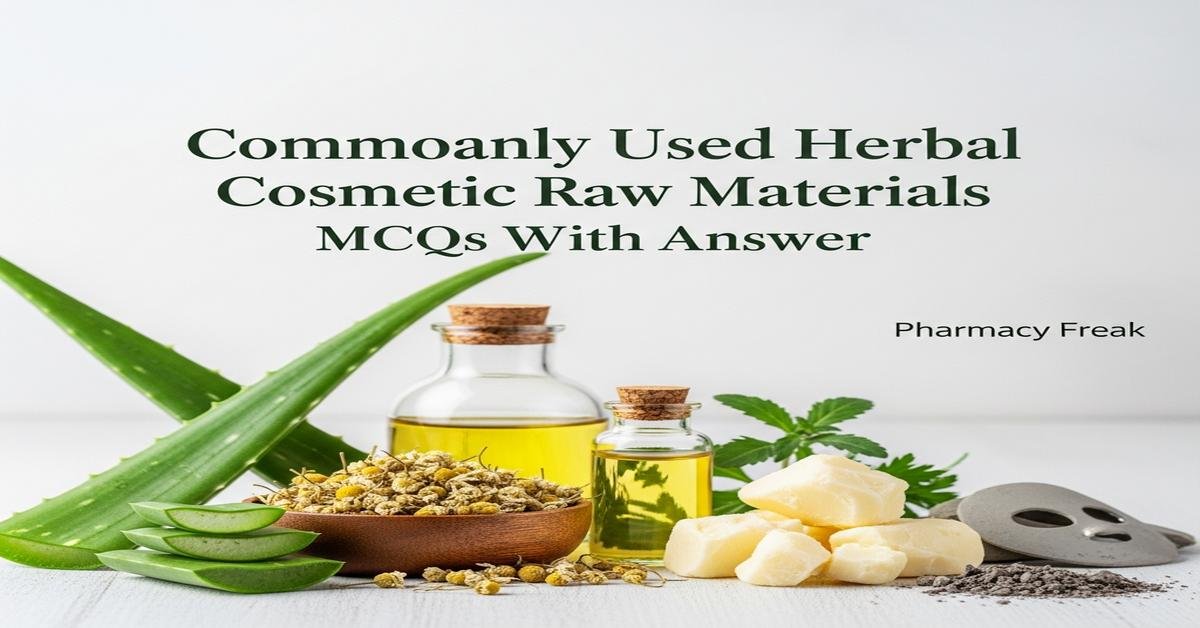
Commonly used herbal cosmetic raw materials MCQs With Answer is designed for M.Pharm students specializing in Herbal Cosmetics (MPG 204T). This quiz collection focuses on plant‑derived ingredients routinely used in topical and hair care formulations, covering their active constituents, INCI names, functional roles (emollient, surfactant, antioxidant, preservative adjuncts), extraction methods, and key quality control parameters. Each question emphasizes deeper understanding useful for formulation development, standardization and regulatory compliance. Use these MCQs to test and strengthen knowledge of raw material selection, phytochemical markers, safety considerations (phototoxicity, heavy metals, microbial limits), and analytical techniques employed for herbal cosmetic raw material evaluation.
Q1. Which constituent is primarily responsible for the gel-forming, soothing and wound‑healing properties of Aloe vera used in cosmetics?
- Anthraquinones
- Acemannan (polysaccharide)
- Saponins
- Tannins
Correct Answer: Acemannan (polysaccharide)
Q2. What is the commonly used INCI name for Neem leaf extract in herbal cosmetics?
- Azadirachta Indica Leaf Extract
- Melia Azadirachta Oil
- Neemia Officinalis Extract
- Azadirachtin Oil
Correct Answer: Azadirachta Indica Leaf Extract
Q3. Which marker compound is most often used for standardization of Curcuma longa (turmeric) raw material for cosmetic formulations?
- Curcuminoids (Curcumin)
- Quercetin
- 4‑Hydroxybenzoic acid
- Menthol
Correct Answer: Curcuminoids (Curcumin)
Q4. Soapnut (Reetha, Sapindus mukorossi) provides natural surfactant activity due to which class of compounds?
- Alkaloids
- Terpenoids
- Saponins
- Flavonoids
Correct Answer: Saponins
Q5. Which extraction technique is preferred for obtaining heat‑sensitive essential oils from sandalwood or rose for cosmetic use with minimal thermal degradation?
- Maceration with water
- Soxhlet extraction with ethanol
- Steam distillation
- Supercritical CO2 extraction
Correct Answer: Supercritical CO2 extraction
Q6. Which phytochemical in Glycyrrhiza glabra (licorice) is primarily responsible for skin‑lightening activity used in cosmetics?
- Glycyrrhizin
- Glabridin
- Glycyrrhetic acid
- Liquiritin
Correct Answer: Glabridin
Q7. For herbal raw material quality control, which test specifically helps detect inorganic contamination and overall mineral content?
- Loss on drying
- Total ash value
- HPTLC fingerprinting
- pH determination
Correct Answer: Total ash value
Q8. Which herb is rich in epigallocatechin gallate (EGCG) and is used for its antioxidant and anti‑inflammatory benefits in cosmetic formulations?
- Camellia sinensis (Green tea)
- Rosmarinus officinalis (Rosemary)
- Ocimum sanctum (Tulsi)
- Matricaria chamomilla (Chamomile)
Correct Answer: Camellia sinensis (Green tea)
Q9. Which raw material is used as a natural emollient and is chemically characterized by high percentage of lauric acid and medium‑chain fatty acids?
- Shea butter
- Coconut oil
- Olive oil
- Jojoba oil
Correct Answer: Coconut oil
Q10. Which herbal ingredient is known to contain furocoumarins (e.g., bergapten) and may cause phototoxic reactions if used improperly in cosmetics?
- Citrus bergamia (Bergamot) peel oil
- Santalum album (Sandalwood) oil
- Rosa damascena (Rose) hydrosol
- Chamomilla recutita (Chamomile) extract
Correct Answer: Citrus bergamia (Bergamot) peel oil
Q11. For herbal shampoos, which plant is traditionally used as a gentle cleansing agent due to its saponin content and also helps detangle hair?
- Shikakai (Acacia concinna)
- Amla (Phyllanthus emblica)
- Neem (Azadirachta indica)
- Hibiscus rosa‑sinensis
Correct Answer: Shikakai (Acacia concinna)
Q12. Which analytical technique is widely used for fingerprinting and quantifying marker compounds in herbal cosmetic raw materials?
- GC‑MS without derivatization for all compounds
- HPTLC / HPLC fingerprinting
- Simple UV spectrophotometry only
- Loss on ignition
Correct Answer: HPTLC / HPLC fingerprinting
Q13. Which herbal raw material is particularly valued in hair care for its high vitamin C and tannin content that promotes hair strength and shine?
- Amla (Phyllanthus emblica)
- Neem (Azadirachta indica)
- Hibiscus rosa‑sinensis
- Centella asiatica
Correct Answer: Amla (Phyllanthus emblica)
Q14. Which component from clove oil is responsible for its local anesthetic and antimicrobial properties used in oral and topical formulations?
- Menthol
- Eugenol
- Cineole
- Limonene
Correct Answer: Eugenol
Q15. Which natural ingredient is commonly used as a botanical humectant in cosmetics due to its strong water‑binding polysaccharides and mucilage?
- Guar gum
- Aloe vera mucilage
- Beeswax
- Rice bran oil
Correct Answer: Aloe vera mucilage
Q16. When assessing microbial safety of herbal raw materials for cosmetics, which microorganism is particularly screened as an indicator of fecal contamination and regulatory non‑compliance?
- Staphylococcus aureus
- Pseudomonas aeruginosa
- Escherichia coli
- Bacillus subtilis
Correct Answer: Escherichia coli
Q17. Which herbal oil is a liquid wax ester that closely mimics human sebum and is used as an excellent non‑comedogenic carrier in cosmetics?
- Coconut oil
- Jojoba oil
- Shea butter
- Almond oil
Correct Answer: Jojoba oil
Q18. Which plant-derived ingredient is commonly standardized to santalols and used for its fragrance and mild anti‑inflammatory effects in premium skincare?
- Rosemary oil
- Sandalwood oil (Santalum album)
- Tea tree oil
- Lavender oil
Correct Answer: Sandalwood oil (Santalum album)
Q19. Which quality parameter measures the loss of volatile constituents and residual moisture in powdered herbal raw materials?
- pH value
- Loss on drying
- Acid insoluble ash
- HPTLC profile
Correct Answer: Loss on drying
Q20. Which botanical is rich in anthocyanins and hibiscus acids and is used in hair care for conditioning, color enhancement and growth promotion?
- Hibiscus rosa‑sinensis
- Centella asiatica
- Curcuma longa
- Neem (Azadirachta indica)
Correct Answer: Hibiscus rosa‑sinensis

