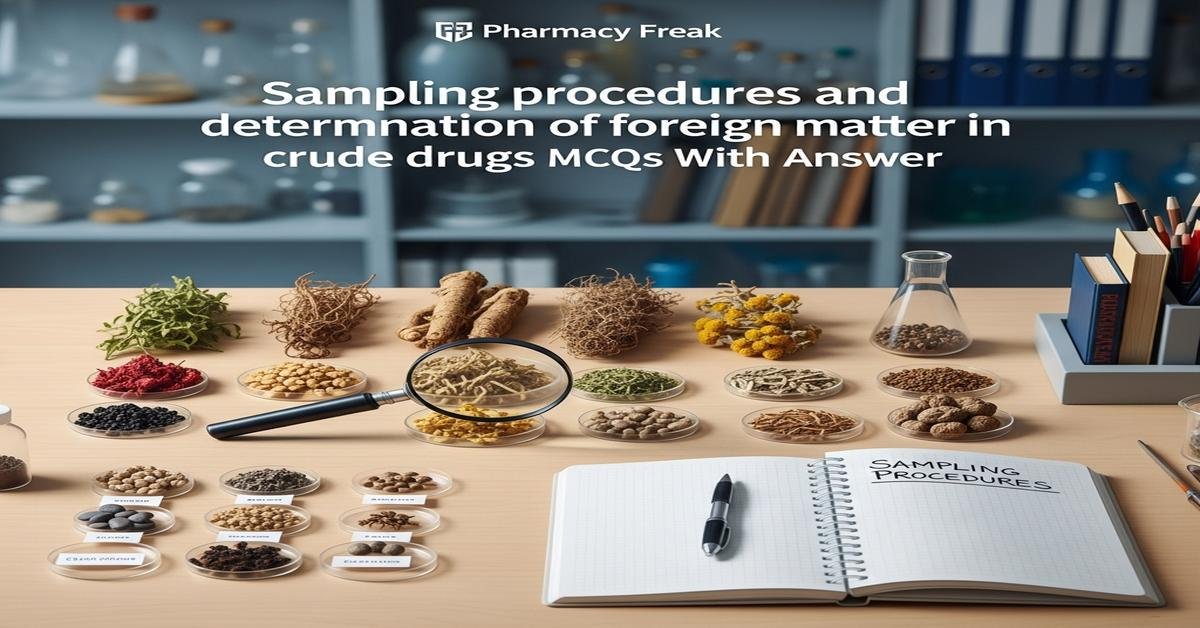
This MCQ set on “Sampling procedures and determination of foreign matter in crude drugs” is designed for M.Pharm students taking Advanced Pharmacognosy-II (MPG 202T). It focuses on practical and theoretical aspects of representative sampling from bulk consignments, sampling plans, sample handling, and the pharmacopoeial methods for detecting and quantifying foreign matter in crude drugs. Questions emphasize critical thinking about sampling strategy, sample size, composite and incremental sampling, laboratory preparation, identification techniques, acceptance criteria, and documentation practices. Use these MCQs to strengthen your conceptual understanding and preparation for examinations and real-world quality control of botanical raw materials.
Q1. Which sampling principle ensures that every unit in a lot has an equal probability of being selected?
- Judgmental sampling
- Convenience sampling
- Random sampling
- Purposive sampling
Correct Answer: Random sampling
Q2. In sampling of crude drug consignments, the term ‘incremental sample’ refers to:
- A sample taken once from the middle of a bale
- A small portion taken repeatedly from different locations in the lot
- Composite sample formed by grinding the entire lot
- Sample reserved for reference after analysis
Correct Answer: A small portion taken repeatedly from different locations in the lot
Q3. What is the main purpose of forming an aggregate (composite) sample from incremental samples of a crude drug lot?
- Reduce laboratory workload by analyzing only one component
- Increase variability to make testing tougher
- Create a representative sample that averages variability across the lot
- Introduce intentional bias for better results
Correct Answer: Create a representative sample that averages variability across the lot
Q4. According to standard sampling practice for crude drugs, which handling step is most important to prevent changes in foreign matter content before analysis?
- Immediate heating at high temperature
- Storage in sealed, clean, dry containers away from contaminants
- Prolonged exposure to sunlight
- Adding preservatives like formalin to the sample
Correct Answer: Storage in sealed, clean, dry containers away from contaminants
Q5. Which of the following best describes ‘foreign matter’ in the context of crude drugs?
- Desired plant parts used therapeutically
- Substances originating from the plant itself that increase potency
- Any extraneous matter such as soil, stones, seeds from other species, insects or animal contamination
- Only microbial contaminants
Correct Answer: Any extraneous matter such as soil, stones, seeds from other species, insects or animal contamination
Q6. Which analytical technique is commonly used to quantify visible foreign matter (e.g., stones, sand, animal fragments) in a crude drug lot?
- Gas chromatography
- Sieving followed by visual inspection
- UV-visible spectrophotometry
- Thin layer chromatography
Correct Answer: Sieving followed by visual inspection
Q7. When determining percent foreign matter by weight, which calculation is correct?
- (Weight of cleaned sample / total sample weight) × 100
- (Weight of foreign matter / total sample weight) × 100
- (Total lot weight / weight of foreign matter) × 100
- (Weight of cleaned sample / weight of foreign matter) × 100
Correct Answer: (Weight of foreign matter / total sample weight) × 100
Q8. For herbal materials with high adherent dirt, which pre-treatment is appropriate before foreign matter determination?
- Washing with water and drying under controlled conditions
- Grinding immediately without cleaning
- Soaking in strong acid
- Heating to carbonize dirt
Correct Answer: Washing with water and drying under controlled conditions
Q9. Which sampling plan concept is used to decide acceptance or rejection of a lot based on a limited number of samples and predefined defect thresholds?
- Statistical acceptance sampling
- Non-probability sampling
- Systematic exclusion
- Arbitrary sampling
Correct Answer: Statistical acceptance sampling
Q10. In the context of crude drug sampling, what is the principal advantage of stratified sampling over simple random sampling?
- It completely eliminates sampling error
- It allows targeted sampling within homogenous subgroups, reducing variability and improving representativeness
- It requires no knowledge of lot structure
- It is faster but less accurate
Correct Answer: It allows targeted sampling within homogenous subgroups, reducing variability and improving representativeness
Q11. Which pharmacopoeial approach is commonly specified for the limit of foreign matter in many crude drugs?
- Zero tolerance for all foreign matter types
- Specified percentage limits by weight or count depending on the crude drug
- Only visual acceptability without limits
- Allow unlimited amounts if therapeutically active
Correct Answer: Specified percentage limits by weight or count depending on the crude drug
Q12. During foreign matter analysis, microscopic examination is primarily used to:
- Quantify moisture content precisely
- Identify small or microscopic foreign particles such as fragments of other plant species, fungal spores or insect parts
- Replace all macroscopic sieving procedures
- Measure bulk density of the sample
Correct Answer: Identify small or microscopic foreign particles such as fragments of other plant species, fungal spores or insect parts
Q13. Which sampling error results from poor sample handling, contamination or segregation after selection rather than from selection method itself?
- Selection bias
- Processing error
- Post-sampling or handling error
- Measurement error
Correct Answer: Post-sampling or handling error
Q14. What is the recommended action when a sample shows foreign matter exceeding pharmacopoeial limits?
- Reclassify the lot as pharmaceutical grade
- Reject or subject the lot to cleaning/decontamination and re-sampling as per SOP and regulatory guidance
- Ignore and release the lot without documentation
- Dilute the sample with clean material to reduce percentage
Correct Answer: Reject or subject the lot to cleaning/decontamination and re-sampling as per SOP and regulatory guidance
Q15. Which of the following is a correct statement about composite samples in crude drug analysis?
- Composite samples amplify extreme values and are never used
- A composite is prepared by combining and mixing incremental samples to represent the whole lot
- Composite samples are smaller than incremental samples by definition
- Composite samples should not be homogenized before testing
Correct Answer: A composite is prepared by combining and mixing incremental samples to represent the whole lot
Q16. The use of a clean, white tray and magnifying glass for foreign matter separation is primarily intended to:
- Improve visual contrast and facilitate detection of small extraneous particles
- Sterilize the sample
- Increase the weight of the sample
- Enhance microbial growth for detection
Correct Answer: Improve visual contrast and facilitate detection of small extraneous particles
Q17. What is the role of documentation and chain-of-custody records in sampling crude drugs?
- They are optional and rarely inspected
- They ensure traceability, integrity of samples, and defensibility of results during regulatory review or dispute
- They are used only for foreign customers
- They replace the need for proper sampling technique
Correct Answer: They ensure traceability, integrity of samples, and defensibility of results during regulatory review or dispute
Q18. Which sample preparation technique is important to ensure accurate determination of foreign matter percentage by weight?
- Leaving the sample at ambient humidity for variable times
- Standardized drying to constant weight to remove moisture variability
- Mixing with water to increase bulk
- Storing in reactive containers
Correct Answer: Standardized drying to constant weight to remove moisture variability
Q19. In acceptance sampling by attributes for foreign matter, what does AQL (Acceptable Quality Level) define?
- The maximum lot size allowed for sampling
- The maximum proportion of defective items (or unacceptable units) considered acceptable during random sampling
- The exact number of samples required regardless of lot size
- The minimum weight of an incremental sample
Correct Answer: The maximum proportion of defective items (or unacceptable units) considered acceptable during random sampling
Q20. Which of the following is a best practice to minimize sampling bias when collecting samples from stacked bales or sacks of crude drug material?
- Always sample from the top center of the stack only
- Collect incremental samples from different heights and positions (top, middle, bottom; center and edges) throughout the stack
- Sample only from damaged packages
- Sample after extensive handling to mix contents
Correct Answer: Collect incremental samples from different heights and positions (top, middle, bottom; center and edges) throughout the stack

