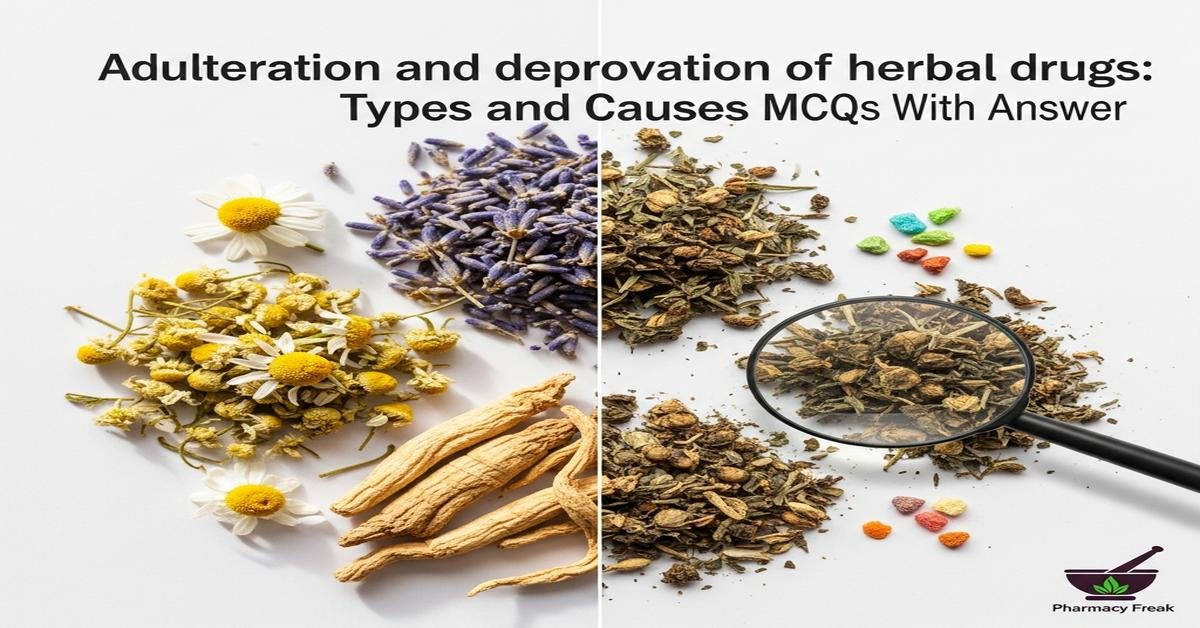
Adulteration and deterioration of herbal drugs pose major challenges to quality, safety, and efficacy in phytopharmaceuticals. For M. Pharm students, a clear grasp of the types of adulteration — intentional substitution, dilution, and contamination — and modes of deterioration — microbial degradation, enzymatic changes, oxidation, photodegradation and loss of volatile constituents — is essential. This quiz set targets advanced concepts in identification, root causes, analytical detection (organoleptic, microscopic, chromatographic, DNA barcoding), and preventive measures (Good Agricultural and Collection Practices, proper drying, packaging, and storage). These MCQs will help you consolidate theory and apply it to quality control, regulatory compliance, and formulation stability of herbal drugs.
Q1. Which of the following best describes ‘adulteration by substitution’ in herbal drugs?
- Mixing genuine drug with inert filler to increase volume
- Replacing a genuine herbal drug with a different, often cheaper, species
- Contamination with heavy metals during processing
- Intentional addition of synthetic drugs to enhance potency
Correct Answer: Replacing a genuine herbal drug with a different, often cheaper, species
Q2. Which factor is the most common cause of microbial deterioration in stored herbal material?
- Exposure to ultraviolet light
- High moisture content and inadequate drying
- Excessive freezing during storage
- Use of amber glass containers
Correct Answer: High moisture content and inadequate drying
Q3. Loss on drying and high moisture are primarily used to assess which type of deterioration risk?
- Photodegradation of alkaloids
- Enzymatic hydrolysis of glycosides
- Microbial growth and mycotoxin formation
- Oxidation of phenolic compounds
Correct Answer: Microbial growth and mycotoxin formation
Q4. Which adulteration is best detected by DNA barcoding rather than by simple organoleptic tests?
- Mixing with calcined clay as a bulking agent
- Substitution of plant species with a morphologically similar species
- Contamination with pesticide residues
- Loss of volatile oils due to improper drying
Correct Answer: Substitution of plant species with a morphologically similar species
Q5. Which chemical test or parameter is most useful for detecting inorganic contamination in herbal powders?
- TLC fingerprinting
- Ash values (total and acid-insoluble ash)
- Thin layer chromatography for alkaloids
- UV-Visible spectrophotometry of phenolics
Correct Answer: Ash values (total and acid-insoluble ash)
Q6. Aflatoxin contamination in herbal drugs is primarily produced by which cause?
- Photodegradation of essential oils
- Fungal growth, especially Aspergillus species under warm, humid conditions
- Oxidation due to exposure to atmospheric oxygen
- Enzymatic browning by polyphenol oxidase during storage
Correct Answer: Fungal growth, especially Aspergillus species under warm, humid conditions
Q7. Which deterioration mechanism most commonly leads to rancidity in oil-containing herbal drugs?
- Microbial proteolysis
- Oxidative degradation of unsaturated lipids
- Hydrolysis to form sugars
- Photochemical polymerization of terpenes
Correct Answer: Oxidative degradation of unsaturated lipids
Q8. Intentional adulteration by addition of pharmaceutical drugs to herbal preparations is primarily done to:
- Improve organoleptic properties such as taste
- Increase apparent therapeutic potency quickly
- Reduce moisture content for better shelf life
- Prevent photodegradation of constituents
Correct Answer: Increase apparent therapeutic potency quickly
Q9. Which of the following preventive measures is most effective to avoid enzymatic degradation of glycosides in harvested plant material?
- Storage at ambient humidity without ventilation
- Immediate drying at controlled temperature to inactivate enzymes
- Exposure to sunlight for prolonged periods
- Packaging in non-breathable plastic at high moisture
Correct Answer: Immediate drying at controlled temperature to inactivate enzymes
Q10. Which analytical technique is most suitable for detecting adulteration by synthetic dyes in herbal powders?
- Microscopic powder analysis
- High-performance liquid chromatography (HPLC) or LC-MS
- Loss on drying
- Organoleptic examination
Correct Answer: High-performance liquid chromatography (HPLC) or LC-MS
Q11. Photodegradation of light-sensitive herbal constituents is mainly prevented by which packaging strategy?
- Use of transparent PET bottles
- Use of amber or opaque containers with UV-blocking properties
- Storing in direct sunlight to maintain temperature
- Using breathable cloth sacks only
Correct Answer: Use of amber or opaque containers with UV-blocking properties
Q12. Which of the following is an example of unintentional adulteration?
- Adding cheaper plant root to mimic a valuable rhizome
- Cross-contamination with foreign plant fragments during collection
- Deliberately spiking with synthetic corticosteroids
- Replacing seeds with inert fillers for profit
Correct Answer: Cross-contamination with foreign plant fragments during collection
Q13. Which parameter in pharmacopoeial monographs helps in detecting excessive inorganic contamination from soil?
- pH of aqueous extract
- Acid-insoluble ash
- Total alkaloid content
- Thin layer chromatography Rf values
Correct Answer: Acid-insoluble ash
Q14. Which deterioration process is most likely responsible for loss of aroma in aromatic herbs like lavender?
- Mycotoxin formation
- Volatilization and oxidative degradation of essential oils
- Increase in ash value
- DNA degradation
Correct Answer: Volatilization and oxidative degradation of essential oils
Q15. Which quality control test is particularly useful to detect exhausted (drug that has lost active constituents) herbal powders?
- Moisture content only
- Quantitative assay of marker compounds or chromatographic fingerprinting
- Visual colour inspection alone
- Acid-insoluble ash measurement alone
Correct Answer: Quantitative assay of marker compounds or chromatographic fingerprinting
Q16. Heavy metal contamination in herbal drugs is often attributed to which primary cause?
- Inadequate drying techniques
- Use of contaminated soil, irrigation water, or proximity to industrial emissions
- Natural enzymatic breakdown
- Intentional substitution with cheaper plants
Correct Answer: Use of contaminated soil, irrigation water, or proximity to industrial emissions
Q17. Which of the following is the best immediate corrective action when a batch shows microbial contamination above pharmacopeial limits?
- Blend contaminated batch with a clean batch to dilute microbes
- Reject the batch and investigate source; implement corrective actions in supply chain
- Reduce moisture by heating without root-cause analysis
- Label the batch for external use only
Correct Answer: Reject the batch and investigate source; implement corrective actions in supply chain
Q18. Which deterioration mechanism explains enzymatic browning observed in cut or bruised herbal material?
- Action of polyphenol oxidase on phenolic substrates forming quinones
- Thermal decomposition of alkaloids
- Photochemical isomerization of terpenes
- Formation of aflatoxins by bacteria
Correct Answer: Action of polyphenol oxidase on phenolic substrates forming quinones
Q19. Good Agricultural and Collection Practices (GACP) primarily reduce which risks related to herbal drug quality?
- Only photodegradation after packaging
- Risks of contamination, incorrect identification, and suboptimal active constituent levels
- Elimination of need for analytical testing
- Guarantee of zero heavy metals regardless of environment
Correct Answer: Risks of contamination, incorrect identification, and suboptimal active constituent levels
Q20. Which of the following combinations is the most comprehensive approach to detect both intentional and unintentional adulteration in a herbal sample?
- Only organoleptic examination and ash values
- Microscopic examination, chromatographic fingerprinting, chemical assays, and DNA barcoding
- Drying the sample and measuring loss on drying only
- Storing the sample under nitrogen and retesting after one year
Correct Answer: Microscopic examination, chromatographic fingerprinting, chemical assays, and DNA barcoding

