Introduction
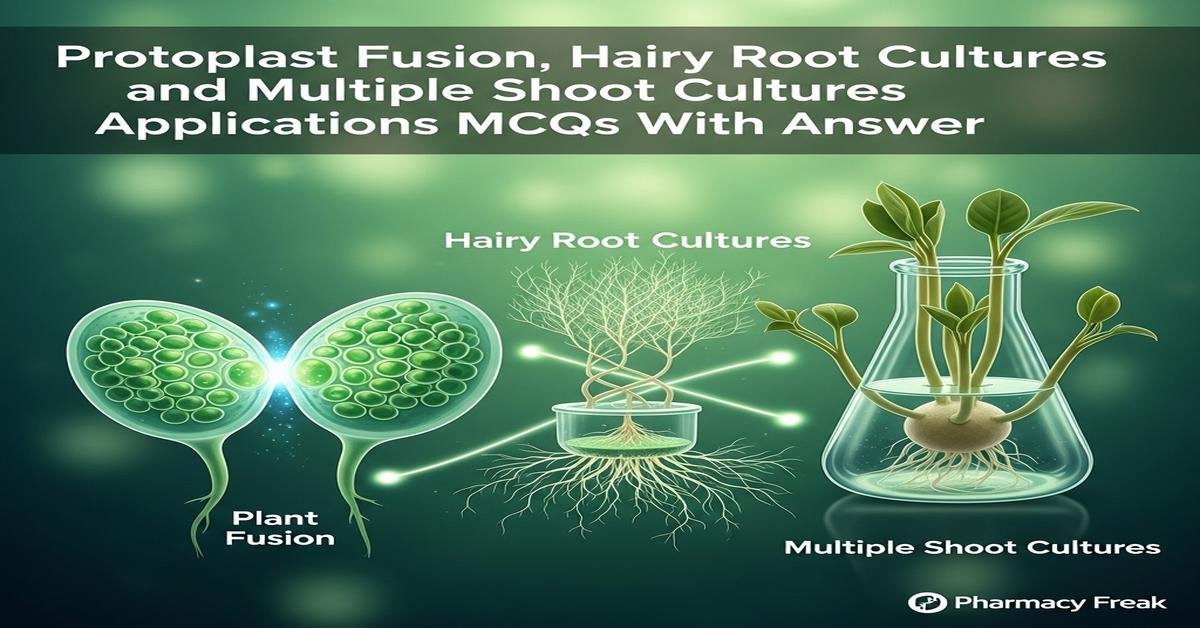
Protoplast fusion, hairy root cultures, and multiple shoot culture techniques are cornerstone tools in medicinal plant biotechnology, particularly for M.Pharm students focused on phytopharmaceutical development and metabolic engineering. This blog-style MCQ set consolidates key principles — from protoplast isolation, somatic hybridization and cybrid production to Agrobacterium rhizogenes-induced hairy roots and cytokinin-driven multiple shoot proliferation — with emphasis on practical applications such as enhanced secondary metabolite production, overcoming sexual incompatibility, and scalable culture systems. Each question probes conceptual understanding and applied aspects relevant to drug yield improvement, bioreactor design, genetic stability, and analytical validation. Use these MCQs to test and strengthen course-level mastery for research or industry practice.
Q1. What is the primary objective of protoplast fusion in plant biotechnology?
- To form chimeric plants by grafting tissues from two species
- To enable somatic hybridization combining nuclear and organelle genomes of two different plants
- To introduce single genes into plants using Agrobacterium tumefaciens
- To directly select for herbicide resistance in seedlings
Correct Answer: To enable somatic hybridization combining nuclear and organelle genomes of two different plants
Q2. Which combination of enzymes is most commonly used for enzymatic isolation of plant protoplasts?
- Trypsin and collagenase
- Cellulase and pectinase (macerozyme)
- Lipase and amylase
- Nuclease and protease
Correct Answer: Cellulase and pectinase (macerozyme)
Q3. Which methods are routinely used to induce fusion between isolated plant protoplasts?
- Agrobacterium-mediated fusion and microinjection
- Polyethylene glycol (PEG) treatment and electrofusion
- Biolistic bombardment and ultrasonic fusion
- CRISPR-Cas9 and RNAi co-culture
Correct Answer: Polyethylene glycol (PEG) treatment and electrofusion
Q4. How does a cybrid differ from a somatic hybrid resulting from protoplast fusion?
- Cybrids contain chloroplasts from both parents while somatic hybrids contain none
- Cybrids combine only organelle genomes with a single nuclear genome, whereas somatic hybrids combine nuclear genomes of both parents
- Cybrids are produced only by sexual hybridization and somatic hybrids only by tissue culture
- Cybrids contain mitochondrial DNA only and somatic hybrids contain chloroplast DNA only
Correct Answer: Cybrids combine only organelle genomes with a single nuclear genome, whereas somatic hybrids combine nuclear genomes of both parents
Q5. Which fundamental breeding barrier is most directly overcome by protoplast fusion?
- Seed dormancy in recalcitrant species
- Pre-zygotic reproductive isolation (flowering time differences)
- Sexual incompatibility due to cross-incompatibility between distant species
- Pollen sterility caused by environmental stress
Correct Answer: Sexual incompatibility due to cross-incompatibility between distant species
Q6. Successful plant regeneration from protoplasts most critically requires which early cellular event?
- Permanent loss of the vacuole
- Immediate chlorophyll synthesis in the protoplast
- Cell wall regeneration followed by cell division and callus formation
- Integration of Ri plasmid into the nuclear genome
Correct Answer: Cell wall regeneration followed by cell division and callus formation
Q7. What is a major technical limitation of protoplast fusion for routine crop improvement?
- It cannot transfer organelle genomes
- It is genotype-dependent with often low regeneration frequencies and potential somaclonal variation
- It always produces sterile progeny due to chromosome loss
- It requires viral vectors to achieve fusion
Correct Answer: It is genotype-dependent with often low regeneration frequencies and potential somaclonal variation
Q8. Hairy root cultures are induced by which microorganism?
- Agrobacterium tumefaciens
- Rhizobium leguminosarum
- Agrobacterium rhizogenes (Rhizobium rhizogenes)
- Fusarium oxysporum
Correct Answer: Agrobacterium rhizogenes (Rhizobium rhizogenes)
Q9. Which genes carried on the Ri plasmid are principally associated with hairy root induction and metabolic changes?
- vir genes (virA, virB)
- rol genes (rolA, rolB, rolC)
- nos genes (nopaline synthase)
- T-DNA aux genes
Correct Answer: rol genes (rolA, rolB, rolC)
Q10. Which characteristic best describes hairy root cultures for secondary metabolite production?
- Require continuous auxin supplementation to grow
- Typically show genetic instability and low metabolite yields
- Exhibit fast growth, genetic stability, and often high levels of root-specific metabolites without exogenous hormones
- Cannot be maintained in liquid culture and are limited to agar plates
Correct Answer: Exhibit fast growth, genetic stability, and often high levels of root-specific metabolites without exogenous hormones
Q11. Compared with undifferentiated cell suspension cultures, hairy root cultures are preferred when the goal is:
- Producing volatile oils only
- Rapid transgenic seed production
- High-yield production of root-specific, complex secondary metabolites with pathway compartmentalization
- Large-scale production of monoclonal antibodies
Correct Answer: High-yield production of root-specific, complex secondary metabolites with pathway compartmentalization
Q12. Which strategy is most widely used to enhance specific secondary metabolite accumulation in hairy root cultures?
- Excision of rol genes from the Ri plasmid
- Application of elicitors such as methyl jasmonate or yeast extract
- Continuous exposure to UV-C radiation for weeks
- Supplying only nitrogen-free medium
Correct Answer: Application of elicitors such as methyl jasmonate or yeast extract
Q13. What is a principal engineering challenge when scaling hairy root cultures in bioreactors?
- Excessive seed formation within the reactor
- Managing shear sensitivity, oxygen transfer and biomass immobilization while maintaining root integrity
- Hairy roots transform into shoots under agitation
- Hairy roots require temperatures below 5°C for optimal growth
Correct Answer: Managing shear sensitivity, oxygen transfer and biomass immobilization while maintaining root integrity
Q14. Multiple shoot cultures (micropropagation) are most commonly initiated to achieve which objective?
- To induce somatic embryogenesis exclusively in gymnosperms
- Rapid clonal propagation through axillary bud proliferation and shoot multiplication
- To produce hairy roots in vitro using rol genes
- To create seedless fruit via protoplast fusion
Correct Answer: Rapid clonal propagation through axillary bud proliferation and shoot multiplication
Q15. Which cytokinin is most commonly used to stimulate shoot proliferation in multiple shoot cultures?
- Indole-3-acetic acid (IAA)
- 6-Benzylaminopurine (BAP)
- Abscisic acid (ABA)
- Gibberellic acid (GA3)
Correct Answer: 6-Benzylaminopurine (BAP)
Q16. In tissue culture media formulation, a high cytokinin-to-auxin ratio generally promotes:
- Root initiation and elongation
- Callus necrosis
- Shoot organogenesis and axillary bud proliferation
- Somatic embryo maturation only
Correct Answer: Shoot organogenesis and axillary bud proliferation
Q17. Vitrification (hyperhydricity) in multiple shoot cultures is most often caused by:
- Low cytokinin levels and high gelling agent concentration
- High relative humidity in culture vessels, excessive cytokinin, and poor gelling/medium composition
- Excessive light intensity during dark incubation
- Nitrogen-deficient medium exclusively
Correct Answer: High relative humidity in culture vessels, excessive cytokinin, and poor gelling/medium composition
Q18. Which application is directly related to multiple shoot cultures in commercial propagation of medicinal plants?
- Encapsulation of shoot buds to produce synthetic seeds for germplasm exchange
- Induction of hairy roots for alkaloid production
- Direct gene editing of mitochondrial genomes
- Protoplast electrofusion for somatic hybrid creation in bioreactors
Correct Answer: Encapsulation of shoot buds to produce synthetic seeds for germplasm exchange
Q19. Somatic hybridization via protoplast fusion can be strategically used in medicinal plant improvement to:
- Only transfer chloroplast DNA while excluding nuclear traits
- Overcome sexual incompatibility and combine nuclear and/or organelle-encoded traits such as disease resistance or metabolite pathways
- Replace Agrobacterium methods for stable single-gene insertion with higher precision
- Induce rooting in recalcitrant woody species without hormone use
Correct Answer: Overcome sexual incompatibility and combine nuclear and/or organelle-encoded traits such as disease resistance or metabolite pathways
Q20. Which molecular approaches are commonly used to assess genetic fidelity of micropropagated multiple shoot cultures?
- Chromatography of secondary metabolites only
- DAPI staining of nuclei exclusively
- Molecular marker analyses such as RAPD, SSR and AFLP to detect clonal fidelity and somaclonal variation
- Root length measurement after acclimatization
Correct Answer: Molecular marker analyses such as RAPD, SSR and AFLP to detect clonal fidelity and somaclonal variation

