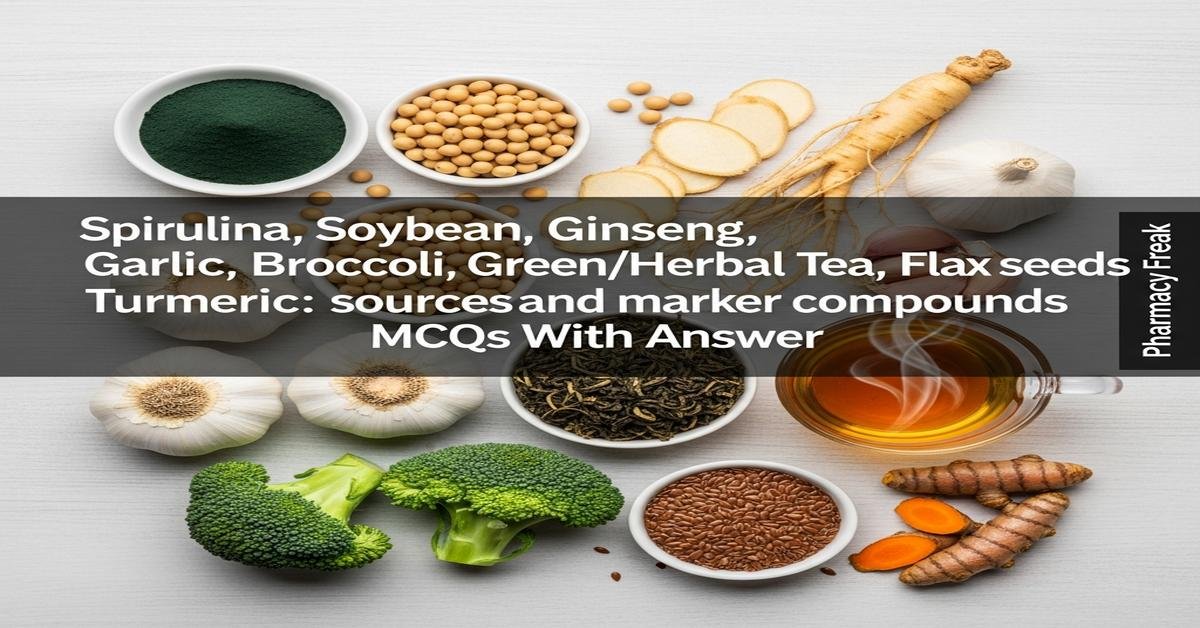
Introduction: Spirulina, Soybean, Ginseng, Garlic, Broccoli, Green/Herbal Tea, Flax seeds and Turmeric are widely studied in pharmacognosy for their therapeutic potential and use as standardized botanical ingredients. This quiz set focuses on botanical sources, characteristic marker compounds, biochemical transformations, and analytical approaches relevant to quality control and standardization. Designed for M.Pharm students taking Advanced Pharmacognosy I (MPG 102T), the questions emphasize critical markers such as phycocyanin, isoflavones, ginsenosides, allicin, glucosinolates/sulforaphane, catechins/EGCG, SDG, ALA and curcumin, plus practical considerations in extraction and analysis. Use these MCQs to reinforce identification, assay choices and stability issues important for herbal drug development and evaluation.
Q1. Which organism is the commonly cultivated source of food-grade Spirulina used in supplements?
- Arthrospira platensis
- Chlorella vulgaris
- Nostoc commune
- Spirulina maxima (as a misnomer)
Correct Answer: Arthrospira platensis
Q2. Which compound is the principal blue pigment and a key analytical marker for Spirulina quality?
- Phycocyanin (C-phycocyanin)
- Chlorophyll a
- Astaxanthin
- B-carotene
Correct Answer: Phycocyanin (C-phycocyanin)
Q3. What is the botanical name of the cultivated soybean, the major source of soy isoflavones?
- Glycine max
- Phaseolus vulgaris
- Vigna radiata
- Glycine soja
Correct Answer: Glycine max
Q4. Which isoflavone is commonly used as a marker compound in soybean phytochemical analysis?
- Genistein
- Quercetin
- Resveratrol
- Curcumin
Correct Answer: Genistein
Q5. The characteristic class of bioactive marker compounds in Panax ginseng are:
- Ginsenosides (triterpenoid saponins)
- Anthraquinones
- Isoflavones
- Alkylamides
Correct Answer: Ginsenosides (triterpenoid saponins)
Q6. Which specific ginsenoside is frequently quantified as a quality marker in ginseng preparations?
- Ginsenoside Rb1
- Glycyrrhizin
- Ginkgolide B
- Epigallocatechin gallate
Correct Answer: Ginsenoside Rb1
Q7. In intact garlic cloves the major sulfur-containing precursor that is enzymatically converted on crushing is:
- Alliin (S-allyl-L-cysteine sulfoxide)
- Allicin
- Ajoene
- Diallyl disulfide
Correct Answer: Alliin (S-allyl-L-cysteine sulfoxide)
Q8. Which compound is produced enzymatically when garlic is crushed and is often used as a pharmacological marker despite its instability?
- Allicin
- S-allyl cysteine
- Alliin
- Methylsulfonylmethane
Correct Answer: Allicin
Q9. Which glucosinolate is the precursor to the chemoprotective isothiocyanate sulforaphane found in broccoli?
- Glucoraphanin
- Sinalbin
- Sinigrin
- Glucoiberin
Correct Answer: Glucoraphanin
Q10. Which plant enzyme catalyzes conversion of glucoraphanin to sulforaphane upon plant tissue damage?
- Myrosinase (thioglucoside glucohydrolase)
- Peroxidase
- Polyphenol oxidase
- β-Glucosidase specific to flavonoids
Correct Answer: Myrosinase (thioglucoside glucohydrolase)
Q11. The major catechin used as a marker for green tea antioxidant activity is:
- Epigallocatechin gallate (EGCG)
- Quercetin
- Kaempferol
- Resveratrol
Correct Answer: Epigallocatechin gallate (EGCG)
Q12. Which amino acid-like constituent unique to Camellia sinensis contributes to relaxation and is used as an indicator in green tea profiling?
- L-theanine
- L-tryptophan
- Gamma-aminobutyric acid (GABA)
- Histidine
Correct Answer: L-theanine
Q13. The principal lignan used as a marker compound in flaxseed (Linum usitatissimum) analysis is:
- Secoisolariciresinol diglucoside (SDG)
- Pinoresinol
- Sesamin
- Enterodiol
Correct Answer: Secoisolariciresinol diglucoside (SDG)
Q14. Which essential fatty acid is particularly abundant in flax seeds and often quantified as a quality parameter?
- Alpha-linolenic acid (ALA, omega-3)
- Linoleic acid (omega-6)
- Oleic acid (omega-9)
- Arachidonic acid
Correct Answer: Alpha-linolenic acid (ALA, omega-3)
Q15. The major curcuminoid marker in turmeric (Curcuma longa) used for standardization is:
- Curcumin (diferuloylmethane)
- Demethoxycurcumin is the only marker
- Turmerone
- Gingerol
Correct Answer: Curcumin (diferuloylmethane)
Q16. Which solvent is commonly used for efficient extraction of curcuminoids from turmeric for HPLC analysis?
- Ethanol (or hydroalcoholic solvent)
- Petroleum ether
- Hexane
- Pure water only
Correct Answer: Ethanol (or hydroalcoholic solvent)
Q17. Which compound derived from broccoli is most associated with induction of phase II detoxification enzymes and is quantified as a bioactive marker?
- Sulforaphane
- Indole-3-carbinol
- Glucobrassicin
- Phenethyl isothiocyanate
Correct Answer: Sulforaphane
Q18. For sensitive and specific profiling of complex ginsenoside mixtures in ginseng extracts, which analytical technique is preferred?
- LC-MS/MS (liquid chromatography–tandem mass spectrometry)
- Thin layer chromatography (TLC) with vanillin
- Simple colorimetric assay
- Paper chromatography
Correct Answer: LC-MS/MS (liquid chromatography–tandem mass spectrometry)
Q19. Which statement best describes the stability of allicin in processed garlic preparations?
- Allicin is chemically unstable and rapidly decomposes to other sulfur compounds
- Allicin is highly stable at high temperatures and during storage
- Allicin is a non-reactive sugar-derived compound
- Allicin concentrates increase during prolonged storage
Correct Answer: Allicin is chemically unstable and rapidly decomposes to other sulfur compounds
Q20. Which approach is commonly used for standardization of turmeric-containing pharmaceutical/herbal formulations?
- Specification of total curcumin content determined by HPLC
- Only organoleptic assessment (color and odor)
- Protein content assay
- Measurement of chlorophyll content
Correct Answer: Specification of total curcumin content determined by HPLC

