Introduction:
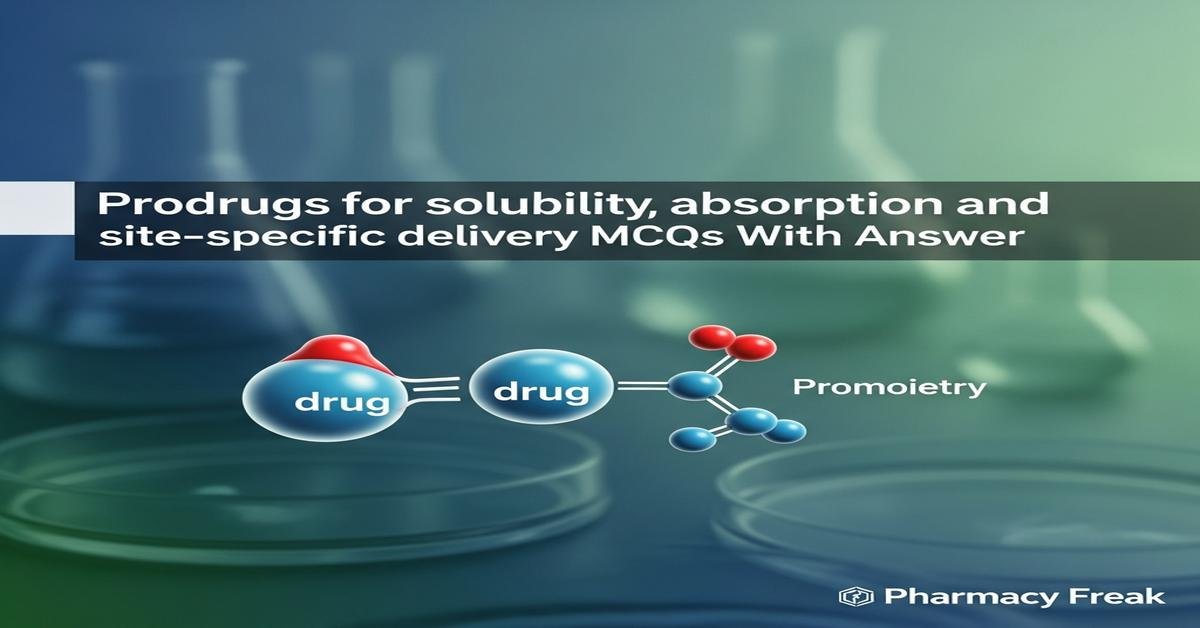
This MCQ collection on prodrugs focuses on improving solubility, enhancing absorption, and achieving site-specific delivery—key strategies in contemporary drug design. Tailored for M.Pharm students, the questions examine prodrug classification, promoieties, enzymatic activation, transporter targeting, and real-world examples. Emphasis is placed on mechanistic understanding: how chemical modifications alter physicochemical properties, interact with biological enzymes and transporters, and enable targeted release in tissues such as the colon, liver, or tumor. The set aims to deepen conceptual clarity and problem-solving skills required for formulation and discovery projects, preparing students for both exams and research-oriented decision-making in prodrug design.
Q1. What is the primary rationale for designing a prodrug to improve aqueous solubility?
- To permanently change the pharmacophore so it has different therapeutic activity
- To transiently add a hydrophilic promoiety that is cleaved in vivo to release the active drug
- To increase plasma protein binding and reduce clearance
- To make the drug more susceptible to CYP-mediated metabolism
Correct Answer: To transiently add a hydrophilic promoiety that is cleaved in vivo to release the active drug
Q2. Which promoiety is commonly used to produce water-soluble phosphate ester prodrugs activated by alkaline phosphatase?
- Valine ester
- Phosphate group
- Glucuronide
- Bile acid conjugate
Correct Answer: Phosphate group
Q3. Valacyclovir is a prodrug of acyclovir designed primarily to improve:
- Metabolic stability by blocking CYP metabolism
- Oral absorption via peptide transporter PEPT1
- Blood–brain barrier penetration through P-gp efflux
- Selective renal excretion
Correct Answer: Oral absorption via peptide transporter PEPT1
Q4. Which enzyme class most commonly hydrolyzes ester prodrugs to release the active drug in plasma and tissues?
- CYP450 oxidases
- Alkaline phosphatases
- Carboxylesterases (esterases)
- UDP-glucuronosyltransferases
Correct Answer: Carboxylesterases (esterases)
Q5. A bioprecursor prodrug differs from a carrier-linked prodrug because it:
- Contains a promoiety that remains in circulation after activation
- Requires only a chemical or metabolic transformation that modifies the drug structure without releasing a separate promoiety
- Always targets a specific transporter for uptake
- Is activated exclusively by gut microbiota
Correct Answer: Requires only a chemical or metabolic transformation that modifies the drug structure without releasing a separate promoiety
Q6. Sulfasalazine is used as a colon-targeted prodrug because it is activated by:
- Hepatic carboxylesterases
- Intestinal alkaline phosphatase
- Bacterial azoreductases in the colon
- CYP3A4 in enterocytes
Correct Answer: Bacterial azoreductases in the colon
Q7. Which property of a promoiety is most desirable when designing a prodrug to utilize carrier-mediated uptake by intestinal transporters?
- High lipophilicity and steric bulk
- Structural mimicry of endogenous transporter substrates (e.g., amino acids, peptides)
- Strong negative charge at physiological pH
- Resistance to enzymatic cleavage in the intestinal lumen
Correct Answer: Structural mimicry of endogenous transporter substrates (e.g., amino acids, peptides)
Q8. Fosphenytoin is a clinically used prodrug of phenytoin designed mainly to:
- Improve oral bioavailability by increasing lipophilicity
- Enhance aqueous solubility for parenteral administration
- Target release to the colon
- Avoid first-pass metabolism by bypassing portal circulation
Correct Answer: Enhance aqueous solubility for parenteral administration
Q9. Which linkage provides greater chemical stability in plasma but can still be enzymatically cleaved in tissues, often used for sustained prodrug activation?
- Simple ester linkage
- Carbamate linkage
- Phosphate monoester
- Imine (Schiff base) linkage
Correct Answer: Carbamate linkage
Q10. A hepatic-targeted prodrug might include which promoiety to take advantage of hepatocyte-specific uptake receptors?
- Galactose or N-acetylgalactosamine (GalNAc)
- Large polyethylene glycol chains
- Aggressive alkylation to increase lipophilicity
- Phosphate diesters to target kidney transporters
Correct Answer: Galactose or N-acetylgalactosamine (GalNAc)
Q11. Which consideration is NOT essential when selecting a promoiety for a solubility-enhancing prodrug?
- Promoiety should be non-toxic and rapidly cleavable in vivo
- Promoiety should make the prodrug permanently active without cleavage
- Promoiety should increase aqueous solubility sufficiently for formulation
- Promoiety should not interfere with target binding once cleaved
Correct Answer: Promoiety should make the prodrug permanently active without cleavage
Q12. Capecitabine is an example of a prodrug designed for preferential activation in tumors by which enzyme cascade?
- Intestinal azoreductases followed by hepatic esterases
- Carboxylesterase → cytidine deaminase → thymidine phosphorylase in tumors
- Alkaline phosphatase followed by renal peptidases
- CYP3A4-mediated oxidation in tumor cells
Correct Answer: Carboxylesterase → cytidine deaminase → thymidine phosphorylase in tumors
Q13. Which of the following is a primary advantage of increasing lipophilicity through a prodrug approach to enhance membrane permeability?
- Absolute increase in receptor affinity of the active drug
- Transient masking of polar functional groups to improve passive diffusion
- Complete avoidance of metabolic clearance pathways
- Guaranteed delivery to a specific organ without off-target exposure
Correct Answer: Transient masking of polar functional groups to improve passive diffusion
Q14. Which marketed prodrug is activated by intestinal and hepatic peptidases and uses an amino-acid promoiety to exploit PEPT transporters?
- Valacyclovir
- Fosphenytoin
- Enalapril
- Sulfasalazine
Correct Answer: Valacyclovir
Q15. For colon-targeted prodrugs, a common strategy is to link the drug to a carrier that is:
- Cleaved by brush-border aminopeptidases in the duodenum
- Hydrolyzed by hepatic CYP enzymes
- Specifically reduced or cleaved by colonic bacterial enzymes
- Permanently stable to all enzymatic activity
Correct Answer: Specifically reduced or cleaved by colonic bacterial enzymes
Q16. Which statement best describes a “mutual prodrug” (codrug)?
- Two drugs are covalently linked so that each serves as a promoiety for the other and both are released upon cleavage
- A drug is linked to a non-pharmacologically active spacer that promotes solubility
- It refers to a drug that is converted into multiple active metabolites
- It is a prodrug activated exclusively by mutualistic gut bacteria
Correct Answer: Two drugs are covalently linked so that each serves as a promoiety for the other and both are released upon cleavage
Q17. Which enzyme is primarily responsible for converting enalapril (prodrug) to enalaprilat (active angiotensin-converting enzyme inhibitor) in vivo?
- Hepatic cytochrome P450 2D6
- Carboxylesterase (plasma or tissue esterase)
- Renal peptidase
- Thymidine phosphorylase
Correct Answer: Carboxylesterase (plasma or tissue esterase)
Q18. Which factor can reduce the predictability of prodrug activation across patient populations?
- Uniform expression of activating enzymes in all tissues
- Interindividual variability in enzyme expression (e.g., genetic polymorphisms)
- Using a chemically stable linker that is not cleaved enzymatically
- Designing the promoiety to mimic ubiquitous dietary amino acids
Correct Answer: Interindividual variability in enzyme expression (e.g., genetic polymorphisms)
Q19. In pulmonary or inhalation prodrug strategies, what is a key design goal?
- Make the prodrug highly susceptible to first-pass hepatic metabolism
- Ensure rapid systemic absorption to minimize lung exposure
- Achieve local activation in the lung with minimal systemic release
- Prevent any enzymatic cleavage to maintain long lung retention of the promoiety
Correct Answer: Achieve local activation in the lung with minimal systemic release
Q20. Which of the following is NOT typically used as a criterion when evaluating the suitability of a promoiety for clinical prodrug development?
- Non-toxicity and known metabolic fate of the promoiety
- Ability of the promoiety to permanently alter target selectivity of the parent drug
- Synthetic feasibility and scalability of the prodrug linkage
- Predictable in vivo cleavage kinetics matching therapeutic needs
Correct Answer: Ability of the promoiety to permanently alter target selectivity of the parent drug

