Introduction:
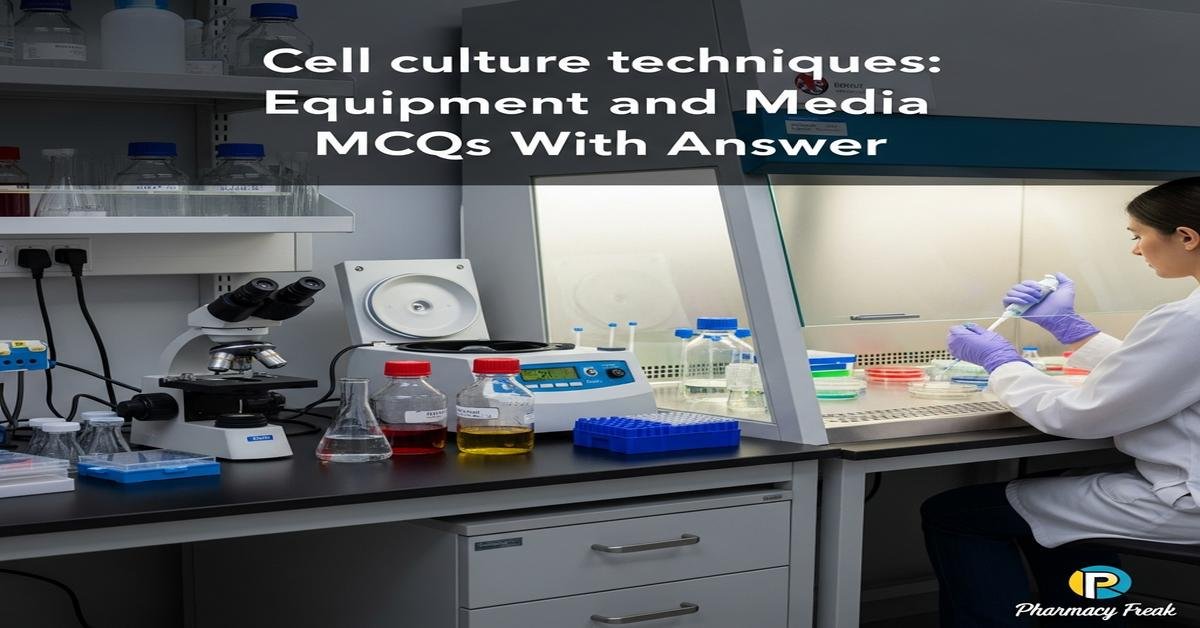
This quiz set on Cell culture techniques: equipment and media is designed for M.Pharm students preparing for advanced examinations and practical lab work. It focuses on critical aspects of cell culture: incubators, biosafety cabinets, filtration, cryopreservation, basal media, serum and serum-free formulations, buffers, sterility controls and monitoring techniques. Questions emphasize applied knowledge—why equipment specifications matter, how media components influence cell physiology, and best practices for aseptic technique and large-scale culture. These MCQs go beyond definitions to test decision-making relevant to experimental design, troubleshooting contamination, and selecting appropriate media and equipment for specific cell culture applications.
Q1. What is the primary reason a CO2 incubator is used for culturing mammalian cells?
- Maintain a constant 37°C for mammalian cells
- Control CO2 concentration to maintain bicarbonate-buffered media pH
- Provide aseptic laminar airflow to prevent contamination
- Remove volatile organic compounds via activated charcoal
Correct Answer: Control CO2 concentration to maintain bicarbonate-buffered media pH
Q2. Which class of biological safety cabinet provides both product and personnel protection while allowing open work access?
- Class I BSC (personnel protection only)
- Class II BSC (product and personnel protection)
- Class III BSC (totally enclosed, glove box)
- Clean bench (product protection only)
Correct Answer: Class II BSC (product and personnel protection)
Q3. What is the role of phenol red in most tissue culture media?
- Act as an antioxidant to protect cells from oxidative stress
- Serve as a pH indicator to monitor culture medium acidity/alkalinity
- Provide essential vitamins for cell growth
- Stabilize dissolved oxygen concentration in medium
Correct Answer: Serve as a pH indicator to monitor culture medium acidity/alkalinity
Q4. Which basal medium is classically preferred for primary hepatocyte culture due to its composition?
- DMEM (Dulbecco’s Modified Eagle Medium)
- RPMI 1640
- L-15 (Leibovitz)
- Williams’ Medium E
Correct Answer: Williams’ Medium E
Q5. Which of the following best describes the major functional contributions of fetal bovine serum (FBS) in culture?
- Provide proteases to facilitate cell detachment
- Adjust osmolarity and buffer capacity of media
- Supply growth factors, attachment factors, and hormones
- Act as the primary energy source for cultured cells
Correct Answer: Supply growth factors, attachment factors, and hormones
Q6. What is the routine FBS concentration commonly used for maintaining many adherent mammalian cell lines?
- 0.5% FBS
- 2% FBS
- 10% FBS
- 30% FBS
Correct Answer: 10% FBS
Q7. Which filter pore size is commonly used to sterilize cell culture media by removing bacteria?
- 0.45 µm
- 0.22 µm
- 0.10 µm
- 0.80 µm
Correct Answer: 0.22 µm
Q8. What is the standard cryoprotectant and typical concentration used for freezing mammalian cells for long-term storage?
- 10% ethanol in PBS
- 10% DMSO in serum-containing medium
- 50% glycerol in water
- 5% sodium chloride solution
Correct Answer: 10% DMSO in serum-containing medium
Q9. How does trypsin-EDTA detach adherent cells from culture surfaces?
- EDTA dissolves extracellular matrix; trypsin stabilizes cell membranes
- Trypsin chelates divalent cations while EDTA proteolyzes adhesion proteins
- Trypsin proteolytically cleaves adhesion proteins and EDTA chelates Ca2+/Mg2+ to weaken cell–cell and cell–substrate interactions
- They both fix the cells to allow mechanical scraping
Correct Answer: Trypsin proteolytically cleaves adhesion proteins and EDTA chelates Ca2+/Mg2+ to weaken cell–cell and cell–substrate interactions
Q10. Which method is considered most sensitive for routine detection of mycoplasma contamination in cell cultures?
- Gram staining of culture supernatant
- PCR-based mycoplasma detection assays
- Measuring turbidity of culture medium
- Visual inspection under phase-contrast microscopy alone
Correct Answer: PCR-based mycoplasma detection assays
Q11. Which media component or additive is commonly used as a non-CO2-dependent buffer to stabilize pH during manipulations outside a CO2 incubator?
- Sodium bicarbonate alone
- HEPES buffer
- Phenol red dye
- EDTA
Correct Answer: HEPES buffer
Q12. HEPA filters used in biosafety cabinets are rated to remove particles down to which size with ~99.97% efficiency?
- 1.0 µm
- 0.3 µm
- 0.05 µm
- 5.0 µm
Correct Answer: 0.3 µm
Q13. What is the main advantage of switching from serum-containing to serum-free, chemically defined media?
- All cell types grow faster in serum-free media without optimization
- Eliminates batch-to-batch variability and allows defined supplementation
- Removes the need for antibiotics
- Prevents adherence of cells to culture plastic
Correct Answer: Eliminates batch-to-batch variability and allows defined supplementation
Q14. What is the typical osmolarity range recommended for mammalian cell culture media?
- ~150 mOsm/kg
- ~300 mOsm/kg
- ~450 mOsm/kg
- ~600 mOsm/kg
Correct Answer: ~300 mOsm/kg
Q15. Which buffering system is most suitable for experiments performed outside a CO2 incubator when CO2 control is not available?
- Bicarbonate buffer alone
- HEPES buffering system
- Phosphate-buffered saline (PBS) as a culture base
- Sodium acetate buffer
Correct Answer: HEPES buffering system
Q16. Why is tissue culture-treated plastic used for adherent cells?
- The treatment sterilizes the plastic surface
- Treated plastic increases hydrophilicity and adds charged groups to promote cell attachment
- Treated plastic slowly releases growth factors
- Treated plastic prevents protein adsorption
Correct Answer: Treated plastic increases hydrophilicity and adds charged groups to promote cell attachment
Q17. Roller bottles or multilayer flasks are primarily used in adherent cell culture to achieve what purpose?
- Allow efficient suspension growth without microcarriers
- Provide very high surface area-to-volume ratio for large-scale adherent cell expansion
- Enhance gas exchange for hypoxic experiments only
- Reduce shear stress to zero during rapid stirring
Correct Answer: Provide very high surface area-to-volume ratio for large-scale adherent cell expansion
Q18. What are the typical working concentrations for penicillin and streptomycin in routine cell culture antibiotic supplementation?
- Penicillin 100 U/mL and streptomycin 100 µg/mL
- Penicillin 1000 U/mL and streptomycin 1000 µg/mL
- Penicillin 1 U/mL and streptomycin 1 µg/mL
- Penicillin 10 U/mL and streptomycin 10 µg/mL
Correct Answer: Penicillin 100 U/mL and streptomycin 100 µg/mL
Q19. What is the recommended cooling rate when freezing typical mammalian cells for cryopreservation to minimize intracellular ice formation?
- Rapid plunge to -196°C (liquid nitrogen) without controlled cooling
- Approximately -1°C per minute down to -80°C before transfer to liquid nitrogen
- Approximately -10°C per minute to -80°C
- Slow cooling at +1°C per minute to room temperature
Correct Answer: Approximately -1°C per minute down to -80°C before transfer to liquid nitrogen
Q20. What is the purpose of microcarrier beads in stirred-tank bioreactors for adherent cell lines?
- To enable suspension growth of inherently non-adherent cells
- To increase available surface area so adherent cells can be grown in stirred suspension systems
- To decrease dissolved oxygen levels around cells
- To serve as cryoprotectants during freezing
Correct Answer: To increase available surface area so adherent cells can be grown in stirred suspension systems

