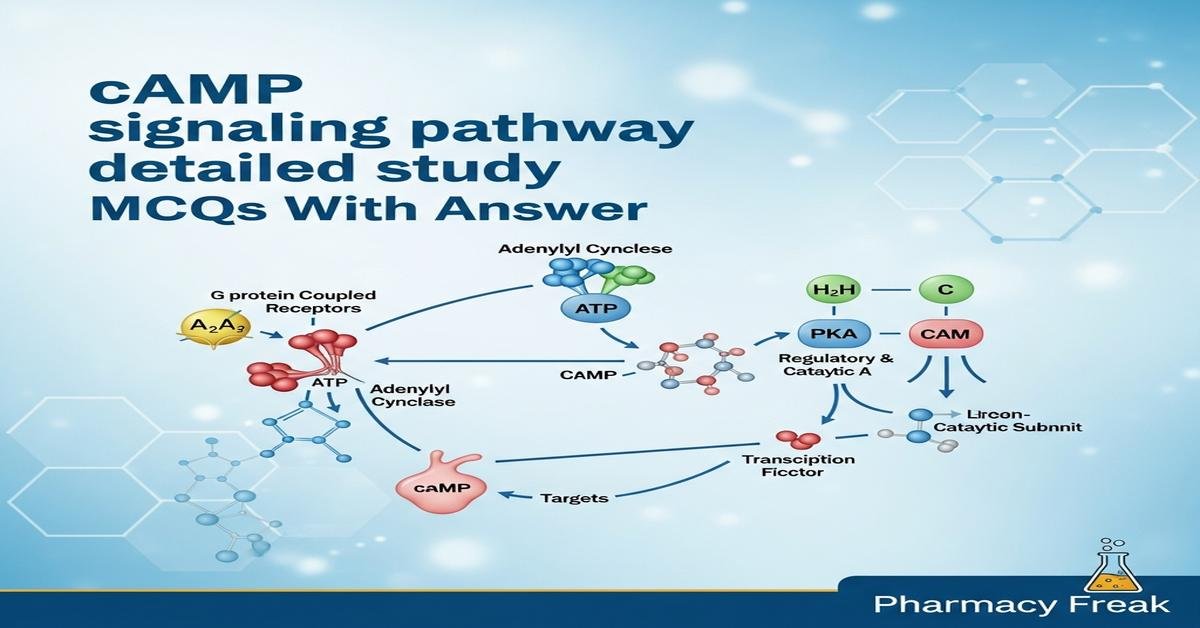
Introduction: This blog provides an in-depth set of multiple-choice questions focused on the cAMP signaling pathway tailored for M.Pharm students studying Cellular and Molecular Pharmacology. The questions cover receptor–G protein coupling, adenylyl cyclase isoforms, PKA structure and regulation, EPAC signaling, PDE-mediated termination, compartmentalization by AKAPs, pharmacological modulators, and clinical implications. Each MCQ tests conceptual understanding, mechanistic detail, and pharmacological relevance to prepare students for advanced coursework and examinations. Explanations reinforce how alterations in cAMP signaling contribute to disease and how drugs exploit pathway nodes, equipping learners with applied knowledge for drug development and therapeutic strategy.
Q1. Which enzyme catalyzes the conversion of ATP to cyclic AMP (cAMP) in response to activated G-protein signaling?
- Adenylyl cyclase (AC)
- Guanylyl cyclase (GC)
- Phospholipase C (PLC)
- Phosphodiesterase (PDE)
Correct Answer: Adenylyl cyclase (AC)
Q2. Activation of which G-protein alpha subunit classically stimulates adenylyl cyclase activity to raise intracellular cAMP?
- Gs alpha
- Gi alpha
- Gq alpha
- G12/13 alpha
Correct Answer: Gs alpha
Q3. The classical PKA holoenzyme in its inactive state is composed of which arrangement of subunits?
- Two regulatory (R) and two catalytic (C) subunits (R2C2)
- One regulatory and one catalytic subunit (RC)
- Two catalytic subunits only (C2)
- Three regulatory and one catalytic subunit (R3C)
Correct Answer: Two regulatory (R) and two catalytic (C) subunits (R2C2)
Q4. How does cAMP activate PKA at the molecular level?
- cAMP binds regulatory subunits causing conformational change and release of catalytic subunits
- cAMP directly phosphorylates the catalytic subunit to activate it
- cAMP binds the catalytic subunit and forms an active holoenzyme
- cAMP degrades the regulatory subunits via proteolysis
Correct Answer: cAMP binds regulatory subunits causing conformational change and release of catalytic subunits
Q5. Which effector is directly activated by cAMP but is distinct from PKA and mediates Rap1-dependent signaling?
- EPAC (Exchange Protein directly Activated by cAMP)
- PDE4
- PKC (Protein kinase C)
- AKAP (A-kinase anchoring protein)
Correct Answer: EPAC (Exchange Protein directly Activated by cAMP)
Q6. What is the principal biochemical mechanism by which phosphodiesterases (PDEs) terminate cAMP signals?
- Hydrolysis of cAMP to AMP
- Phosphorylation of cAMP to cAMP-P
- Export of cAMP out of the cell via transporters
- Oxidation of cAMP to inactive metabolites
Correct Answer: Hydrolysis of cAMP to AMP
Q7. Methylxanthines such as caffeine and theophylline increase intracellular cAMP primarily by which pharmacologic action?
- Inhibition of phosphodiesterases (PDEs)
- Activation of adenylyl cyclase directly
- Agonism at beta-adrenergic receptors
- Blockade of Gs protein function
Correct Answer: Inhibition of phosphodiesterases (PDEs)
Q8. What is the main role of A-kinase anchoring proteins (AKAPs) in cAMP signaling?
- Localize PKA to specific subcellular compartments to create signaling microdomains
- Act as guanine nucleotide exchange factors for G proteins
- Directly hydrolyze cAMP in signaling complexes
- Transport cAMP across membranes
Correct Answer: Localize PKA to specific subcellular compartments to create signaling microdomains
Q9. Which adenylyl cyclase isoforms are positively regulated by Ca2+/calmodulin?
- AC1 and AC8
- AC5 and AC6
- AC2 and AC9
- AC3 and AC7 inhibited by Ca2+/calmodulin
Correct Answer: AC1 and AC8
Q10. cAMP compartmentalization in cells is achieved primarily by which combination of mechanisms?
- Localized PDE activity and AKAP-mediated anchoring of signaling components
- Global diffusion of cAMP without regulation
- Direct sequestration of cAMP into vesicles
- Permanent association of PKA with AC, preventing diffusion
Correct Answer: Localized PDE activity and AKAP-mediated anchoring of signaling components
Q11. PKA predominantly phosphorylates which type of amino acid residues on substrate proteins?
- Serine and threonine residues
- Tyrosine residues
- Histidine residues
- Lysine residues
Correct Answer: Serine and threonine residues
Q12. In cardiac myocytes, increased cAMP/PKA signaling enhances contractility mainly by phosphorylation of which target?
- L-type voltage-gated calcium channels (increasing Ca2+ influx)
- Sodium–potassium ATPase (increasing Na+/K+ exchange)
- Ryanodine receptors to decrease Ca2+ release
- Muscarinic receptors to reduce heart rate
Correct Answer: L-type voltage-gated calcium channels (increasing Ca2+ influx)
Q13. Phosphorylation of CREB by PKA at which residue is critical for CRE-mediated gene transcription?
- Serine 133
- Tyrosine 705
- Threonine 308
- Serine 9
Correct Answer: Serine 133
Q14. Which class of drugs acting through GPCRs increases cAMP levels via Gs coupling and is commonly used as bronchodilators?
- Beta-2 adrenergic agonists
- Beta blockers
- Muscarinic agonists
- Alpha-1 adrenergic agonists
Correct Answer: Beta-2 adrenergic agonists
Q15. Activation of Gi-coupled receptors affects intracellular cAMP levels in which way?
- Decrease cAMP by inhibition of adenylyl cyclase
- Increase cAMP by activation of adenylyl cyclase
- No change in cAMP but increases cGMP
- Directly activate PKA independent of cAMP
Correct Answer: Decrease cAMP by inhibition of adenylyl cyclase
Q16. Which experimental tool allows real-time measurements of intracellular cAMP dynamics with subcellular resolution?
- FRET-based cAMP biosensors (e.g., Epac-based sensors)
- Western blot for PKA substrates
- ELISA on cell lysates only providing endpoint cAMP
- Patch-clamp electrophysiology monitoring ionic currents
Correct Answer: FRET-based cAMP biosensors (e.g., Epac-based sensors)
Q17. Rolipram is a selective inhibitor of which phosphodiesterase family, often implicated in inflammatory and CNS processes?
- PDE4
- PDE3
- PDE5
- PDE1
Correct Answer: PDE4
Q18. Constitutively activating mutations in the Gs alpha subunit (GNAS) that elevate cAMP are classically associated with which clinical syndrome?
- McCune–Albright syndrome
- Cystic fibrosis
- Liddle syndrome
- Alport syndrome
Correct Answer: McCune–Albright syndrome
Q19. Which role does arrestin play in GPCR regulation that affects cAMP signaling?
- Bind phosphorylated GPCRs to prevent further G-protein coupling and promote receptor internalization
- Activate adenylyl cyclase directly to increase cAMP
- Serve as an alternative Gs alpha subunit to maintain signaling
- Hydrolyze cAMP to AMP as a PDE mimic
Correct Answer: Bind phosphorylated GPCRs to prevent further G-protein coupling and promote receptor internalization
Q20. A negative feedback mechanism that limits cAMP signaling involves PKA-mediated phosphorylation of which target to accelerate cAMP degradation?
- Phosphorylation and activation of specific PDE isoforms
- Phosphorylation and inhibition of adenylyl cyclase permanently
- Proteolytic degradation of cAMP by PKA
- Export of cAMP by PKA-activated transporters
Correct Answer: Phosphorylation and activation of specific PDE isoforms

