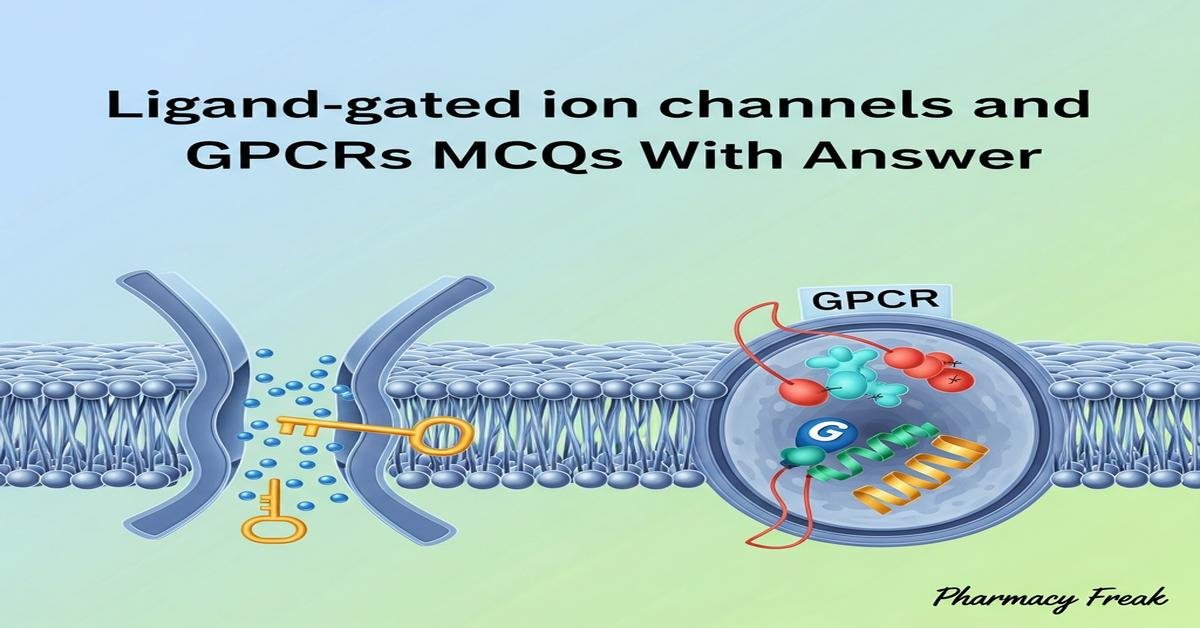
Ligand-gated ion channels and G protein–coupled receptors (GPCRs) form the backbone of fast synaptic transmission and diverse cellular signaling in pharmacology. This quiz compilation for M.Pharm students focuses on molecular architecture, activation mechanisms, ion selectivity, signaling cascades, regulatory processes, pharmacological modulation and clinically relevant drug examples. Questions probe detailed concepts such as Cys-loop receptor structure, subtype-specific permeability, G-protein coupling specificity (Gs, Gi/o, Gq/11), second-messenger pathways, desensitization, biased agonism, and allosteric modulators. Designed to deepen mechanistic understanding and link molecular features to therapeutic strategies, these MCQs will help consolidate knowledge required for advanced coursework, research, and rational drug design in cellular and molecular pharmacology.
Q1. Which structural family do nicotinic acetylcholine receptors (nAChRs) and GABA-A receptors both belong to?
- Cys-loop pentameric ligand-gated ion channels
- Seven-transmembrane (7TM) GPCR family
- Ionotropic glutamate receptor family
- P2X trimeric ATP-gated channel family
Correct Answer: Cys-loop pentameric ligand-gated ion channels
Q2. Which G protein alpha subunit class primarily activates phospholipase C-beta leading to IP3 and DAG production?
- Gs
- Gi/o
- Gq/11
- G12/13
Correct Answer: Gq/11
Q3. A positive allosteric modulator of GABA-A receptors, such as benzodiazepines, produces which effect?
- Increase channel opening frequency or efficacy without directly activating the receptor
- Block the GABA binding site and prevent channel activation
- Open the chloride channel in absence of GABA as a direct agonist
- Irreversibly inactivate GABA-A receptor subunits
Correct Answer: Increase channel opening frequency or efficacy without directly activating the receptor
Q4. Which ligand-gated ion channel is notable for high Ca2+ permeability and is important in modulation of neurotransmitter release and plasticity?
- Alpha7 nicotinic acetylcholine receptor (α7 nAChR)
- GABA-A receptor containing γ2 subunit
- Glycine receptor homomeric alpha1
- 5-HT3 receptor with low Ca2+ conductance
Correct Answer: Alpha7 nicotinic acetylcholine receptor (α7 nAChR)
Q5. Which statement best describes “biased agonism” at GPCRs?
- A ligand preferentially stabilizes receptor conformations that activate either G protein signaling or β-arrestin pathways
- A ligand that only binds irreversibly to the orthosteric site
- A ligand that produces identical activation of all downstream effectors in every tissue
- A ligand that solely acts as a competitive antagonist at the receptor
Correct Answer: A ligand preferentially stabilizes receptor conformations that activate either G protein signaling or β-arrestin pathways
Q6. Which molecular event is primarily responsible for homologous desensitization of GPCRs after prolonged agonist exposure?
- G protein–coupled receptor kinase (GRK) phosphorylation followed by β-arrestin binding
- Proteasomal degradation of ligand in the extracellular space
- Direct oxidation of G proteins by reactive oxygen species
- Increased synaptic transmitter reuptake
Correct Answer: G protein–coupled receptor kinase (GRK) phosphorylation followed by β-arrestin binding
Q7. Which drug is an example of a GPCR inverse agonist rather than a neutral antagonist?
- Propranolol at β-adrenergic receptors (in some contexts acts as inverse agonist)
- Prazosin at α1-adrenergic receptors (purely neutral antagonist)
- Nifedipine at L-type calcium channels (not a GPCR ligand)
- Morphine at μ-opioid receptors (full agonist)
Correct Answer: Propranolol at β-adrenergic receptors (in some contexts acts as inverse agonist)
Q8. Which ion permeation property differentiates NMDA-type glutamate receptors from AMPA receptors?
- NMDA receptors are highly permeable to Ca2+ and require both ligand binding and membrane depolarization to relieve Mg2+ block
- NMDA receptors are impermeable to Na+ and K+
- AMPA receptors require a co-agonist glycine for activation similar to NMDA receptors
- AMPA receptors exhibit voltage-dependent Mg2+ block like NMDA receptors
Correct Answer: NMDA receptors are highly permeable to Ca2+ and require both ligand binding and membrane depolarization to relieve Mg2+ block
Q9. Which GPCR family is characterized by long N-terminal extracellular domains often involved in binding large peptide ligands (e.g., secretin, glucagon receptors)?
- Class A (Rhodopsin-like)
- Class B (Secretin-like)
- Class C (Metabotropic glutamate/GABA-B-like)
- Frizzled/Taste2 family
Correct Answer: Class B (Secretin-like)
Q10. Which of the following best describes an allosteric antagonist of a ligand-gated ion channel?
- It binds a site distinct from the orthosteric ligand-binding pocket and reduces receptor response to the orthosteric agonist
- It competes directly with the agonist at the orthosteric binding site
- It increases agonist affinity through conformational stabilization
- It permanently opens the ion channel regardless of agonist presence
Correct Answer: It binds a site distinct from the orthosteric ligand-binding pocket and reduces receptor response to the orthosteric agonist
Q11. Activation of which G protein results in inhibition of adenylyl cyclase and decreased intracellular cAMP?
- Gs
- Gi/o
- Gq/11
- G12/13
Correct Answer: Gi/o
Q12. Which kinetic property distinguishes fast synaptic transmission mediated by ligand-gated ion channels from GPCR-mediated signaling?
- Ligand-gated channels mediate millisecond-scale ion flux and rapid postsynaptic potentials; GPCRs act on slower (seconds to minutes) second-messenger cascades
- GPCRs open ion channels immediately upon ligand binding within microseconds
- Ligand-gated channels require transcriptional activation to affect membrane potential
- GPCR signaling never involves phosphorylation or receptor internalization
Correct Answer: Ligand-gated channels mediate millisecond-scale ion flux and rapid postsynaptic potentials; GPCRs act on slower (seconds to minutes) second-messenger cascades
Q13. Which molecular mechanism explains how a point mutation in a ligand-gated ion channel can cause congenital myasthenic syndrome?
- Mutation reduces channel opening probability or alters ion selectivity in the muscle nicotinic receptor, impairing neuromuscular transmission
- Mutation increases cAMP production in presynaptic neurons via GPCR activation
- Mutation prevents GPCR dimerization in cardiac tissue
- Mutation enhances nitric oxide synthase activity in smooth muscle
Correct Answer: Mutation reduces channel opening probability or alters ion selectivity in the muscle nicotinic receptor, impairing neuromuscular transmission
Q14. Which structural feature is diagnostic of class A GPCRs (rhodopsin-like) and important for ligand binding and activation?
- Seven transmembrane α-helices with conserved DRY motif at the cytoplasmic end of helix 3
- Large extracellular Venus flytrap domain similar to mGluRs
- Long C-terminal extracellular tail involved in peptide binding
- Trimeric assembly forming a central ion pore
Correct Answer: Seven transmembrane α-helices with conserved DRY motif at the cytoplasmic end of helix 3
Q15. Which pharmacological strategy targets GPCR internalization to modulate receptor signaling for therapeutic benefit?
- Designing ligands that recruit β-arrestin preferentially to promote receptor internalization and β-arrestin–mediated signaling
- Developing drugs that irreversibly methylate the orthosteric binding pocket
- Using non-specific proteases to cleave extracellular loops of the receptor
- Blocking all endocytosis pathways globally in the cell
Correct Answer: Designing ligands that recruit β-arrestin preferentially to promote receptor internalization and β-arrestin–mediated signaling
Q16. Which statement about competitive antagonism at ligand-gated ion channels is correct?
- A competitive antagonist binds the orthosteric site and its inhibitory effects can be overcome by increasing agonist concentration
- A competitive antagonist always acts at a separate allosteric site and cannot be displaced by agonist
- A competitive antagonist irreversibly blocks the ion pore and cannot be reversed
- A competitive antagonist increases the maximal response (Emax) of the agonist
Correct Answer: A competitive antagonist binds the orthosteric site and its inhibitory effects can be overcome by increasing agonist concentration
Q17. Which intracellular effector is directly activated by Gs alpha subunits and leads to increased cAMP?
- Adenylyl cyclase
- Phospholipase C-beta
- Rho guanine nucleotide exchange factors (RhoGEFs)
- Guanylyl cyclase
Correct Answer: Adenylyl cyclase
Q18. Which receptor type is primarily targeted by benzodiazepines and what is the main therapeutic consequence?
- GABA-A receptor positive allosteric modulation leading to anxiolytic, sedative and anticonvulsant effects
- NMDA receptor antagonism resulting in opioid-like analgesia
- Muscarinic M2 receptor activation causing bronchodilation
- Alpha1-adrenergic receptor blockade producing stimulant effects
Correct Answer: GABA-A receptor positive allosteric modulation leading to anxiolytic, sedative and anticonvulsant effects
Q19. In GPCR signaling, which small GTP-binding protein pathway is commonly activated by G12/13 family members to regulate cytoskeletal rearrangements?
- RhoA pathway via RhoGEFs
- Ras-MAPK pathway directly through Raf activation
- cGMP-PKG pathway via guanylyl cyclase activation
- Calmodulin-dependent kinase pathway via direct Ca2+ influx through the GPCR
Correct Answer: RhoA pathway via RhoGEFs
Q20. Which experimental evidence would best demonstrate that a ligand is an allosteric modulator rather than an orthosteric agonist at a GPCR?
- The ligand shifts the agonist concentration–response curve non-competitively and shows probe dependence (effects vary with different orthosteric agonists)
- The ligand can be completely displaced by increasing orthosteric agonist concentration in a parallel rightward shift without change in Emax
- The ligand binds covalently to the orthosteric site and blocks all agonists irreversibly
- The ligand activates the receptor only after proteolytic cleavage of its N-terminus
Correct Answer: The ligand shifts the agonist concentration–response curve non-competitively and shows probe dependence (effects vary with different orthosteric agonists)

