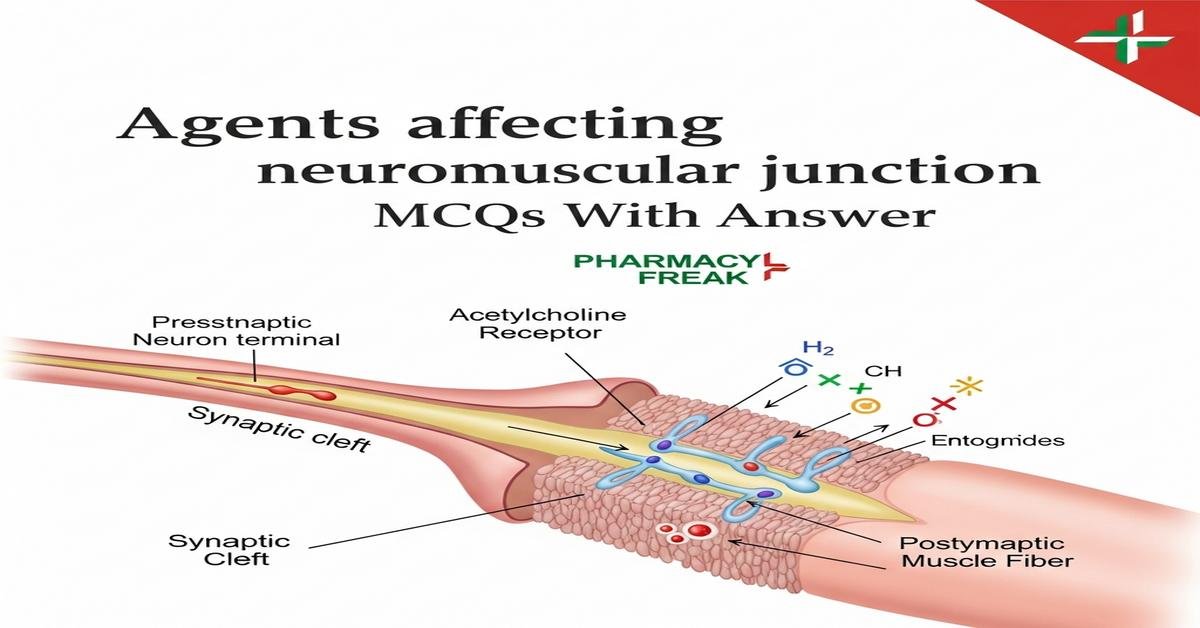
Introduction: This quiz collection on Agents Affecting the Neuromuscular Junction is designed for M.Pharm students preparing for Advanced Pharmacology-I. It focuses on mechanisms, pharmacokinetics, clinical applications, adverse effects, monitoring, and drug interactions at the neuromuscular junction. Questions probe deeper concepts such as depolarizing versus nondepolarizing blockade, reversal strategies (cholinesterase inhibitors and sugammadex), special situations (pseudocholinesterase deficiency, malignant hyperthermia), presynaptic modulators (aminoglycosides, magnesium), and toxins (organophosphates, botulinum). Each MCQ tests applied knowledge relevant to therapeutics, perioperative management, and toxicology to help consolidate pharmacologic principles and prepare for postgraduate examinations and clinical decision-making.
Q1. Which of the following is a depolarizing neuromuscular blocker commonly used for rapid sequence induction?
- Succinylcholine (suxamethonium)
- Rocuronium
- Neostigmine
- Botulinum toxin
Correct Answer: Succinylcholine (suxamethonium)
Q2. What is the primary mechanism by which sugammadex reverses neuromuscular blockade?
- Encapsulation and inactivation of steroidal neuromuscular blockers such as rocuronium
- Inhibition of acetylcholinesterase to increase acetylcholine at the motor endplate
- Competitive antagonism at the nicotinic acetylcholine receptor
- Increasing presynaptic release of acetylcholine
Correct Answer: Encapsulation and inactivation of steroidal neuromuscular blockers such as rocuronium
Q3. How does neostigmine reverse nondepolarizing neuromuscular blockade?
- Inhibiting acetylcholinesterase to increase acetylcholine concentration at the neuromuscular junction
- Directly displacing the blocker from the nicotinic receptor
- Blocking presynaptic potassium channels to increase release of acetylcholine
- Binding to and inactivating the neuromuscular blocker in plasma
Correct Answer: Inhibiting acetylcholinesterase to increase acetylcholine concentration at the neuromuscular junction
Q4. Which statement best characterizes a Phase II block produced by prolonged succinylcholine exposure?
- It resembles nondepolarizing blockade with fade on train-of-four and is poorly reversed by acetylcholinesterase inhibitors
- It is an exaggerated Phase I depolarizing block with persistent fasciculations and no fade
- It is rapidly reversed by small doses of succinylcholine
- It increases pseudocholinesterase activity and shortens blockade duration
Correct Answer: It resembles nondepolarizing blockade with fade on train-of-four and is poorly reversed by acetylcholinesterase inhibitors
Q5. A patient with pseudocholinesterase deficiency will have prolonged blockade after administration of which drug?
- Succinylcholine (suxamethonium)
- Rocuronium
- Vecuronium
- Neostigmine
Correct Answer: Succinylcholine (suxamethonium)
Q6. In acute organophosphate poisoning presenting with cholinergic crisis, the recommended pharmacologic treatment includes which combination?
- Atropine plus pralidoxime (an oxime) to antagonize muscarinic effects and reactivate acetylcholinesterase
- Neostigmine and physostigmine to competitively inhibit organophosphate binding
- Sugammadex and atropine to encapsulate toxins and block muscarinic receptors
- Dantrolene and neostigmine to reduce muscle rigidity and increase acetylcholine
Correct Answer: Atropine plus pralidoxime (an oxime) to antagonize muscarinic effects and reactivate acetylcholinesterase
Q7. Botulinum toxin causes neuromuscular blockade by which mechanism?
- Cleaving SNARE proteins to prevent acetylcholine vesicle fusion and release
- Inhibiting acetylcholinesterase at the synaptic cleft
- Blocking postsynaptic nicotinic receptors competitively
- Increasing presynaptic calcium influx and depleting vesicles
Correct Answer: Cleaving SNARE proteins to prevent acetylcholine vesicle fusion and release
Q8. How do aminoglycoside antibiotics potentiate neuromuscular blockade?
- Inhibiting presynaptic calcium entry and reducing acetylcholine release
- Enhancing postsynaptic nicotinic receptor sensitivity to acetylcholine
- Activating acetylcholinesterase to degrade acetylcholine more rapidly
- Directly depolarizing the motor endplate causing Phase I block
Correct Answer: Inhibiting presynaptic calcium entry and reducing acetylcholine release
Q9. Which of the following is a steroidal nondepolarizing neuromuscular blocker?
- Rocuronium
- Atracurium
- Succinylcholine
- Dantrolene
Correct Answer: Rocuronium
Q10. The drug of choice for treating malignant hyperthermia is which agent?
- Dantrolene, which inhibits ryanodine receptor-mediated calcium release from the sarcoplasmic reticulum
- Neostigmine to increase neuromuscular transmission
- Atropine to block muscarinic effects
- Sugammadex to encapsulate triggering agents
Correct Answer: Dantrolene, which inhibits ryanodine receptor-mediated calcium release from the sarcoplasmic reticulum
Q11. Which monitoring technique is most appropriate for assessing depth of neuromuscular blockade intraoperatively?
- Train-of-four stimulation using a peripheral nerve stimulator
- Bispectral index (BIS) monitoring of consciousness
- Pulse oximetry alone
- Capnography waveform analysis
Correct Answer: Train-of-four stimulation using a peripheral nerve stimulator
Q12. Which agent provides rapid and specific reversal of rocuronium-induced blockade by direct binding in plasma?
- Sugammadex
- Neostigmine
- Physostigmine
- Atropine
Correct Answer: Sugammadex
Q13. Edrophonium is best described as which of the following in the context of myasthenia gravis diagnosis?
- Short-acting acetylcholinesterase inhibitor used diagnostically to transiently improve muscle strength
- Long-acting irreversible acetylcholinesterase inhibitor used for chronic therapy
- Presynaptic calcium channel blocker that increases acetylcholine release
- Competitive nicotinic receptor antagonist used to confirm neuromuscular blockade
Correct Answer: Short-acting acetylcholinesterase inhibitor used diagnostically to transiently improve muscle strength
Q14. Why is pyridostigmine preferred for long-term management of myasthenia gravis compared to neostigmine?
- It has a longer duration of action and is suitable for oral administration for chronic therapy
- It crosses the blood–brain barrier producing central cholinergic benefits
- It irreversibly inhibits acetylcholinesterase, providing sustained effect
- It directly stimulates nicotinic receptors independent of acetylcholine
Correct Answer: It has a longer duration of action and is suitable for oral administration for chronic therapy
Q15. Which statement best describes a Phase I neuromuscular block produced by succinylcholine?
- Sustained depolarization of the motor endplate causing fasciculations and absence of fade on train-of-four; not reversed by acetylcholinesterase inhibitors
- Resembles a nondepolarizing block with fade and responds well to neostigmine
- Is mediated by antibody-induced receptor internalization as in myasthenia gravis
- Results from presynaptic inhibition of acetylcholine vesicle release
Correct Answer: Sustained depolarization of the motor endplate causing fasciculations and absence of fade on train-of-four; not reversed by acetylcholinesterase inhibitors
Q16. How does magnesium sulfate influence neuromuscular transmission when used perioperatively?
- It reduces presynaptic calcium influx, decreasing acetylcholine release and potentiating neuromuscular blockade
- It increases acetylcholine synthesis and antagonizes neuromuscular blockers
- It directly activates postsynaptic nicotinic receptors to reverse blockade
- It enhances plasma cholinesterase activity shortening succinylcholine action
Correct Answer: It reduces presynaptic calcium influx, decreasing acetylcholine release and potentiating neuromuscular blockade
Q17. Which nondepolarizing neuromuscular blocker is a benzylisoquinolinium compound that undergoes Hofmann elimination and organ-independent degradation?
- Cisatracurium
- Rocuronium
- Pancuronium
- Succinylcholine
Correct Answer: Cisatracurium
Q18. Pralidoxime (2-PAM) reverses organophosphate inhibition of acetylcholinesterase by which mechanism?
- Hydrolyzing the covalent bond between the organophosphate and acetylcholinesterase before the enzyme–inhibitor complex ages
- Competitively inhibiting muscarinic receptors to block cholinergic signs
- Inhibiting acetylcholinesterase further to protect the enzyme
- Binding irreversibly to acetylcholine to prevent overstimulation
Correct Answer: Hydrolyzing the covalent bond between the organophosphate and acetylcholinesterase before the enzyme–inhibitor complex ages
Q19. Which adverse effect is most commonly associated with administration of neostigmine as a reversal agent?
- Bradycardia and increased bronchial secretions due to muscarinic stimulation
- Hypertension and tachycardia due to sympathetic activation
- Nephrotoxicity with oliguria
- Direct myotoxicity with persistent weakness
Correct Answer: Bradycardia and increased bronchial secretions due to muscarinic stimulation
Q20. Which statement best describes therapeutic uses of botulinum toxin in clinical practice?
- Local injection blocks acetylcholine release and is used for focal dystonias, spasticity, cosmetic reduction of wrinkles, and hyperhidrosis
- Systemic infusion enhances acetylcholine release to treat myasthenia gravis
- Topical application reverses organophosphate poisoning by restoring acetylcholinesterase activity
- Oral administration is used for long-term management of neuromuscular blockade
Correct Answer: Local injection blocks acetylcholine release and is used for focal dystonias, spasticity, cosmetic reduction of wrinkles, and hyperhidrosis

