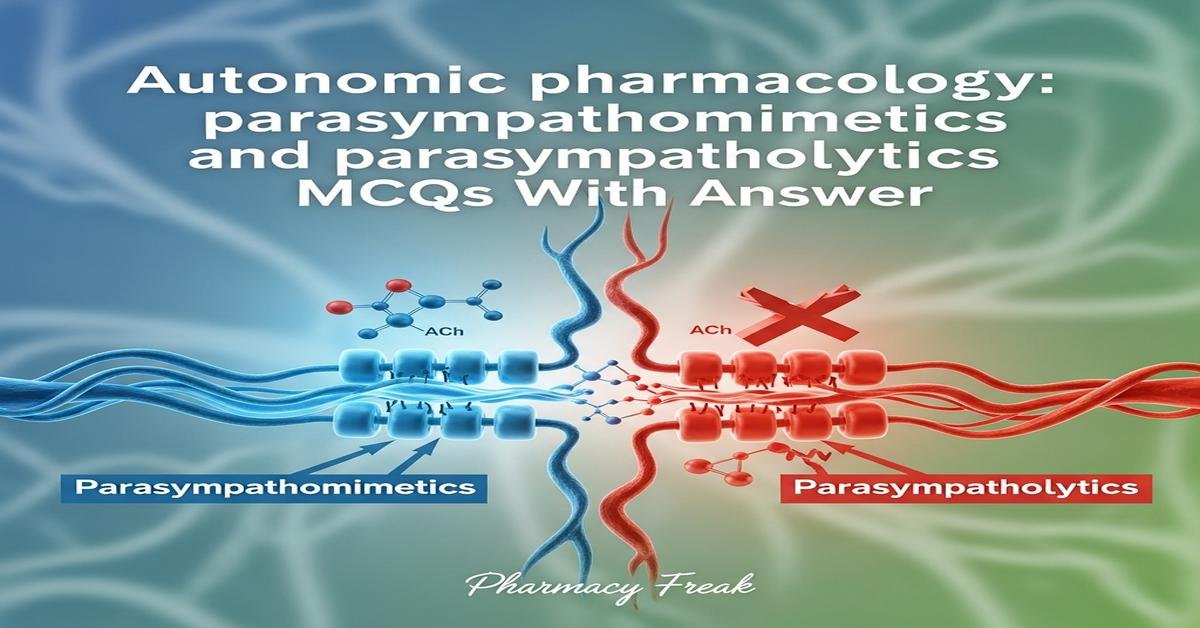
Introduction: This quiz collection focuses on parasympathomimetics and parasympatholytics — key areas in autonomic pharmacology for M.Pharm students. It covers receptor pharmacology (M1–M5, nicotinic subtypes), direct and indirect cholinomimetics, reversible and irreversible cholinesterase inhibitors, clinical uses (glaucoma, myasthenia gravis, Alzheimer’s, COPD, overactive bladder), adverse effects, toxicology and antidotes. Questions emphasize mechanism-of-action, pharmacokinetics (tertiary vs quaternary amines), drug selection in specific clinical contexts, and important drug interactions. These MCQs are designed to deepen conceptual understanding and prepare you for advanced pharmacology assessments and clinical reasoning in therapeutics.
Q1. Which drug is a direct muscarinic agonist specifically used to promote bladder contraction in postoperative urinary retention and is resistant to acetylcholinesterase?
- Bethanechol
- Pilocarpine
- Carbachol
- Muscarine
Correct Answer: Bethanechol
Q2. Which cholinesterase inhibitor crosses the blood–brain barrier and is the preferred antidote for severe central anticholinergic toxicity?
- Neostigmine
- Physostigmine
- Edrophonium
- Pralidoxime (2-PAM)
Correct Answer: Physostigmine
Q3. Which statement best describes the mechanism of action of pilocarpine in glaucoma?
- It inhibits aqueous humor production by ciliary epithelium via beta blockade
- It stimulates M3 receptors causing ciliary muscle contraction and increases trabecular outflow
- It blocks M3 receptors to reduce pupillary constriction and improve outflow
- It is an alpha-2 agonist that reduces intraocular pressure by decreasing aqueous secretion
Correct Answer: It stimulates M3 receptors causing ciliary muscle contraction and increases trabecular outflow
Q4. Which antimuscarinic agent is a quaternary amine used by inhalation for COPD and has minimal systemic CNS effects?
- Atropine
- Ipratropium
- Scopolamine
- Oxybutynin
Correct Answer: Ipratropium
Q5. A patient with myasthenia gravis shows improved muscle strength after intravenous drug administration; which reversible cholinesterase inhibitor is most commonly used for diagnostic edrophonium test historically and has very short duration?
- Neostigmine
- Edrophonium
- Pyridostigmine
- Donepezil
Correct Answer: Edrophonium
Q6. Which property distinguishes tertiary amine antimuscarinic drugs from quaternary amines clinically?
- Tertiary amines are longer acting at peripheral receptors than quaternary amines
- Tertiary amines cross the blood–brain barrier and may produce central effects
- Tertiary amines exclusively block nicotinic receptors while quaternary amines block muscarinic receptors
- Tertiary amines are always irreversible antagonists of muscarinic receptors
Correct Answer: Tertiary amines cross the blood–brain barrier and may produce central effects
Q7. Which receptor subtype is primarily responsible for slowing heart rate and decreasing AV nodal conduction when stimulated by acetylcholine?
- M1 (neural)
- M2 (cardiac)
- M3 (glandular/smooth muscle)
- Nn (neuronal nicotinic)
Correct Answer: M2 (cardiac)
Q8. Which drug is an irreversible acetylcholinesterase inhibitor used topically for chronic open-angle glaucoma and can cause prolonged miosis?
- Physostigmine
- Echothiophate
- Neostigmine
- Galantamine
Correct Answer: Echothiophate
Q9. Organophosphate poisoning typically produces muscarinic and nicotinic symptoms; which combination is the correct immediate pharmacologic management?
- Atropine and benzodiazepines
- Atropine and pralidoxime (2-PAM)
- Neostigmine and physostigmine
- Propranolol and naloxone
Correct Answer: Atropine and pralidoxime (2-PAM)
Q10. Which antimuscarinic drug is preferred for motion sickness due to its pronounced central effects and ability to prevent vestibular disturbances?
- Ipratropium
- Glycopyrrolate
- Scopolamine
- Tiotropium
Correct Answer: Scopolamine
Q11. Which statement about carbachol is correct?
- It is a selective M3 agonist used systemically for urinary retention
- It is resistant to acetylcholinesterase and activates both muscarinic and nicotinic receptors
- It is a reversible acetylcholinesterase inhibitor used in Alzheimer’s disease
- It is a quaternary antimuscarinic used to decrease secretions
Correct Answer: It is resistant to acetylcholinesterase and activates both muscarinic and nicotinic receptors
Q12. Which antimuscarinic is commonly used to reduce drooling and perioperative secretions without crossing the blood–brain barrier?
- Glycopyrrolate
- Atropine
- Scopolamine
- Oxybutynin
Correct Answer: Glycopyrrolate
Q13. A patient on donepezil for Alzheimer’s complains of bradycardia and increased GI cramps. What is the pharmacologic explanation?
- Donepezil is an M3 antagonist causing rebound parasympathetic activity
- Donepezil is a central and peripheral reversible cholinesterase inhibitor that increases acetylcholine at muscarinic receptors
- Donepezil is an irreversible organophosphate that causes long-lasting parasympathetic excess
- Donepezil blocks nicotinic receptors in autonomic ganglia leading to vagal activation
Correct Answer: Donepezil is a central and peripheral reversible cholinesterase inhibitor that increases acetylcholine at muscarinic receptors
Q14. Which antimuscarinic drug is most appropriate for treating overactive bladder with preference for M3 receptor antagonism and is used orally?
- Tiotropium
- Tolterodine
- Ipratropium
- Scopolamine
Correct Answer: Tolterodine
Q15. Which of the following best explains why pralidoxime (2-PAM) may fail to reactivate acetylcholinesterase in organophosphate poisoning?
- Pralidoxime cannot reach muscarinic receptors in the heart
- Aging of the phosphorylated enzyme has occurred, making reactivation impossible
- Pralidoxime is only effective against carbamate poisoning, not organophosphates
- Pralidoxime is an acetylcholinesterase substrate and is competitively inhibited
Correct Answer: Aging of the phosphorylated enzyme has occurred, making reactivation impossible
Q16. Which drug is best for reversing neuromuscular blockade produced by nondepolarizing neuromuscular blockers during anesthesia?
- Pralidoxime
- Neostigmine (often with atropine/glycopyrrolate)
- Succinylcholine
- Pilocarpine
Correct Answer: Neostigmine (often with atropine/glycopyrrolate)
Q17. Blockade of which receptor subtype by antimuscarinic drugs is primarily responsible for precipitating acute urinary retention in susceptible patients?
- M1 receptors in autonomic ganglia
- M2 receptors in the heart
- M3 receptors in bladder detrusor muscle
- Nn receptors at the neuromuscular junction
Correct Answer: M3 receptors in bladder detrusor muscle
Q18. Which feature distinguishes organophosphate (irreversible AChE inhibitor) poisoning from poisoning with reversible AChE inhibitors clinically?
- Organophosphates cause predominantly CNS stimulation without peripheral signs
- Organophosphates produce long-lasting inhibition and require regeneration or aging considerations; pralidoxime can reactivate if given early
- Reversible inhibitors always cause nicotinic blockade without muscarinic signs
- Reversible inhibitors cause permanent AChE inactivation similar to organophosphates
Correct Answer: Organophosphates produce long-lasting inhibition and require regeneration or aging considerations; pralidoxime can reactivate if given early
Q19. Which combination of effects is typical for systemic atropine overdose?
- Bradycardia, salivation, bronchorrhea, miosis
- Tachycardia, dry mouth, blurred vision (mydriasis), urinary retention
- Hypotension, lacrimation, diarrhea, bronchoconstriction
- Muscle fasciculations, sweating, pinpoint pupils
Correct Answer: Tachycardia, dry mouth, blurred vision (mydriasis), urinary retention
Q20. Which nicotinic receptor subtype is primarily located at the autonomic ganglia and adrenal medulla, mediating fast synaptic transmission there?
- Nm (muscle-type) at neuromuscular junction
- Nn (neuronal) at autonomic ganglia and adrenal medulla
- M3 at smooth muscle
- Alpha-2 adrenergic receptor in presynaptic nerve terminals
Correct Answer: Nn (neuronal) at autonomic ganglia and adrenal medulla

