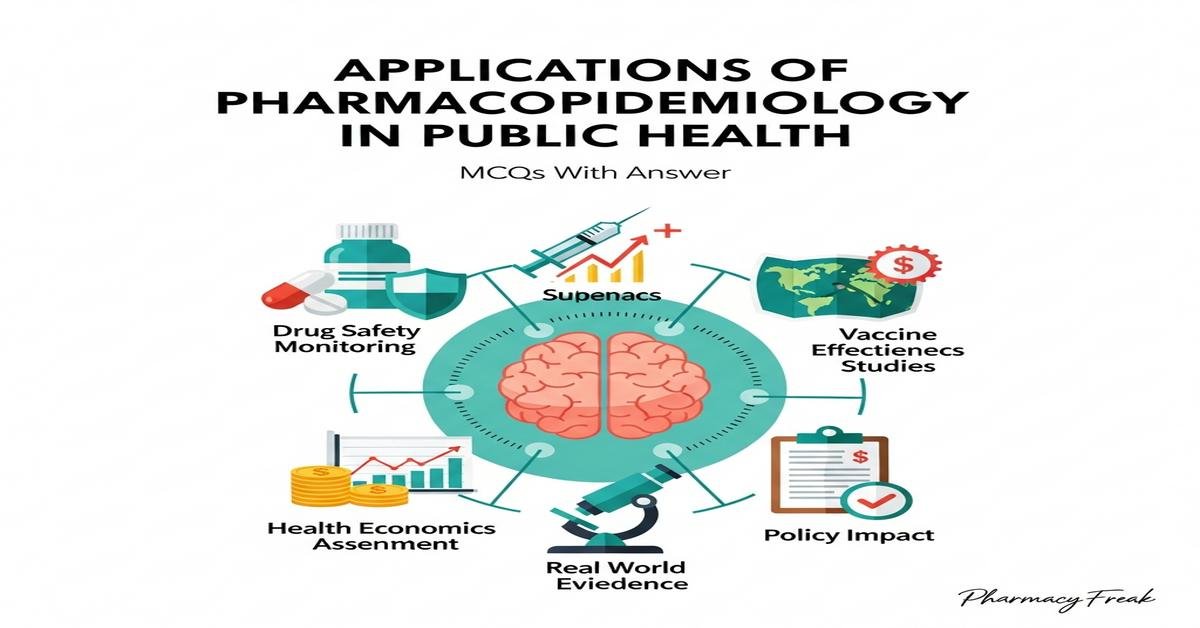
Introduction: Applications of pharmacoepidemiology in public health MCQs With Answer is designed for M.Pharm students to strengthen understanding of how pharmacoepidemiology informs population-level medicine use, safety, and policy. This set focuses on real-world applications — post-marketing surveillance, drug utilization studies, risk–benefit assessment, vaccine safety monitoring, antibiotic stewardship, and methods to reduce bias in observational studies. Questions emphasize interpretation of data sources such as electronic health records, claims databases, and registries, plus analytical approaches like cohort and case–control designs, propensity scoring, and new-user designs. These MCQs bridge theory and public health practice to prepare students for research, regulatory roles, and clinical decision-making.
Q1. What is the primary role of pharmacoepidemiology in public health?
- To develop new molecular drugs in the laboratory
- To assess patterns, causes, and effects of drug use and outcomes in populations
- To replace randomized controlled trials as the only source of evidence
- To manufacture medications at scale
Correct Answer: To assess patterns, causes, and effects of drug use and outcomes in populations
Q2. Which data source is most commonly used for large-scale post-marketing safety studies in pharmacoepidemiology?
- Phase I clinical trial reports
- Electronic health records and administrative claims databases
- Preclinical animal study data
- Patient focus group transcripts
Correct Answer: Electronic health records and administrative claims databases
Q3. What is ‘signal detection’ in the context of pharmacovigilance?
- The process of designing randomized trials
- Identifying potential safety issues from spontaneous reports or data mining
- Signal processing of laboratory instruments
- Marketing campaigns for new drugs
Correct Answer: Identifying potential safety issues from spontaneous reports or data mining
Q4. Which study design is best suited to estimate incidence rates of adverse drug reactions in a defined population?
- Case report
- Cohort study
- Case series
- Expert opinion survey
Correct Answer: Cohort study
Q5. In pharmacoepidemiology, what is the purpose of a ‘new-user design’?
- To include only prevalent long-term users
- To study initiation of therapy and reduce bias from prior use
- To ensure random allocation of treatment
- To analyze drug production batches
Correct Answer: To study initiation of therapy and reduce bias from prior use
Q6. Which approach is commonly used to adjust for measured confounding in observational pharmacoepidemiologic studies?
- Intention-to-treat analysis
- Propensity score methods
- Blinding of participants
- Random allocation
Correct Answer: Propensity score methods
Q7. How does pharmacoepidemiology contribute to antibiotic stewardship programs?
- By promoting over-the-counter antibiotic sales
- By analyzing prescribing patterns and resistance trends to inform interventions
- By developing new antibiotic molecules
- By providing individual-level genetic testing for resistance
Correct Answer: By analyzing prescribing patterns and resistance trends to inform interventions
Q8. Which metric is used in drug utilization research to compare population-level exposure across regions?
- Defined daily dose (DDD) per 1,000 inhabitants per day
- Number needed to treat (NNT)
- IC50 values from in vitro assays
- Median lethal dose (LD50)
Correct Answer: Defined daily dose (DDD) per 1,000 inhabitants per day
Q9. What is a major limitation of spontaneous adverse event reporting systems?
- They capture complete denominator data for incidence calculation
- They are immune to reporting biases
- Under-reporting and lack of reliable exposure data
- They replace the need for pharmacoepidemiologic studies
Correct Answer: Under-reporting and lack of reliable exposure data
Q10. Which methodological tool helps reduce immortal time bias in pharmacoepidemiologic studies?
- Including prevalent users only
- Time-varying exposure definitions and appropriate cohort entry
- Ignoring follow-up duration
- Using only cross-sectional data
Correct Answer: Time-varying exposure definitions and appropriate cohort entry
Q11. How can pharmacoepidemiology inform vaccine safety monitoring during mass immunization programs?
- By using ecological and self-controlled case series designs to detect temporal associations
- By replacing clinical trials entirely for licensure
- By focusing only on pre-licensure animal studies
- By increasing vaccine manufacturing speed
Correct Answer: By using ecological and self-controlled case series designs to detect temporal associations
Q12. What is the main objective of pregnancy exposure registries in pharmacoepidemiology?
- To evaluate drug stability during storage
- To assess maternal and fetal outcomes after drug exposure in pregnancy
- To randomize pregnant women to new treatments
- To monitor vaccine cold-chain integrity
Correct Answer: To assess maternal and fetal outcomes after drug exposure in pregnancy
Q13. Which pharmacoepidemiologic approach is particularly useful for evaluating transient effects after vaccination or drug exposure?
- Cross-sectional survey
- Self-controlled case series
- Prospective randomized trial
- Meta-analysis of animal studies
Correct Answer: Self-controlled case series
Q14. In regulatory decision-making, pharmacoepidemiology provides evidence primarily for which purpose?
- Determining molecular drug targets
- Post-marketing safety surveillance and label changes
- Designing preclinical toxicity studies
- Optimizing manufacturing workflows
Correct Answer: Post-marketing safety surveillance and label changes
Q15. Which bias is introduced when healthier patients are more likely to receive a treatment, confounding treatment-outcome associations?
- Selection bias due to healthy user effect
- Observer bias in laboratory assays
- Reporting bias in spontaneous reports
- Publication bias in journals
Correct Answer: Selection bias due to healthy user effect
Q16. How does linking multiple data sources (EHR, claims, registries) strengthen pharmacoepidemiologic studies?
- It guarantees elimination of confounding
- It enhances outcome ascertainment, exposure measurement, and confounder control
- It simplifies analysis by reducing variables
- It makes randomized trials unnecessary
Correct Answer: It enhances outcome ascertainment, exposure measurement, and confounder control
Q17. In the context of a pandemic, what role can pharmacoepidemiology play?
- Only theoretical modeling unrelated to medications
- Rapid assessment of real-world effectiveness and safety of therapeutics and vaccines
- Designing small preclinical studies
- Producing personal protective equipment
Correct Answer: Rapid assessment of real-world effectiveness and safety of therapeutics and vaccines
Q18. Which analytic measure helps quantify absolute public health impact of an adverse drug effect?
- Relative risk only
- Number needed to harm (NNH) or attributable risk
- Hazard ratio without incidence context
- In vitro inhibitory concentration
Correct Answer: Number needed to harm (NNH) or attributable risk
Q19. Why are pharmacoepidemiologic studies important for vulnerable populations (children, elderly, pregnant women)?
- They are usually over-represented in randomized trials
- They provide safety and effectiveness data where pre-licensure evidence is limited
- They ensure drugs are only marketed to these groups
- They replace clinical judgment entirely
Correct Answer: They provide safety and effectiveness data where pre-licensure evidence is limited
Q20. What is the advantage of active surveillance systems compared with passive spontaneous reporting?
- Active surveillance is cheaper and requires no infrastructure
- Active surveillance systematically seeks events, improving completeness and timeliness of safety signals
- Active surveillance eliminates confounding without analytic methods
- Active surveillance relies solely on media reports
Correct Answer: Active surveillance systematically seeks events, improving completeness and timeliness of safety signals

