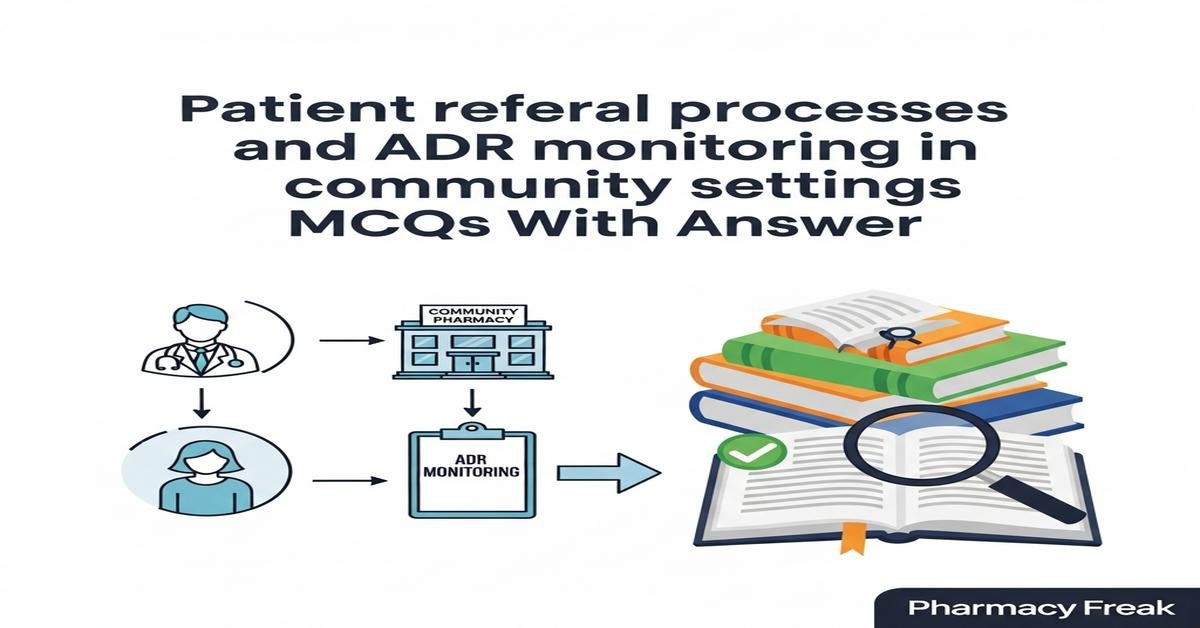
Introduction:
This quiz set focuses on patient referral processes and adverse drug reaction (ADR) monitoring in community settings, tailored for M.Pharm students. It reinforces clinical decision-making, documentation standards, communication pathways, and ethical-legal responsibilities involved in referring patients from community pharmacies to higher levels of care. The ADR section emphasizes pharmacovigilance principles applicable in community practice: identification, documentation, causality assessment, reporting mechanisms (national and international), and signal detection methods. Questions are designed to deepen understanding of practical workflows, referral letter content, triage criteria, reporting timelines, and tools such as WHO-UMC and Naranjo scales. Use these MCQs to test and expand competency in safe patient transfer and vigilant ADR management.
Q1. Which of the following is the most essential element that must be included in a community-to-hospital referral letter?
- Patient’s family income
- Comprehensive medication list including doses and recent changes
- Pharmacy opening hours
- Name of the dispensing pharmacist only
Correct Answer: Comprehensive medication list including doses and recent changes
Q2. In a community pharmacy setting, which situation most clearly requires immediate referral to emergency care?
- Patient requesting a repeat antibiotic without prescription
- New onset chest pain with diaphoresis and shortness of breath
- Mild transient headache after starting antihypertensive
- Chronic knee pain worsening over months
Correct Answer: New onset chest pain with diaphoresis and shortness of breath
Q3. Which communication method best ensures traceable and timely handover when referring a patient to a secondary care physician?
- Verbally telling the patient to see a doctor
- Sending a structured electronic referral with clinical summary and contact details
- Writing a note on the prescription pad without contact information
- Posting the referral letter by regular mail
Correct Answer: Sending a structured electronic referral with clinical summary and contact details
Q4. In pharmacovigilance, which classification denotes an ADR that results in death, is life-threatening, requires hospitalization, or causes persistent disability?
- Unavoidable ADR
- Serious ADR
- Minor ADR
- Probable ADR
Correct Answer: Serious ADR
Q5. Which causality assessment method is commonly used globally and classifies ADRs into categories such as certain, probable, possible, unlikely, conditional/unclassified, and unassessable/unclassifiable?
- Naranjo Algorithm
- WHO-UMC causality assessment system
- MedDRA coding system
- PRR disproportionality method
Correct Answer: WHO-UMC causality assessment system
Q6. For a community pharmacist reporting a suspected serious ADR to the national pharmacovigilance program, which of the following is the most appropriate timeframe for initial reporting if local regulations require prompt action?
- Within 24 hours
- Within 7–14 days
- Within 6 months
- Only at yearly audits
Correct Answer: Within 7–14 days
Q7. Which of the following best describes ‘signal detection’ in pharmacovigilance applied to community ADR reports?
- Identifying a previously unknown or incompletely documented adverse reaction from aggregated reports
- Immediate treatment of an allergic reaction in the pharmacy
- Replacing a prescribed medicine with an OTC product
- Counting prescription volumes for inventory control
Correct Answer: Identifying a previously unknown or incompletely documented adverse reaction from aggregated reports
Q8. What is the primary role of MedDRA in ADR reporting?
- Quantifying drug potency
- Providing a standardized medical terminology for coding adverse events
- Measuring adherence to therapy
- Assessing financial impact of ADRs
Correct Answer: Providing a standardized medical terminology for coding adverse events
Q9. Which statement best reflects the difference between ‘seriousness’ and ‘severity’ of an ADR?
- Severity refers to causality; seriousness refers to time of onset
- Seriousness is regulatory (hospitalization, death); severity describes intensity (mild, moderate, severe)
- They are synonymous and interchangeable
- Severity is assessed only by the patient’s opinion; seriousness only by the pharmacist
Correct Answer: Seriousness is regulatory (hospitalization, death); severity describes intensity (mild, moderate, severe)
Q10. When assessing a suspected ADR with the Naranjo algorithm, which type of information will increase the Naranjo score?
- Presence of an alternative cause that explains the event
- Event occurring after the drug was discontinued
- Positive rechallenge reproducing the reaction
- Unknown temporal relationship to drug administration
Correct Answer: Positive rechallenge reproducing the reaction
Q11. In community referral feedback loops, which practice most improves continuity of care after a pharmacist refers a patient to a physician?
- Never following up once referral is sent
- Requesting and documenting discharge or management feedback from the receiving clinician
- Giving verbal instructions to the patient only
- Assuming the patient will inform the pharmacist of outcomes
Correct Answer: Requesting and documenting discharge or management feedback from the receiving clinician
Q12. Which of the following best describes a key ethical consideration when reporting ADRs from community practice?
- Publishing patient identifiers in public signal reports
- Ensuring patient confidentiality and obtaining consent when required for identifiable data
- Refusing to report ADRs without written legal counsel
- Only reporting ADRs for expensive medications
Correct Answer: Ensuring patient confidentiality and obtaining consent when required for identifiable data
Q13. Which pharmacovigilance database is the WHO global repository that contains individual case safety reports (ICSRs) submitted by national centers?
- VigiBase
- ClinicalTrials.gov
- PubMed
- RxNorm
Correct Answer: VigiBase
Q14. What is the most appropriate immediate action by a community pharmacist when a patient presents with signs of anaphylaxis after medication intake?
- Advise to rest and come back if symptoms worsen
- Administer or assist with intramuscular epinephrine and call emergency services
- Record the event and report to pharmacovigilance later
- Recommend oral antihistamine and discharge
Correct Answer: Administer or assist with intramuscular epinephrine and call emergency services
Q15. Which element is NOT typically used in formal triage protocols in community pharmacy referrals?
- Vital signs or symptom severity indicators
- Red flag symptom checklist
- Pharmacist’s assessment of medication-related risk
- Pharmacist’s personal opinion about the prescribing physician’s competence
Correct Answer: Pharmacist’s personal opinion about the prescribing physician’s competence
Q16. When reporting an ADR to a national center, which data element most improves causality assessment?
- Patient’s favorite color
- Temporal relationship between drug administration and onset of reaction
- Retail price of the medication
- Number of times pharmacy was visited
Correct Answer: Temporal relationship between drug administration and onset of reaction
Q17. Which disproportionality measure is commonly used in signal detection from spontaneous reporting systems to indicate a higher-than-expected reporting rate?
- Relative Risk (RR) for clinical trials only
- Proportional Reporting Ratio (PRR)
- Body Mass Index (BMI)
- Number Needed to Treat (NNT)
Correct Answer: Proportional Reporting Ratio (PRR)
Q18. In a community setting, which of the following is the best practice for preventing medication-related referrals and ADRs?
- Avoid counseling to save time
- Perform structured medication review, check interactions, and counsel on adverse effects and adherence
- Recommend multiple over-the-counter alternatives without checking prescriptions
- Provide advice only when the patient directly requests it
Correct Answer: Perform structured medication review, check interactions, and counsel on adverse effects and adherence
Q19. What is the role of the pharmacist in reporting an ADR under the Pharmacovigilance Programme of India (PvPI)?
- Only physicians can report to PvPI
- Pharmacists are encouraged to report suspected ADRs using the suspected ADR reporting form or online portal
- Pharmacists should report only if the ADR is confirmed by a hospital
- Reporting is prohibited for community pharmacists
Correct Answer: Pharmacists are encouraged to report suspected ADRs using the suspected ADR reporting form or online portal
Q20. Which of the following best describes a practical quality improvement metric for community ADR reporting activities?
- Number of prescriptions dispensed per day
- Proportion of suspected ADRs reported to the national center relative to the number identified locally and the completeness/quality of each report
- Average waiting time in the pharmacy queue
- Stock turnover rate of common OTC analgesics
Correct Answer: Proportion of suspected ADRs reported to the national center relative to the number identified locally and the completeness/quality of each report

