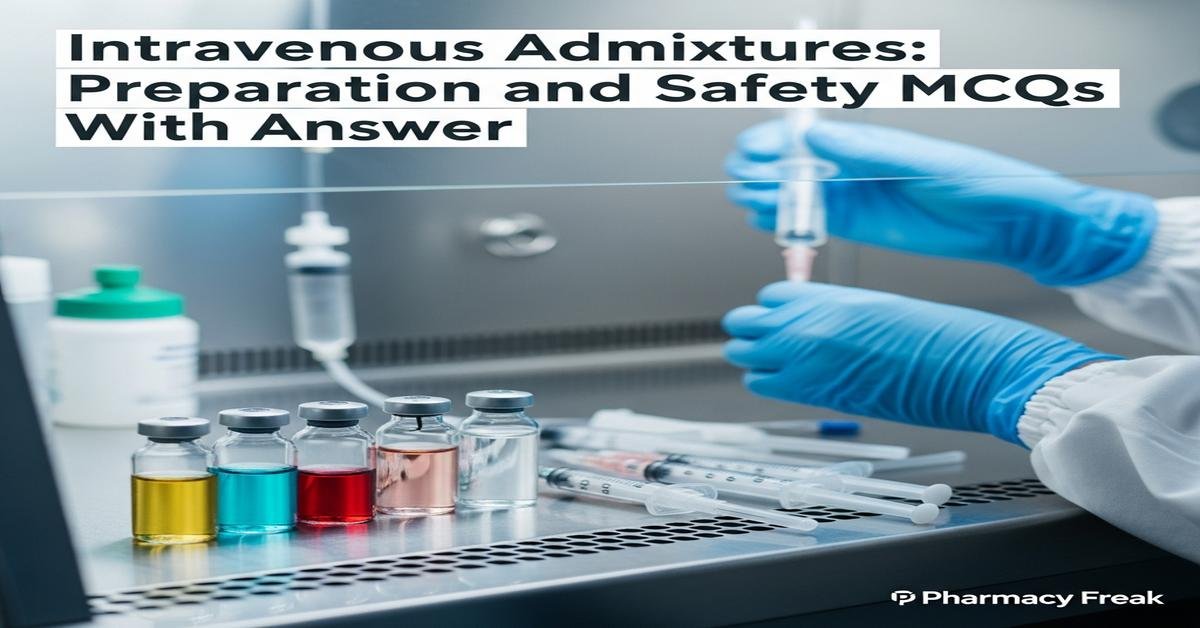
Intravenous admixtures: preparation and safety MCQs With Answer
This quiz collection is tailored for M.Pharm students studying Hospital & Community Pharmacy (MPP 103T). It focuses on sterile intravenous (IV) admixture practices, covering aseptic technique, environmental controls, incompatibilities, stability, labeling, PPE, hazardous drug handling, and regulatory standards such as USP guidance. Questions emphasize practical decision-making: selecting correct diluents, preventing contamination, identifying appropriate engineering controls, and recognizing common incompatibilities and risks (particulates, precipitation, adsorption, photodegradation). Answers are provided to reinforce learning and clinical application. Use these MCQs for revision, class discussion, or exam preparation to deepen understanding of safe IV admixture preparation and risk mitigation in hospital pharmacy practice.
Q1. Which statement best defines an intravenous (IV) admixture in hospital pharmacy practice?
- A sterile product manufactured by pharmaceutical companies for IV use only
- A compounded parenteral product formed by mixing two or more sterile components under aseptic conditions for intravenous administration
- An oral medication dissolved into sterile water for injection
- A non-sterile mixture of drugs administered intramuscularly
Correct Answer: A compounded parenteral product formed by mixing two or more sterile components under aseptic conditions for intravenous administration
Q2. What is the required ISO classification for the primary engineering control (PEC) where sterile IV admixtures are prepared according to USP guidance?
- ISO Class 8
- ISO Class 7
- ISO Class 5
- ISO Class 3
Correct Answer: ISO Class 5
Q3. Which personal protective equipment (PPE) configuration is most appropriate when preparing hazardous (cytotoxic) IV admixtures?
- Single pair of non-chemotherapy gloves and a cloth lab coat
- Two pairs of chemotherapy-tested gloves, impermeable gown, and eye/respiratory protection as required
- No gloves but safety glasses and regular gown
- Standard surgical mask only
Correct Answer: Two pairs of chemotherapy-tested gloves, impermeable gown, and eye/respiratory protection as required
Q4. Which in-line filter pore size is recommended for lipid-containing total parenteral nutrition (TPN) infusions?
- 0.22 micron
- 0.45 micron
- 1.2 micron
- 5 micron
Correct Answer: 1.2 micron
Q5. Which change most increases the risk of calcium-phosphate precipitation in parenteral nutrition admixtures?
- Lowering temperature while keeping concentrations low
- Increasing concentrations of calcium and phosphate and raising pH
- Adding trace elements after lipids
- Using glass containers instead of PVC
Correct Answer: Increasing concentrations of calcium and phosphate and raising pH
Q6. Which drug is well known to be lost by adsorption or leaching when stored or infused via PVC infusion sets or bags?
- Nitroglycerin
- Gentamicin
- Heparin
- Vancomycin
Correct Answer: Nitroglycerin
Q7. For immediate-use sterile preparations prepared outside of ISO-classified buffer areas for emergency procedures, what is the maximum beyond-use time (BUD)?
- 24 hours
- 12 hours
- 1 hour
- 48 hours
Correct Answer: 1 hour
Q8. Which disinfectant is routinely recommended for surface disinfection inside ISO Class 5 workbenches prior to sterile compounding?
- Quaternary ammonium compound only
- 70% isopropyl alcohol
- 3% hydrogen peroxide exclusively
- Deionized water
Correct Answer: 70% isopropyl alcohol
Q9. What is the best practice to minimize coring of vial septa when withdrawing medication?
- Use the largest gauge needle available
- Pierce at a very shallow angle every time
- Use a filter needle or blunt cannula designed to prevent coring
- Always pre-warm the vial before puncture
Correct Answer: Use a filter needle or blunt cannula designed to prevent coring
Q10. Which is the most common root cause of particulate contamination in sterile IV admixtures?
- Improper aseptic technique and personnel-related practices
- Use of plastic over glass containers
- Ambient room temperature being too low
- Choice of diluent (D5W vs NS)
Correct Answer: Improper aseptic technique and personnel-related practices
Q11. Ceftriaxone should not be co-administered via Y-site or mixed with which type of solution because of the risk of precipitation?
- Dextrose 5% (D5W)
- Calcium-containing solutions (e.g., Ringer’s lactate)
- Normal saline (0.9% NaCl)
- Sterile water for injection
Correct Answer: Calcium-containing solutions (e.g., Ringer’s lactate)
Q12. Which of the following information is essential and should appear on an IV admixture label prepared for a specific patient?
- Patient name only
- Drug name and concentration only
- Patient name, drug name and concentration, route, beyond-use date, and preparer initials
- Bar code only
Correct Answer: Patient name, drug name and concentration, route, beyond-use date, and preparer initials
Q13. Which environmental factor most directly causes photodegradation of certain IV drugs during storage and administration?
- High ambient humidity
- Exposure to light (UV/visible)
- Low oxygen concentration
- Presence of trace metals
Correct Answer: Exposure to light (UV/visible)
Q14. Which containment device is appropriate for sterile compounding of hazardous (cytotoxic) drugs according to USP guidance?
- Standard horizontal laminar airflow hood (open-front LAF)
- Class II biological safety cabinet (BSC) or Compounding Aseptic Containment Isolator (CACI)
- Class III glove box without negative pressure
- Regular pharmacy bench with local exhaust fan
Correct Answer: Class II biological safety cabinet (BSC) or Compounding Aseptic Containment Isolator (CACI)
Q15. Which assay is commonly used to detect bacterial endotoxins (pyrogens) in parenteral products?
- Culture on blood agar
- Limulus amebocyte lysate (LAL) test
- High-performance liquid chromatography (HPLC)
- pH titration
Correct Answer: Limulus amebocyte lysate (LAL) test
Q16. What is the correct general sequence for sterile garbing before entering an ISO Class 7 buffer area (outer-to-inner sequence)?
- Gown → Mask → Hair cover → Gloves → Hand hygiene
- Hair and shoe covers → Face mask → Hand hygiene → Gown → Sterile gloves
- Sterile gloves → Gown → Mask → Hair cover → Hand hygiene
- Hand hygiene → Shoe covers → Sterile gown → Mask → Gloves
Correct Answer: Hair and shoe covers → Face mask → Hand hygiene → Gown → Sterile gloves
Q17. Which IV drug is classically light-sensitive and typically requires protection from light during preparation and administration?
- Vancomycin
- Nitroprusside
- Heparin
- Cefazolin
Correct Answer: Nitroprusside
Q18. Amphotericin B deoxycholate is typically diluted for IV infusion in which diluent to avoid compatibility issues?
- Normal saline (0.9% NaCl)
- Dextrose 5% in water (D5W)
- Lactated Ringer’s solution
- Sterile water for injection only (for final infusion)
Correct Answer: Dextrose 5% in water (D5W)
Q19. High-efficiency particulate air (HEPA) filters are rated to remove approximately what percentage of particles at 0.3 microns?
- 95%
- 99.97%
- 80%
- 50%
Correct Answer: 99.97%
Q20. Which scenario constitutes high-risk sterile compounding according to standard compounding risk categories?
- Reconstituting a single-dose vial with a sterile diluent in ISO Class 5
- Using non-sterile bulk drug substances to prepare sterile products for multiple patients
- Mixing two commercially available sterile IV bags immediately before administration
- Performing a simple admixture of two sterile products aseptically
Correct Answer: Using non-sterile bulk drug substances to prepare sterile products for multiple patients

