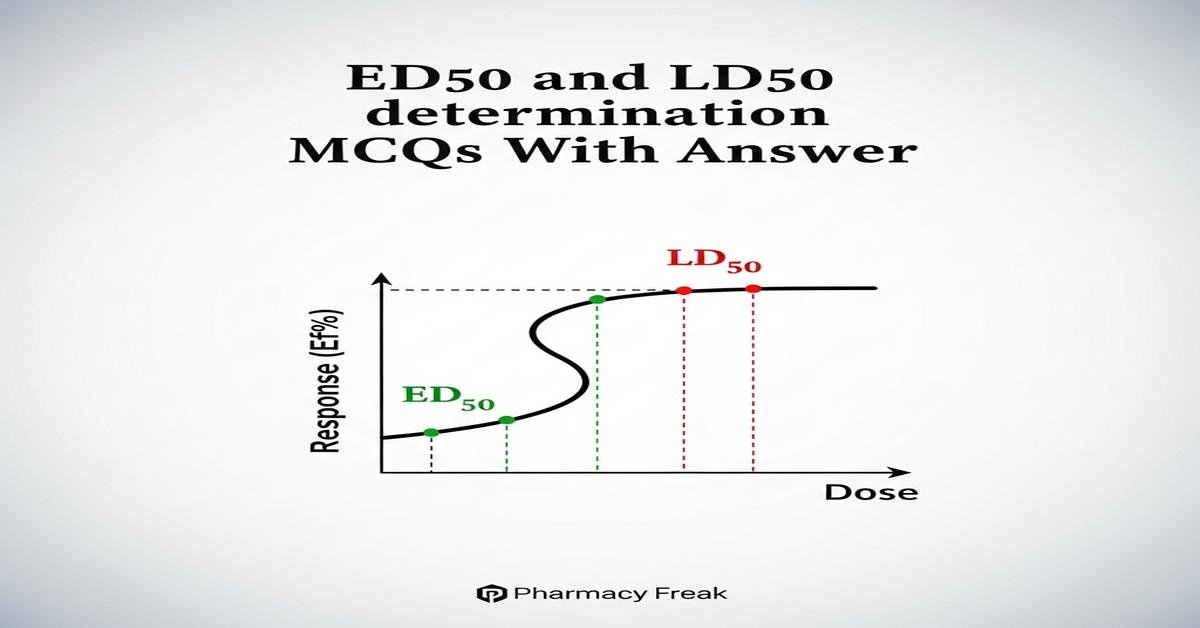
Introduction: This set of MCQs on ED50 and LD50 determination is tailored for M.Pharm students studying Biological Evaluation of Drug Therapy. It focuses on quantitative assessment of drug potency and toxicity, experimental approaches for deriving median effective and lethal doses, and statistical methods used to analyze dose-response relationships. Questions cover conceptual distinctions (quantal vs graded responses), common bioassay techniques (Reed-Muench, Spearman-Kärber, probit analysis, Litchfield-Wilcoxon), interpretation of therapeutic index and safety margin, experimental design considerations, and calculation-related reasoning. The aim is to reinforce both theoretical understanding and practical decision-making skills needed for accurate ED50/LD50 estimation in preclinical research.
Q1. What does ED50 represent in pharmacology?
- The dose at which 50% of subjects experience any adverse effect
- The dose that produces 50% of the maximal graded response
- The dose effective in 50% of a population producing a predefined quantal effect
- The dose that is lethal to 50% of the population
Correct Answer: The dose effective in 50% of a population producing a predefined quantal effect
Q2. Which statistical method transforms percentage responses to a linear relationship for dose-response analysis?
- Non-linear regression without transformation
- Probit analysis
- ANOVA
- Kaplan–Meier estimation
Correct Answer: Probit analysis
Q3. The Reed-Muench method is primarily used to estimate:
- Median inhibitory concentration (IC50) from continuous data
- ED50 or LD50 from quantal (binary) response data
- Area under the curve for pharmacokinetics
- Time-to-event survival data
Correct Answer: ED50 or LD50 from quantal (binary) response data
Q4. Which of the following best distinguishes graded and quantal dose-response measurements?
- Graded responses are measured as present/absent; quantal measure is continuous magnitude
- Quantal responses require smaller sample sizes than graded responses
- Graded responses measure magnitude of effect per subject; quantal responses are binary across subjects
- Quantal responses cannot be analyzed by probit methods
Correct Answer: Graded responses measure magnitude of effect per subject; quantal responses are binary across subjects
Q5. Which index is calculated as LD50 divided by ED50 and used to express drug safety?
- Therapeutic index
- Potency ratio
- Safety coefficient
- Therapeutic window
Correct Answer: Therapeutic index
Q6. When performing LD50 estimation in animals, which ethical alternative is recommended to reduce animal use?
- Use of fixed-dose procedure and humane endpoints
- Increasing the number of animals to improve accuracy
- Using maximum tolerated dose for all animals
- Administering lethal doses to minimize time
Correct Answer: Use of fixed-dose procedure and humane endpoints
Q7. In probit analysis, why is logarithmic transformation of dose commonly applied?
- To convert a non-linear dose-response relationship into a linear form for regression
- To eliminate variability in biological response
- To allow use of parametric t-tests instead of regression
- To make doses additive rather than multiplicative
Correct Answer: To convert a non-linear dose-response relationship into a linear form for regression
Q8. Which method estimates median effective dose by calculating cumulative proportions and interpolation between dose levels?
- Spearman-Kärber method
- Litchfield-Wilcoxon method
- Reed-Muench method
- Kaplan-Meier method
Correct Answer: Reed-Muench method
Q9. What does a steep slope of a dose-response curve around ED50 indicate?
- Small changes in dose produce large changes in response probability
- Poor assay sensitivity to dose changes
- Large inter-individual variability in sensitivity
- The ED50 estimate is unreliable
Correct Answer: Small changes in dose produce large changes in response probability
Q10. The Spearman-Kärber method is particularly useful when:
- Your response data are continuous measurements across subjects
- All dose groups yield exactly 0% or 100% responses only
- Quantal dose-response data are available and you prefer a simple non-parametric estimator
- Probit assumptions (normal tolerance distribution) are strictly met
Correct Answer: Quantal dose-response data are available and you prefer a simple non-parametric estimator
Q11. Which confidence interval reporting is most appropriate when presenting ED50 or LD50 estimates?
- 95% confidence interval around the median estimate
- Interquartile range only
- Standard deviation of individual doses
- No interval needed if a point estimate is given
Correct Answer: 95% confidence interval around the median estimate
Q12. If LD50 is very close to ED50 for a drug, what does that imply clinically?
- The drug has a wide therapeutic margin and is very safe
- The therapeutic index is low indicating high risk of toxicity at therapeutic doses
- Dosing becomes more flexible with minimal monitoring
- The drug is ineffective and should not be used
Correct Answer: The therapeutic index is low indicating high risk of toxicity at therapeutic doses
Q13. Litchfield and Wilcoxon method is commonly used to:
- Perform survival analysis for LD50 experiments
- Estimate median effective dose with probit transformation only
- Estimate ED50/LD50 by dose-response linear regression on log-dose with binomial responses
- Compare two different therapies using paired t-test
Correct Answer: Estimate ED50/LD50 by dose-response linear regression on log-dose with binomial responses
Q14. In a typical bioassay for ED50, increasing sample size per dose group primarily affects:
- The mean potency estimate but not its precision
- The precision (narrower confidence interval) of the ED50 estimate
- The slope of the dose-response curve only
- It has no effect if doses are well spaced
Correct Answer: The precision (narrower confidence interval) of the ED50 estimate
Q15. Which route of administration can significantly alter ED50/LD50 values and must be stated in reports?
- Only intravenous route matters; others are equivalent
- Route such as oral, intravenous, intraperitoneal, or inhalation can all significantly alter values
- Topical route never affects systemic ED50
- Route is irrelevant if doses are adjusted per body weight
Correct Answer: Route such as oral, intravenous, intraperitoneal, or inhalation can all significantly alter values
Q16. When estimating ED50 from graded response curves, which parameter is commonly derived directly from the curve?
- Percentage mortality at each dose
- Maximal effect (Emax) and the EC50 (concentration producing 50% of Emax)
- Time-to-peak concentration
- Variance of individual responses only
Correct Answer: Maximal effect (Emax) and the EC50 (concentration producing 50% of Emax)
Q17. What is the main assumption underlying probit analysis for ED50/LD50 estimation?
- Responses follow a uniform distribution across doses
- The tolerance (sensitivity) distribution is normal after log-dose transformation
- All subjects respond identically at a given dose
- Doses are linearly spaced on the original scale
Correct Answer: The tolerance (sensitivity) distribution is normal after log-dose transformation
Q18. Which practice improves the reliability of LD50 estimation in preclinical studies?
- Using single large dose groups only
- Choosing several dose levels around the expected median and using adequate animals per group
- Reporting only the most toxic dose result
- Ignoring sex differences to simplify analysis
Correct Answer: Choosing several dose levels around the expected median and using adequate animals per group
Q19. The safety margin defined as (LD1/ED99) is useful because:
- It focuses on extreme percentiles to assess risk of low-probability toxic events at near-maximal therapeutic effect
- It is identical to the therapeutic index LD50/ED50
- It reduces the need for confidence intervals
- It is only applicable to topical drugs
Correct Answer: It focuses on extreme percentiles to assess risk of low-probability toxic events at near-maximal therapeutic effect
Q20. In reporting ED50 and LD50, which of the following is essential to ensure reproducibility?
- Only the point estimate without experimental details
- Detailed methodology including species/strain, route, dosing schedule, statistical method, and confidence intervals
- Brand name of the compound only
- Only the date of the experiment
Correct Answer: Detailed methodology including species/strain, route, dosing schedule, statistical method, and confidence intervals

