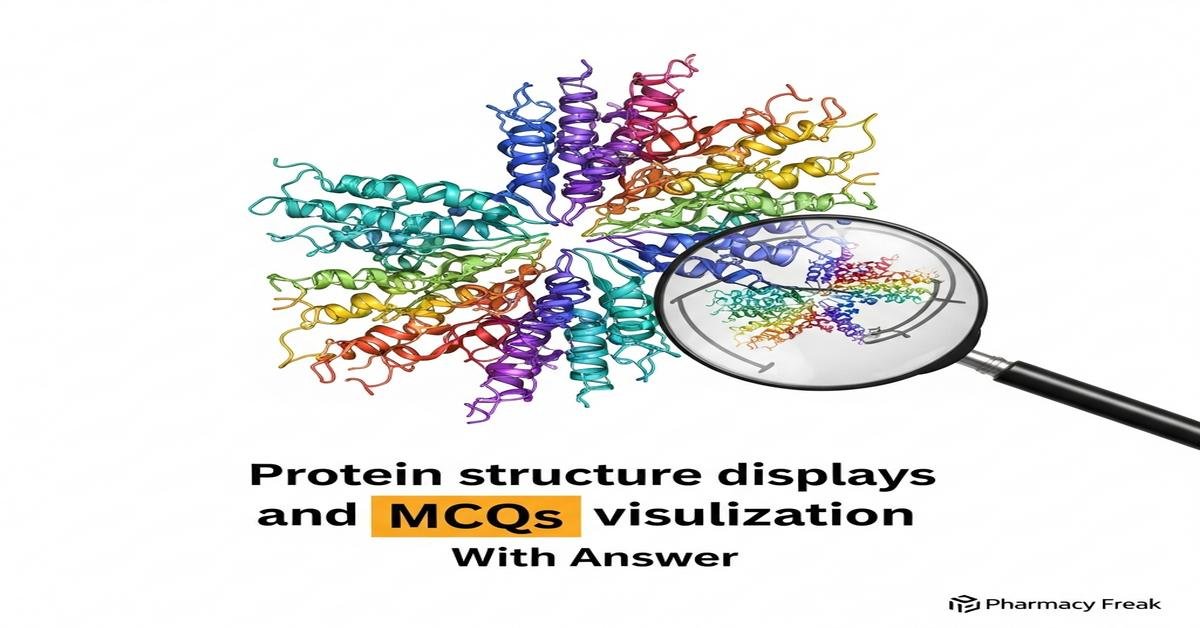
Protein structure displays and visualization MCQs With Answer
Understanding how to visualize and interpret protein structures is essential for M.Pharm students involved in drug design, structural biology, and computational modeling. This quiz collection focuses on advanced concepts in protein display methods, file formats, visualization tools, surface and density representations, and validation metrics commonly used in research and pharmaceutical applications. Each question targets practical visualization skills — choosing representations to analyze binding sites, mapping properties (electrostatics, hydrophobicity, conservation) onto structures, interpreting experimental maps, and using common software (PyMOL, Chimera, VMD). These MCQs will reinforce your ability to select and interpret structural displays relevant to ligand design and structural validation.
Q1. Which protein representation is most effective for clearly showing secondary structure elements like alpha-helices and beta-sheets?
- Space-filling (CPK)
- Wireframe
- Ribbon (cartoon)
- Surface
Correct Answer: Ribbon (cartoon)
Q2. Which visualization tool is particularly well-suited for interactive exploration of cryo-EM density maps and fitting atomic models into maps?
- PyMOL
- UCSF Chimera
- RasMol
- BLAST
Correct Answer: UCSF Chimera
Q3. Which file format is the recommended modern replacement for the legacy PDB format for storing detailed macromolecular data?
- PDB
- FASTA
- mmCIF (PDBx/mmCIF)
- SDF
Correct Answer: mmCIF (PDBx/mmCIF)
Q4. Which program or method is commonly used to compute and visualize electrostatic potential surfaces for proteins?
- APBS (Adaptive Poisson-Boltzmann Solver)
- DSSP
- MSMS
- PROCHECK
Correct Answer: APBS (Adaptive Poisson-Boltzmann Solver)
Q5. What is the standard quantitative metric used to measure structural similarity after superposition of two protein models?
- RMSD (root-mean-square deviation)
- B-factor
- SASA (solvent accessible surface area)
- Occupancy
Correct Answer: RMSD (root-mean-square deviation)
Q6. Which surface description is generated by tracing the center of a rolling probe sphere over atomic van der Waals radii?
- Solvent-accessible surface (SASA)
- Solvent-excluded (molecular/Connolly) surface
- Van der Waals surface
- Electrostatic potential map
Correct Answer: Solvent-accessible surface (SASA)
Q7. Which parameter is commonly color-mapped onto a structure to visualize atomic displacement or dynamic disorder observed in crystallography?
- B-factor (temperature factor)
- Occupancy
- Electron density contour level
- Sequence conservation score
Correct Answer: B-factor (temperature factor)
Q8. Which visualization tool is optimized for displaying molecular dynamics trajectories and calculating per-residue fluctuations?
- VMD (Visual Molecular Dynamics)
- PyMOL
- RasMol
- Swiss-PdbViewer
Correct Answer: VMD (Visual Molecular Dynamics)
Q9. To visually identify binding pockets and cavities on a protein surface for ligand placement, which display is most appropriate?
- Ribbon diagram
- Surface (solvent-excluded / molecular surface)
- Wireframe
- Ball-and-stick only
Correct Answer: Surface (solvent-excluded / molecular surface)
Q10. Which algorithm or program is widely used to assign secondary structure based on hydrogen bonding patterns and backbone geometry?
- DSSP (Dictionary of Secondary Structure of Proteins)
- PROCHECK
- BLAST
- APBS
Correct Answer: DSSP (Dictionary of Secondary Structure of Proteins)
Q11. In electron density map visualization, what does increasing the contour level generally represent?
- Displaying higher map-density regions typically expressed in sigma units
- Increasing the temperature factor of atoms
- Raising atomic occupancy values
- Changing solvent ionic strength
Correct Answer: Displaying higher map-density regions typically expressed in sigma units
Q12. When mapping evolutionary conservation onto a structure to highlight functional residues, you should color the model by which metric?
- Sequence conservation scores (e.g., ConSurf)
- B-factor
- Hydrophobicity index
- RMSD
Correct Answer: Sequence conservation scores (e.g., ConSurf)
Q13. Which legacy format includes ANISOU records to store anisotropic displacement parameters for atoms?
- PDB (with ANISOU records)
- FASTA
- MMCIF without ANISOU
- MOL2
Correct Answer: PDB (with ANISOU records)
Q14. For analyzing specific ligand-protein interactions (hydrogen bonds, pi-stacking) in detail, which visualization approach is most informative?
- Stick representation for ligand and nearby residues with explicit hydrogen bonds shown
- Surface only with no atomic detail
- Ribbon only without side chains
- Space-filling for entire protein only
Correct Answer: Stick representation for ligand and nearby residues with explicit hydrogen bonds shown
Q15. Which online or programmatic tool is widely used for structural validation including clash analysis, rotamer evaluation, and Ramachandran plots?
- MolProbity
- PyMOL (visualization only)
- GROMACS (MD engine)
- Clustal Omega (sequence aligner)
Correct Answer: MolProbity
Q16. When an electrostatic potential surface is mapped onto a protein, what physical quantity is being displayed on the surface?
- Electrostatic potential (electrostatic field values)
- Hydrophobicity index
- B-factor
- Occupancy
Correct Answer: Electrostatic potential (electrostatic field values)
Q17. To create a smooth animation depicting conformational change between two known states of a protein, which approach is typically used?
- Morphing by interpolating coordinates after structural alignment
- Averaging coordinates of both states into one static model
- Increasing B-factors to exaggerate motion
- Altering atomic occupancies only
Correct Answer: Morphing by interpolating coordinates after structural alignment
Q18. In molecular dynamics analysis, what does RMSF (root-mean-square fluctuation) per residue display visualize?
- Per-residue flexibility or fluctuation over the trajectory
- Global structural similarity to reference
- Crystallographic B-factor directly
- Solvent-accessible surface area per residue
Correct Answer: Per-residue flexibility or fluctuation over the trajectory
Q19. Which coloring scheme is most appropriate for visually distinguishing hydrophobic and polar surface regions relevant to ligand binding?
- Hydrophobicity coloring (e.g., Kyte-Doolittle scale)
- B-factor coloring
- Charge coloring (electrostatic only)
- Secondary structure coloring
Correct Answer: Hydrophobicity coloring (e.g., Kyte-Doolittle scale)
Q20. Which molecular graphics program is commonly used for producing publication-quality ray-traced images with advanced lighting and shadows?
- PyMOL (ray tracing capabilities)
- RasMol (basic rendering)
- Notepad
- BLAST
Correct Answer: PyMOL (ray tracing capabilities)

