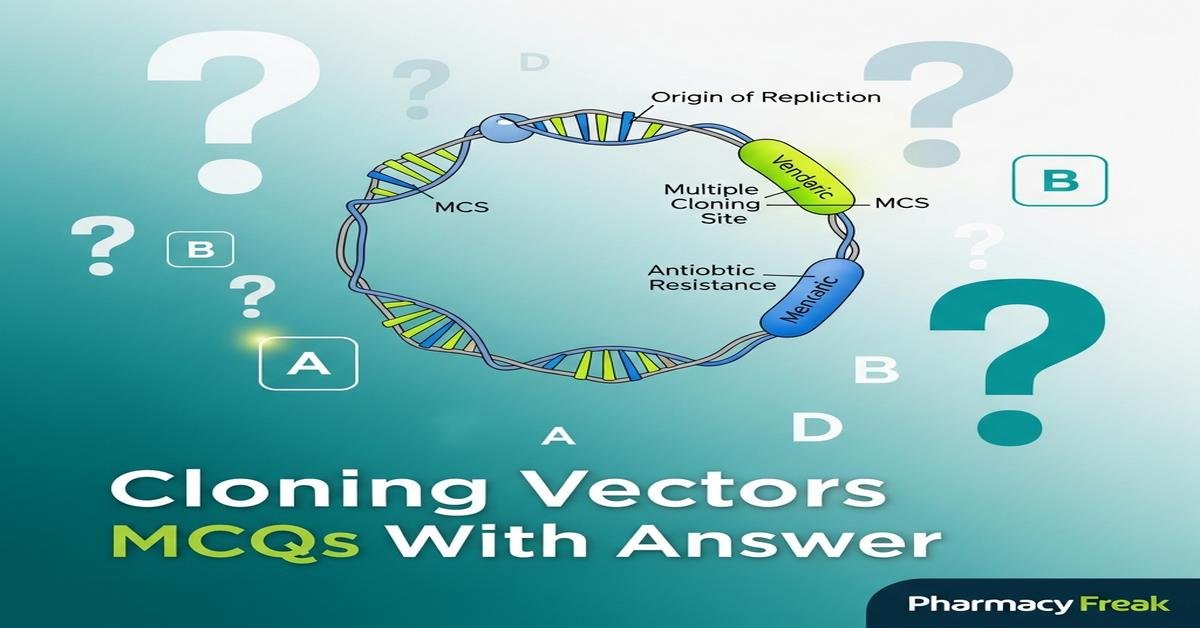
Introduction: This quiz collection covers cloning vectors — their design, functional elements, and applications — tailored for M.Pharm students in Advanced Pharmaceutical Biotechnology. You will encounter questions on plasmids, cosmids, BACs, YACs, phagemids, shuttle and expression vectors, selection systems, screening methods, and modern cloning technologies such as Gateway and TOPO cloning. The objective is to reinforce conceptual understanding and practical decision-making needed for molecular cloning in pharmaceutical research, including vector choice for expression, stability, insert size and host compatibility. Answers are provided to help you self-assess and prepare for both theory and lab-based examinations.
Q1. What best defines a cloning vector?
- A DNA molecule that contains selectable markers only
- A DNA molecule used to carry foreign DNA into a host cell where it can be replicated and/or expressed
- An RNA molecule that directs protein translation in a new host
- A viral particle used only for transient gene delivery
Correct Answer: A DNA molecule used to carry foreign DNA into a host cell where it can be replicated and/or expressed
Q2. Which of the following is NOT an essential feature of a typical bacterial cloning vector?
- Origin of replication
- Selectable marker gene
- Multiple cloning site (MCS)
- Polyadenylation signal
Correct Answer: Polyadenylation signal
Q3. pBR322 is historically important as a cloning vector because it:
- Is >100 kb in size and used for genomic libraries
- Contains two antibiotic resistance markers (ampR, tetR) and a ColE1 origin in a ~4.4 kb backbone
- Has eukaryotic promoters for high-level mammalian expression
- Is a phage-derived vector producing single-stranded DNA only
Correct Answer: Contains two antibiotic resistance markers (ampR, tetR) and a ColE1 origin in a ~4.4 kb backbone
Q4. High-copy-number plasmid vectors are generally preferred when:
- Large (100–300 kb) inserts are required
- Maximal yield of recombinant plasmid DNA is needed despite potential metabolic burden on the host
- Stable maintenance with low metabolic cost is the priority
- Single-stranded DNA production for sequencing is the goal
Correct Answer: Maximal yield of recombinant plasmid DNA is needed despite potential metabolic burden on the host
Q5. The pUC series of vectors facilitate blue-white screening because they:
- Carry the T7 promoter for high expression in all E. coli strains
- Contain a lacZ alpha fragment within the MCS that is disrupted by insertion, allowing alpha-complementation screening on X-gal
- Encode GFP which fluoresces when no insert is present
- Have a temperature-sensitive origin of replication exploited during screening
Correct Answer: Contain a lacZ alpha fragment within the MCS that is disrupted by insertion, allowing alpha-complementation screening on X-gal
Q6. Cosmids are useful cloning vectors because they:
- Can accommodate extremely large inserts up to several megabases
- Combine plasmid replication functions with lambda phage cos sites to package 35–52 kb inserts into phage particles
- Are specialized for eukaryotic chromosomal integration via telomeres
- Provide single-copy maintenance with eukaryotic centromeres
Correct Answer: Combine plasmid replication functions with lambda phage cos sites to package 35–52 kb inserts into phage particles
Q7. Bacterial artificial chromosomes (BACs) are commonly chosen for genomic cloning because they:
- Are derived from lambda phage and only accept ~15 kb inserts
- Use the F-plasmid replicon and can stably maintain 100–300 kb inserts in E. coli
- Are high-copy plasmids used for protein overexpression
- Are designed solely for yeast expression with ARS and CEN elements
Correct Answer: Use the F-plasmid replicon and can stably maintain 100–300 kb inserts in E. coli
Q8. Yeast artificial chromosomes (YACs) are distinct from BACs because YACs:
- Are maintained as circular plasmids in bacteria
- Require telomeres, centromere (CEN) and autonomously replicating sequence (ARS) to stably propagate large linear inserts in Saccharomyces cerevisiae
- Cannot host inserts larger than 10 kb
- Are primarily used to produce single-stranded DNA for sequencing
Correct Answer: Require telomeres, centromere (CEN) and autonomously replicating sequence (ARS) to stably propagate large linear inserts in Saccharomyces cerevisiae
Q9. A shuttle vector is best described as:
- A vector that shuttles between different cellular compartments without replicating
- A vector engineered to replicate in two different host species because it contains two origins of replication and selectable markers for each host
- A viral vector that only infects mammalian cells
- A plasmid that cannot be maintained but is used transiently
Correct Answer: A vector engineered to replicate in two different host species because it contains two origins of replication and selectable markers for each host
Q10. Key features of a protein expression vector for bacterial expression include:
- Strong promoter (e.g., T7), ribosome binding site (RBS), translation initiation site, and often affinity tag sequences for purification
- Telomeres and centromere sequences for mitotic stability
- Only an origin of replication without any promoter
- Polylinkers for eukaryotic splicing elements
Correct Answer: Strong promoter (e.g., T7), ribosome binding site (RBS), translation initiation site, and often affinity tag sequences for purification
Q11. The pET series of expression vectors are widely used because they:
- Contain a lac promoter recognized by host RNAP in all E. coli strains
- Use the T7 promoter and require a host strain that provides T7 RNA polymerase (e.g., BL21(DE3)) for robust expression
- Are shuttle vectors for yeast and bacteria
- Are low-copy vectors for stable maintenance of toxic genes without inducible control
Correct Answer: Use the T7 promoter and require a host strain that provides T7 RNA polymerase (e.g., BL21(DE3)) for robust expression
Q12. Gateway cloning technology is based on:
- Type IIS restriction enzymes creating non-palindromic overhangs
- Topoisomerase I-mediated ligation of PCR products
- Site-specific recombination using att sites (attP/attB/attL/attR) to transfer DNA without restriction enzymes or ligase
- Homologous recombination in yeast only
Correct Answer: Site-specific recombination using att sites (attP/attB/attL/attR) to transfer DNA without restriction enzymes or ligase
Q13. TOPO cloning accelerates insertion of PCR products by:
- Using type II topoisomerase as both restriction endonuclease and ligase to covalently join DNA ends, often in a TA cloning format
- Requiring long homologous recombination arms in yeast
- Using integrases that recombine att sites
- Needing blunt-end ligation with T4 DNA ligase and overnight incubation
Correct Answer: Using type II topoisomerase as both restriction endonuclease and ligase to covalently join DNA ends, often in a TA cloning format
Q14. Phagemids differ from standard plasmids because they:
- Contain lambda cos sites for packaging into lambda heads
- Include an f1 origin that allows production of single-stranded DNA when complemented by a helper phage
- Are only used in yeast and contain ARS sequences
- Are always integrated into the host chromosome
Correct Answer: Include an f1 origin that allows production of single-stranded DNA when complemented by a helper phage
Q15. Blue–white screening identifies clones with inserts because:
- Insert-containing plasmids produce blue colonies on X-gal plates due to enhanced beta-galactosidase activity
- Insertion interrupts the lacZ alpha fragment so colonies remain white on X-gal/IPTG plates, whereas colonies without insert are blue
- Only clones with insert can metabolize kanamycin and form blue colonies
- Insertion induces fluorescence under UV light
Correct Answer: Insertion interrupts the lacZ alpha fragment so colonies remain white on X-gal/IPTG plates, whereas colonies without insert are blue
Q16. Which antibiotic selection system is generally more stable in mixed-culture bacterial cloning and why?
- Ampicillin selection is most stable because beta-lactamase is retained intracellularly
- Kanamycin selection is often more stable because the resistance enzyme acts intracellularly rather than being secreted, reducing cross-protection
- Tetracycline selection is unstable because the resistance gene is absent in plasmids
- Spectinomycin selection always causes plasmid loss
Correct Answer: Kanamycin selection is often more stable because the resistance enzyme acts intracellularly rather than being secreted, reducing cross-protection
Q17. A Multiple Cloning Site (MCS) is designed to:
- Provide promoter elements for eukaryotic transcription
- Contain several unique restriction enzyme recognition sites in close proximity to permit directional or flexible cloning of inserts
- Encode protein tags for purification
- Ensure chromosomal integration of the plasmid
Correct Answer: Contain several unique restriction enzyme recognition sites in close proximity to permit directional or flexible cloning of inserts
Q18. Plasmid incompatibility refers to:
- The inability of two plasmids to be maintained stably in the same cell when they share the same replication control system or partitioning functions
- The fact that plasmids cannot coexist with bacteriophages
- The inability to transform two different plasmids into one host due to antibiotic cross-resistance only
- Damage to plasmid DNA during heat-shock transformation
Correct Answer: The inability of two plasmids to be maintained stably in the same cell when they share the same replication control system or partitioning functions
Q19. For constructing a genomic library intended to capture and stably maintain 150 kb fragments, which vector type is most appropriate and why?
- pUC plasmid because its high copy number stabilizes large inserts
- BAC vector because it can stably maintain large genomic fragments (~100–300 kb) with low copy number and partition functions
- Phagemid because it packages very large linear DNA into phage particles
- Expression vector like pET because it provides strong promoters for large genomic inserts
Correct Answer: BAC vector because it can stably maintain large genomic fragments (~100–300 kb) with low copy number and partition functions
Q20. Important elements for efficient expression from a eukaryotic expression vector include:
- ColE1 origin, lacZ alpha and T7 promoter
- Strong eukaryotic promoter (e.g., CMV), Kozak sequence for translation initiation, polyadenylation signal (e.g., BGH), and appropriate selectable marker (e.g., neo)
- f1 origin and cos sites for phage packaging
- Only bacterial RBS and terminator sequences
Correct Answer: Strong eukaryotic promoter (e.g., CMV), Kozak sequence for translation initiation, polyadenylation signal (e.g., BGH), and appropriate selectable marker (e.g., neo)

