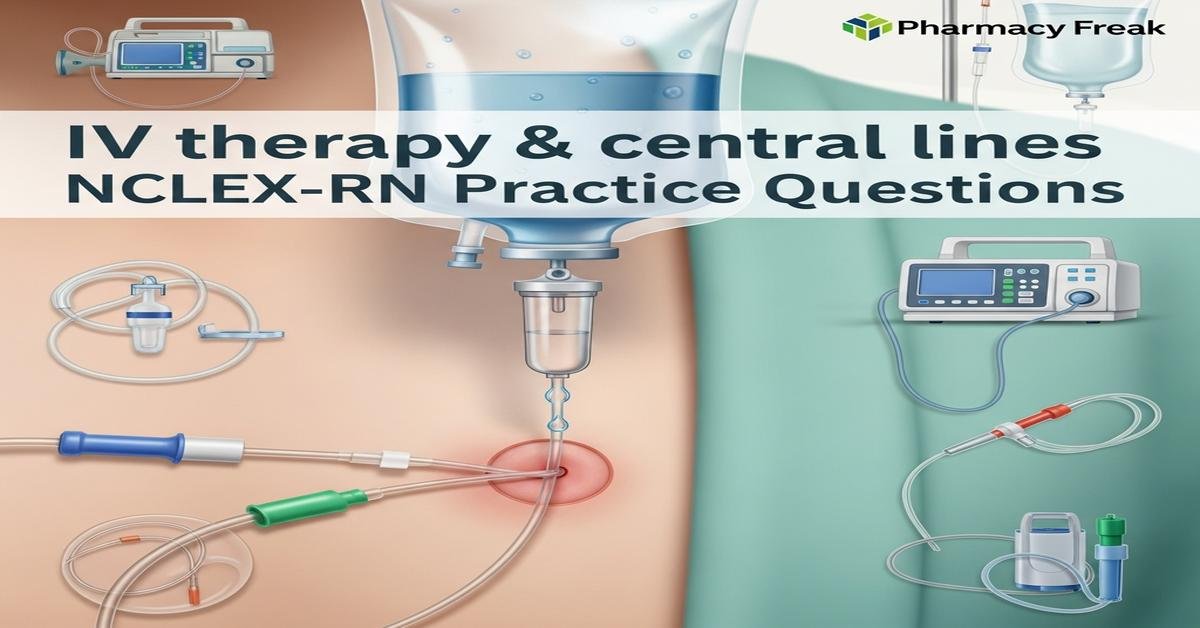
IV therapy & central lines NCLEX-RN Practice Questions help you sharpen clinical judgment for safe medication delivery and complication management. This topic-wise set focuses on central venous access devices (CVADs), infusion safety, sterile technique, prevention of catheter-related bloodstream infections (CLABSIs), recognition and response to complications (air embolism, pneumothorax, occlusion, extravasation), and calculation skills for IV infusions. You’ll also review evidence-based care for TPN, vesicants, blood transfusion through central lines, and patient teaching for PICCs and ports. Each question mirrors NCLEX-RN complexity, requiring you to prioritize, apply standards, and think like a nurse. Use these 30 MCQs to assess readiness and close knowledge gaps in Pharmacological & Parenteral Therapies.
Q1. A patient receiving dopamine through a peripheral IV develops swelling, pain, and blanching at the site. What is the priority nursing action?
- Stop the infusion, leave the catheter in place, aspirate residual drug, and prepare to infiltrate phentolamine per protocol
- Remove the catheter immediately and apply warm compresses only
- Slow the infusion rate, elevate the extremity, and reassess in 30 minutes
- Continue the infusion while you prepare the antidote to avoid hypotension
Correct Answer: Stop the infusion, leave the catheter in place, aspirate residual drug, and prepare to infiltrate phentolamine per protocol
Q2. You attempt to flush a newly placed central venous catheter (CVC) and feel resistance without blood return. What is the safest action?
- Force flush with a 3 mL syringe to clear the occlusion quickly
- Do not force flush; reposition the patient, have them cough or raise the arm, attempt gentle aspiration, and if still no blood return, hold medications and notify the provider
- Begin the ordered medication through a peripheral IV while ignoring the central line issue
- Administer a thrombolytic into the lumen without a prescription to restore flow
Correct Answer: Do not force flush; reposition the patient, have them cough or raise the arm, attempt gentle aspiration, and if still no blood return, hold medications and notify the provider
Q3. During a central line dressing change, the cap is accidentally removed and the patient suddenly reports dyspnea and chest pain. Suspecting air embolism, which action is priority?
- Place the patient in high-Fowler’s position and encourage deep breathing only
- Place the patient in left lateral Trendelenburg position, clamp the catheter, administer 100% oxygen, and notify the provider
- Apply a cold pack to the site and continue the infusion
- Sit the patient upright and administer a bronchodilator as needed
Correct Answer: Place the patient in left lateral Trendelenburg position, clamp the catheter, administer 100% oxygen, and notify the provider
Q4. Your patient’s TPN via central line is nearly finished and the pharmacy is delayed. What should you hang to prevent hypoglycemia?
- D10W at the same rate until the next TPN bag is available
- 0.9% normal saline at keep-vein-open rate
- Clamp the line and wait for the next TPN bag
- D5W at half the TPN rate
Correct Answer: D10W at the same rate until the next TPN bag is available
Q5. Which infusion requires a central venous access device due to osmolarity and risk profile?
- 0.9% sodium chloride
- Lactated Ringer’s solution
- 3% hypertonic saline
- Total parenteral nutrition with 20% dextrose and amino acids
Correct Answer: Total parenteral nutrition with 20% dextrose and amino acids
Q6. To prevent air embolism during removal of a non-tunneled central line, which technique is correct?
- Remove with the patient sitting upright while inhaling deeply and apply a dry gauze
- Remove with the patient supine (or slight Trendelenburg), have them perform Valsalva, apply firm pressure, then an occlusive petroleum dressing
- Have the patient exhale gently during removal and leave the site open to air
- Remove in high-Fowler’s position and apply transparent dressing only
Correct Answer: Remove with the patient supine (or slight Trendelenburg), have them perform Valsalva, apply firm pressure, then an occlusive petroleum dressing
Q7. A patient with a PICC develops fever, chills, and erythema at the insertion site. What is the best initial nursing action?
- Administer broad-spectrum antibiotics immediately, then collect blood cultures
- Obtain paired blood cultures from the catheter and a peripheral site before starting antibiotics
- Remove the PICC immediately before obtaining cultures
- Increase TPN rate to support immune function during infection
Correct Answer: Obtain paired blood cultures from the catheter and a peripheral site before starting antibiotics
Q8. Fifteen minutes after initiating PRBCs via a central line, the patient develops fever, chills, and back pain. What is the priority action?
- Slow the transfusion and reassess in 10 minutes
- Stop the transfusion, keep the line open with normal saline using new tubing, notify the provider and blood bank, and monitor vitals
- Administer acetaminophen and continue the transfusion
- Flush the blood tubing with saline and restart at a slower rate
Correct Answer: Stop the transfusion, keep the line open with normal saline using new tubing, notify the provider and blood bank, and monitor vitals
Q9. Which central access is most appropriate for long-term, intermittent outpatient vesicant chemotherapy?
- Non-tunneled triple-lumen subclavian catheter
- PICC line intended for short-term inpatient therapy only
- Implanted subcutaneous port accessed with a non-coring needle
- Femoral central line
Correct Answer: Implanted subcutaneous port accessed with a non-coring needle
Q10. Which statement reflects correct best practice when accessing an implanted port for chemotherapy?
- Use a standard hypodermic needle for deeper penetration
- Use a non-coring (Huber) needle, maintain sterile technique, and confirm blood return before administering a vesicant
- Prime the port with heparin only; blood return is not necessary
- Alcohol swab is sufficient; chlorhexidine prep is unnecessary
Correct Answer: Use a non-coring (Huber) needle, maintain sterile technique, and confirm blood return before administering a vesicant
Q11. Which technique is correct during a sterile central line dressing change?
- Clean with iodine and blot dry to speed dressing application
- Wear a mask (nurse and patient), use sterile gloves, scrub with chlorhexidine using friction for 30 seconds, allow to dry completely, and apply a CHG-impregnated disc with a transparent dressing
- Use clean gloves since sterile gloves are not necessary for maintenance
- Fan the site to dry the antiseptic faster and reduce moisture
Correct Answer: Wear a mask (nurse and patient), use sterile gloves, scrub with chlorhexidine using friction for 30 seconds, allow to dry completely, and apply a CHG-impregnated disc with a transparent dressing
Q12. The provider orders vancomycin 1 g in 250 mL to infuse over 2 hours using tubing with a drop factor of 10 gtt/mL. What is the drip rate?
- 17 gtt/min
- 21 gtt/min
- 25 gtt/min
- 42 gtt/min
Correct Answer: 21 gtt/min
Q13. For a triple-lumen central venous catheter, which lumen is generally preferred for blood sampling and high-volume infusions?
- Distal lumen (largest bore)
- Proximal lumen (smallest bore)
- Medial lumen only
- Any lumen with a heparin lock
Correct Answer: Distal lumen (largest bore)
Q14. Shortly after subclavian CVC insertion, a patient develops acute dyspnea and decreased breath sounds on the right. What is the immediate nursing action?
- Encourage ambulation to improve aeration
- Apply oxygen, position semi-Fowler’s, notify the provider, and prepare for a stat chest x-ray
- Increase IV fluids to treat hypotension
- Remove the catheter immediately
Correct Answer: Apply oxygen, position semi-Fowler’s, notify the provider, and prepare for a stat chest x-ray
Q15. A peripheral IV site is cool, pale, edematous, and the infusion is sluggish. Which complication is most likely?
- Phlebitis
- Infiltration
- Local infection
- Fluid overload
Correct Answer: Infiltration
Q16. Which patient statement about PICC care indicates a need for further teaching?
- I will avoid blood pressure measurements and venipuncture in my PICC arm
- I will keep the dressing clean, dry, and intact and report any redness or swelling
- I can have my blood pressure taken on either arm
- I will flush the line as instructed and avoid heavy lifting with the PICC arm
Correct Answer: I can have my blood pressure taken on either arm
Q17. Which therapy requires a dedicated lumen and should not be co-infused with other medications or solutions?
- 0.9% normal saline maintenance fluids
- Antibiotics compatible by Y-site
- Total parenteral nutrition (TPN)
- Electrolyte replacement with potassium chloride
Correct Answer: Total parenteral nutrition (TPN)
Q18. Before giving an IV push medication through a central line, how should the nurse best verify catheter patency?
- Assume patency if the last nurse documented a flush
- Aspirate for brisk blood return and confirm an easy saline flush without resistance
- Flush forcefully until resistance resolves
- Elevate the limb to improve flow if sluggish
Correct Answer: Aspirate for brisk blood return and confirm an easy saline flush without resistance
Q19. A PICC has no blood return and resists flushing despite repositioning. The provider suspects thrombotic occlusion. Which order would you anticipate?
- Administer a systemic heparin bolus
- Instill alteplase (tPA) into the catheter lumen per protocol and allow to dwell
- Remove the PICC immediately at the bedside
- Force flush with a 3 mL syringe to break the clot
Correct Answer: Instill alteplase (tPA) into the catheter lumen per protocol and allow to dwell
Q20. Which single action most effectively reduces CLABSI risk during routine catheter access?
- Using sterile gloves for all tubing connections
- Performing hand hygiene before and after any catheter manipulation
- Changing dressings every 24 hours regardless of condition
- Using povidone-iodine instead of chlorhexidine
Correct Answer: Performing hand hygiene before and after any catheter manipulation
Q21. The order is 1,000 mL of normal saline over 8 hours via infusion pump. What pump rate (mL/hr) should you set?
- 75 mL/hr
- 100 mL/hr
- 125 mL/hr
- 150 mL/hr
Correct Answer: 125 mL/hr
Q22. A patient receiving doxorubicin through a central line develops pain and swelling at the site with suspected extravasation. What is the correct nursing action?
- Stop the infusion, aspirate residual drug, apply cold compresses, and notify the provider for potential dexrazoxane
- Remove the catheter immediately and apply warm compresses
- Elevate the arm and continue at a slower rate
- Flush the line with saline to dilute the vesicant
Correct Answer: Stop the infusion, aspirate residual drug, apply cold compresses, and notify the provider for potential dexrazoxane
Q23. Which statement about tunneled hemodialysis catheters is correct?
- They are appropriate for routine IV medications and blood draws
- They should be used only for dialysis unless there is an emergency and nephrology approves
- They do not require heparin locking between sessions
- They are the preferred access for long-term TPN
Correct Answer: They should be used only for dialysis unless there is an emergency and nephrology approves
Q24. During a central line dressing change, which technique minimizes the risk of catheter dislodgement?
- Peel off the old dressing away from the insertion site in one quick motion
- Stabilize the catheter, remove the old dressing by pulling toward the insertion site, and use a securement device
- Have the patient cough during removal to loosen the adhesive
- Apply lotion under the dressing to prevent sticking
Correct Answer: Stabilize the catheter, remove the old dressing by pulling toward the insertion site, and use a securement device
Q25. The order is potassium chloride 40 mEq in 100 mL to infuse over 1 hour via PICC with continuous ECG monitoring. What is the best nursing action?
- Proceed; central lines allow up to 40 mEq/hr without special monitoring
- Change to a peripheral IV because it is safer for rapid KCl administration
- Clarify the order because it exceeds the typical maximum of 20 mEq/hr via central line
- Deliver the dose via IV push with a large lumen
Correct Answer: Clarify the order because it exceeds the typical maximum of 20 mEq/hr via central line
Q26. A patient with a PICC reports “gurgling” in the ear and palpitations during flushing. What is the priority action?
- Continue flushing; this is expected with PICCs
- Stop infusions, assess external catheter length, and notify the provider to obtain a chest x-ray for tip location
- Increase IV flow rate to clear the sensation
- Have the patient drink water and lie on the affected side
Correct Answer: Stop infusions, assess external catheter length, and notify the provider to obtain a chest x-ray for tip location
Q27. After central line insertion, which step must occur before first use for medication administration?
- Prime the line with heparin and begin infusions
- Obtain radiographic confirmation of catheter tip location and provider verification
- Confirm the patient denies pain at the site
- Check that the dressing is dry and intact
Correct Answer: Obtain radiographic confirmation of catheter tip location and provider verification
Q28. A patient has a multi-lumen CVC with TPN running. A blood sample is needed. What is the best approach?
- Pause TPN and draw the specimen from the same lumen to avoid multiple sticks
- Use a different lumen dedicated for blood draws and avoid the TPN lumen
- Draw from the TPN lumen and increase the TPN rate to compensate
- Stop the TPN permanently and use a peripheral stick only
Correct Answer: Use a different lumen dedicated for blood draws and avoid the TPN lumen
Q29. To reduce air embolism risk when changing a CVC needleless connector (cap), which practice is best?
- Place the patient supine, clamp the catheter, have the patient perform Valsalva (or exhale/hum), and quickly replace the cap after scrubbing the hub
- Seat the patient upright to improve breathing during the change
- Leave the catheter unclamped to avoid pressure changes
- Ask the patient to take a deep breath in and hold it while sitting
Correct Answer: Place the patient supine, clamp the catheter, have the patient perform Valsalva (or exhale/hum), and quickly replace the cap after scrubbing the hub
Q30. The order is dopamine at 5 mcg/kg/min for a 70-kg patient. Pharmacy supplies 400 mg in 250 mL. What pump rate (mL/hr) is correct?
- 9 mL/hr
- 13 mL/hr
- 18 mL/hr
- 21 mL/hr
Correct Answer: 13 mL/hr
Explore more NCLEX-RN resources
Use these quick links to practice by full-length, domain, topic, or jump into the question bank.
Complete NCLEX-RN Practice Resources
All-in-one hub: 5200+ free questions and essential NCLEX practice links.
NCLEX-RN Full Length Practice Test
Simulate exam conditions with full-length practice tests.
NCLEX-RN Domain Wise Practice Test
Practice by NCLEX client needs categories/domains.
NCLEX-RN Topic Wise Practice Test
Target weak areas with topic-focused question sets.
NCLEX-RN Question Bank
Browse and drill questions anytime from the NCLEX bank.

