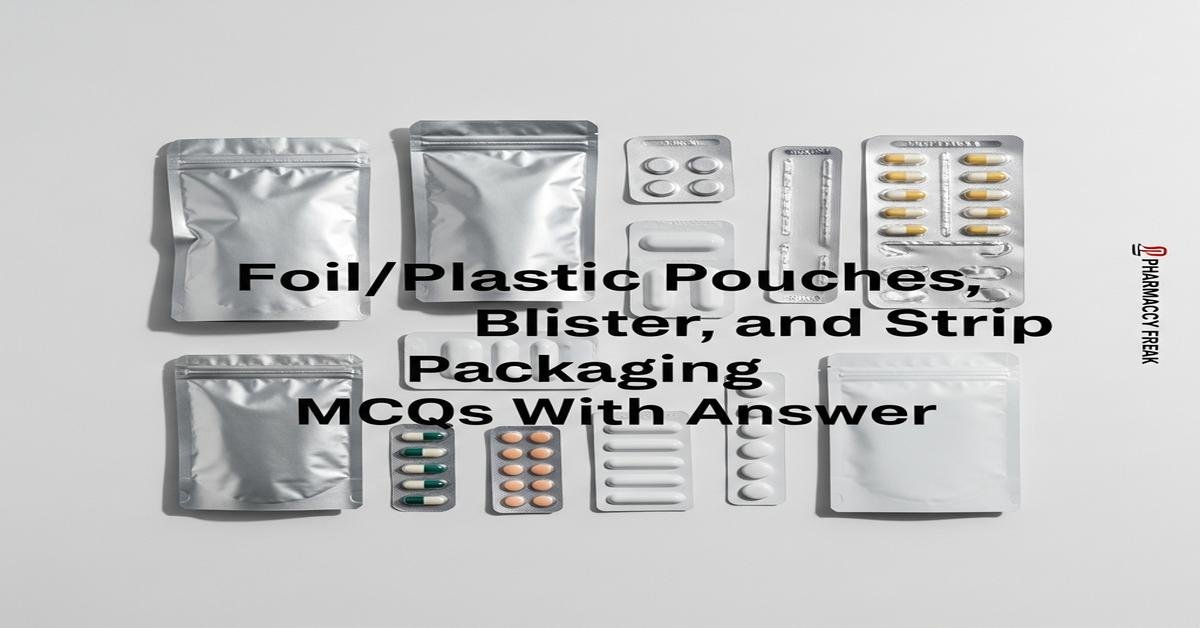
Introduction: This quiz collection focuses on foil/plastic pouches, blister, and strip packaging — key unit-dose systems in pharmaceutical manufacturing. It is designed for M.Pharm students preparing for exams and industry roles, covering materials (PVC, PVDC, Aclar, aluminium laminates), forming and sealing processes (thermoforming, cold-forming, heat/cold seals), barrier properties (OTR, WVTR), equipment parameters, common defects, testing/validation, and child‑resistance and stability considerations. Questions probe deeper into material selection, lamination strategies, sealing mechanics, and package performance tests to build practical understanding for formulation protection, compliance, and scale-up. Use these MCQs to assess and reinforce applied knowledge in packaging science and technology.
Q1. Which material is most commonly used as the thermoformable base film for standard blister packs?
- Polyethylene terephthalate (PET)
- Polyvinyl chloride (PVC)
- Polyethylene (PE)
- Polytetrafluoroethylene (PTFE)
Correct Answer: Polyvinyl chloride (PVC)
Q2. Which film is known for providing the best moisture barrier for blister packaging among the options below?
- PVC (Polyvinyl chloride)
- PETG (Polyethylene terephthalate glycol)
- Aclar (PCTFE)
- Polypropylene (PP)
Correct Answer: Aclar (PCTFE)
Q3. What is the primary function of lidding foil in a blister pack?
- To provide aesthetic printing surface only
- To act as the thermoformable cavity material
- To create a hermetic seal and act as a barrier to moisture, light and gases
- To reduce the blister forming temperature
Correct Answer: To create a hermetic seal and act as a barrier to moisture, light and gases
Q4. What differentiates a cold-seal lamination from a heat-seal lamination for blister lidding?
- Cold-seal uses UV-curable lacquer while heat-seal uses hot-melt adhesive
- Cold-seal requires no pressure while heat-seal requires high pressure
- Cold-seal uses pressure-sensitive adhesive and requires no heat, suitable for heat-sensitive products
- Cold-seal is only used with aluminium blister bases while heat-seal is for plastic bases
Correct Answer: Cold-seal uses pressure-sensitive adhesive and requires no heat, suitable for heat-sensitive products
Q5. Which material is most commonly used for cold‑form (cold‑forming) blister base foils?
- Transparent PVC film
- Aluminium-based cold-form foil
- Polyethylene film
- Polycarbonate sheet
Correct Answer: Aluminium-based cold-form foil
Q6. Which of the following is a principal advantage of strip packaging for tablets?
- It always provides a clearer window for product visualization than blisters
- It is best suited for liquid dose forms
- Compact unit-dose format with reduced material usage and good tamper evidence
- Requires no heat sealing and is always recyclable
Correct Answer: Compact unit-dose format with reduced material usage and good tamper evidence
Q7. If the heat-seal temperature in a blister sealing operation is set too low, what is the most likely outcome?
- Excessive browning of the film
- Seal over-strength causing difficulty in opening
- Poor sealing strength leading to leaks and loss of barrier
- Immediate melting of the lidding foil
Correct Answer: Poor sealing strength leading to leaks and loss of barrier
Q8. Which analytical parameter specifically quantifies how much oxygen passes through a packaging film?
- Moisture Vapor Transmission Rate (MVTR)
- Tensile Strength
- Oxygen Transmission Rate (OTR)
- Heat Seal Initiation Temperature (HSIT)
Correct Answer: Oxygen Transmission Rate (OTR)
Q9. Why is PVC often laminated with PVDC or replaced by Aclar in blister applications for hygroscopic drugs?
- Because PVC is too rigid and PVDC softens it
- Because PVC has poor moisture barrier (high WVTR) and needs better barrier layers
- Because PVC cannot be thermoformed
- Because PVDC gives better printability only
Correct Answer: Because PVC has poor moisture barrier (high WVTR) and needs better barrier layers
Q10. Why are domed or deep-pocket blister cavities used for certain products like softgel capsules?
- They reduce the surface area for printing
- They provide a protective void to prevent product deformation and allow easy extraction
- They make heat sealing unnecessary
- They improve oxygen transmission to the product
Correct Answer: They provide a protective void to prevent product deformation and allow easy extraction
Q11. Typical thermoforming temperature range for PVC blister forming is approximately:
- 20–50 °C
- 80–100 °C
- 160–180 °C
- 300–350 °C
Correct Answer: 160–180 °C
Q12. What is the role of heat-seal lacquer or sealant coating applied to lidding foils?
- To improve the decorative appearance only
- To increase the thermoformable film thickness
- To provide a reliable heat-sealable layer that bonds to the blister base
- To make the foil electrically conductive
Correct Answer: To provide a reliable heat-sealable layer that bonds to the blister base
Q13. What is a key advantage of cold‑formed (alu‑alu) blister packs compared with thermoformed PVC blisters?
- They are transparent for product visualization
- They have excellent barrier properties to moisture and oxygen
- They form at room temperature without equipment
- They are always cheaper to produce
Correct Answer: They have excellent barrier properties to moisture and oxygen
Q14. Which test is used to quantify the force required to open a sealed blister by peeling the lidding foil?
- Seal integrity leak test
- Peel strength (seal peel) test
- Water vapor permeability test
- Compression testing
Correct Answer: Peel strength (seal peel) test
Q15. Which statement best characterizes Aclar film used in packaging?
- Aclar is a low-cost PVC substitute with poor barrier
- Aclar is a PCTFE film with outstanding moisture barrier but is comparatively expensive
- Aclar is an adhesive lacquer for lidding foils
- Aclar is a paper-based backing for strip packs
Correct Answer: Aclar is a PCTFE film with outstanding moisture barrier but is comparatively expensive
Q16. For highly hygroscopic APIs requiring the best protection, which primary packaging is typically selected?
- Clear PVC thermoformed blister with standard aluminum foil lidding
- Cold-formed aluminium/aluminium (Alu-Alu) blister
- Simple polyethylene pouch without laminate
- Cardboard folding carton without inner lining
Correct Answer: Cold-formed aluminium/aluminium (Alu-Alu) blister
Q17. Which of the following is a primary advantage of blister packaging in patient use?
- Eliminates the need for any secondary packaging
- Provides unit‑dose presentation with tamper evidence and dose control
- Always provides the lowest cost packaging option
- Guarantees indefinite long‑term stability without testing
Correct Answer: Provides unit‑dose presentation with tamper evidence and dose control
Q18. Which defect is most commonly associated with excessive thermoforming temperature or dwell time in blister forming?
- Increased barrier performance
- Browning, film thinning or burn-through of the forming film
- Improved peelability
- Reduced cavity depth
Correct Answer: Browning, film thinning or burn-through of the forming film
Q19. Strip packs for tablets often use which type of lidding material to ensure individual cavities are sealed?
- Non-laminated kraft paper
- Aluminium foil laminate specifically designed for strip-seal
- Uncoated PET film
- Cotton-based sheet material
Correct Answer: Aluminium foil laminate specifically designed for strip-seal
Q20. For moisture-sensitive formulations packaged in blisters, which validation parameter is most critical to ensure product protection?
- Color fastness of printing inks
- Seal integrity and closure performance (leak/peel/pressure tests)
- No‑load machine speed capability
- Thickness of outer carton only
Correct Answer: Seal integrity and closure performance (leak/peel/pressure tests)

