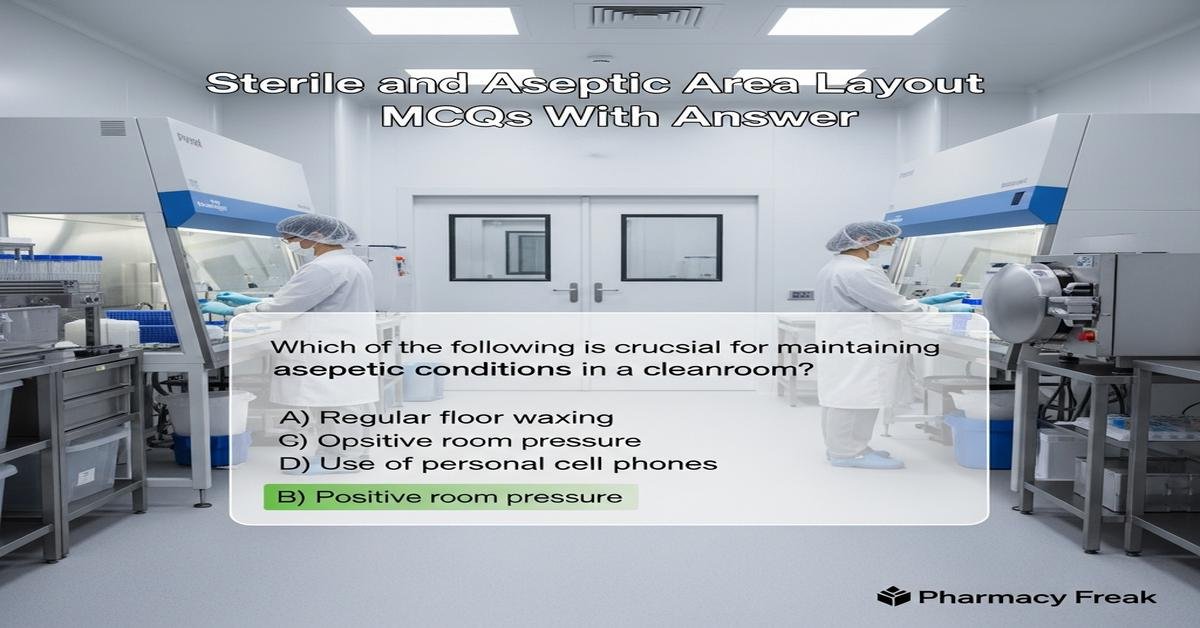
Sterile and aseptic area layout MCQs With Answer
Understanding sterile and aseptic area layout is essential for M.Pharm students preparing for roles in sterile manufacturing, quality assurance, and regulatory compliance. This set of targeted MCQs focuses on principles of cleanroom classification, airflow design, pressure differentials, personnel and material flows, HVAC and HEPA filtration, gowning, barrier systems (LAF, isolators), and environmental monitoring. Each question is crafted to deepen conceptual knowledge and application—helpful for exam preparation and practical decision-making in facility design and validation. Working through these questions will sharpen your ability to design, evaluate, and troubleshoot sterile production areas in alignment with GMP and industry best practices.
Q1. Which ISO cleanroom class is typically equivalent to EU GMP Grade A (critical zone) for aseptic processing?
- ISO 9
- ISO 5
- ISO 7
- ISO 8
Correct Answer: ISO 5
Q2. What is the primary purpose of maintaining a pressure cascade between adjacent cleanroom zones?
- To control temperature gradients between rooms
- To prevent migration of contaminants from lower to higher cleanliness zones
- To increase air changes per hour in critical areas
- To reduce noise from HVAC equipment
Correct Answer: To prevent migration of contaminants from lower to higher cleanliness zones
Q3. For aseptic processing, what minimum differential pressure is commonly recommended between Grade A/B and surrounding zones to ensure directional airflow?
- 5 Pa
- 10 Pa
- 15 Pa
- 25 Pa
Correct Answer: 10 Pa
Q4. Which airflow pattern is most appropriate inside a Grade A workbench (laminar flow hood) to protect the sterile product?
- Turbulent mixing airflow from multiple inlets
- Unidirectional (laminar) vertical or horizontal airflow
- Recirculating room air with HEPA filtration only at return
- Intermittent pulsed airflow to reduce particle settling
Correct Answer: Unidirectional (laminar) vertical or horizontal airflow
Q5. In cleanroom layout, which of the following best describes the purpose of an ante-room (airlock)?
- To store raw materials prior to sterilization
- To provide transitional gowning and minimize contamination entry into the critical zone
- To house main air handling units for isolated ducting
- To serve as a break room for operators
Correct Answer: To provide transitional gowning and minimize contamination entry into the critical zone
Q6. Which filter is typically used as the final filtration stage for supplying air to Grade A/B areas in aseptic manufacturing?
- Pre-filter (G4)
- HEPA filter (H13/H14)
- Activated carbon filter
- Bag filter (F7)
Correct Answer: HEPA filter (H13/H14)
Q7. During cleanroom validation, which test is performed to visualize airflow patterns and detect turbulence or dead zones?
- Microbial surface sampling
- Airborne particle counting
- Smoke study / airflow visualization using tracer smoke
- Filter integrity (DOP/PAO) test
Correct Answer: Smoke study / airflow visualization using tracer smoke
Q8. Which gowning sequence minimizes contamination risk when entering from a less clean zone to a cleaner zone?
- Shoe covers → hair cover → gown → gloves
- Gown → gloves → hair cover → shoe covers
- Hair cover → shoe covers → gown → gloves
- Gloves → gown → hair cover → shoe covers
Correct Answer: Hair cover → shoe covers → gown → gloves
Q9. What is the main advantage of using isolators or Restricted Access Barrier Systems (RABS) over conventional laminar flow hoods?
- Lower capital cost and simpler maintenance
- Complete removal of the need for HEPA filtration
- Physical barrier reducing operator contact and environmental contamination risk
- Allows higher temperatures to be used in processing
Correct Answer: Physical barrier reducing operator contact and environmental contamination risk
Q10. For microbial control, which monitoring method provides direct quantitative data about viable airborne contamination?
- Particle counter (non-viable)
- Settle plates (passive air sampling)
- Active air samplers (e.g., slit-to-agar, impaction)
- Surface ATP bioluminescence
Correct Answer: Active air samplers (e.g., slit-to-agar, impaction)
Q11. In designing personnel and material flows within sterile facilities, which principle is most important?
- Mixing personnel and materials to optimize walking distances
- Creating a uni-directional flow from dirty to clean to prevent cross-contamination
- Allowing re-entry to the same zone after break without re-gowning
- Sharing the same entrances for raw materials and finished products
Correct Answer: Creating a uni-directional flow from dirty to clean to prevent cross-contamination
Q12. Which of the following is an appropriate air change rate (ACH) consideration for a Grade A laminar flow cabinet working area?
- Rely solely on room ACH; cabinet does not require independent flow specification
- Ensure high velocity unidirectional airflow through the cabinet providing recommended face velocity (e.g., ~0.45 m/s for horizontal LAF)
- Maintain ACH below 5 to stabilize airborne particles
- Switch off cabinet airflow during critical operations to avoid turbulence
Correct Answer: Ensure high velocity unidirectional airflow through the cabinet providing recommended face velocity (e.g., ~0.45 m/s for horizontal LAF)
Q13. Which statement about HEPA filter integrity testing is correct?
- It is only necessary on initial installation; not part of routine verification
- It can be performed using aerosol challenge (PAO/DOP) or photometers to detect leaks
- HEPA filters do not require monitoring if pre-filters are changed regularly
- Filter integrity is assessed by monitoring temperature and humidity upstream
Correct Answer: It can be performed using aerosol challenge (PAO/DOP) or photometers to detect leaks
Q14. What is the recommended placement strategy for LAF cabinets in a production room to minimize cross-drafts and contamination?
- Place LAF cabinets close to doors and high-traffic areas to save space
- Position LAF cabinets away from supply diffusers, doors and personnel walkways to avoid disruptive cross-drafts
- Direct LAF cabinets towards return grilles for maximum recirculation
- Cluster multiple cabinets tightly together to create a single airflow field
Correct Answer: Position LAF cabinets away from supply diffusers, doors and personnel walkways to avoid disruptive cross-drafts
Q15. In an aseptic suite layout, what is the main function of a pass-through pass box (material airlock)?
- To sterilize personnel entering the clean area
- To transfer materials between zones while minimizing airflow disturbance and contamination risk
- To act as a temporary storage for finished products
- To provide emergency exit from the cleanroom
Correct Answer: To transfer materials between zones while minimizing airflow disturbance and contamination risk
Q16. Which environmental parameter, besides particulate and microbiological counts, is critical to control in sterile area layout due to its effect on personnel comfort and microbial growth?
- Noise level
- Lighting intensity
- Relative humidity and temperature
- Electromagnetic interference
Correct Answer: Relative humidity and temperature
Q17. When validating cleanroom transfer flows, which documentation and testing evidence is typically required by regulatory authorities?
- Only architectural drawings are sufficient
- Smoke studies, pressure mapping, HVAC balancing reports and SOPs for personnel/material flow
- Only routine environmental monitoring reports without initial validation
- Verbal confirmation from the facility manager
Correct Answer: Smoke studies, pressure mapping, HVAC balancing reports and SOPs for personnel/material flow
Q18. In a pressure cascade, what is the consequence of reversing the pressure differential so that a cleaner zone is at lower pressure than an adjacent dirtier zone?
- Improved containment of contaminants within the clean zone
- Increased risk of contamination ingress into the cleaner zone
- No impact as long as HEPA filters are installed
- Enhanced temperature control in the cleaner zone
Correct Answer: Increased risk of contamination ingress into the cleaner zone
Q19. For layout of sterile utilities (e.g., WFI and clean steam), which principle should be followed to support aseptic area integrity?
- Locate utilities in adjacently accessible corridors without segregation
- Ensure dedicated, clearly segregated piping routes and controlled access to prevent contamination
- Share utility lines between sterile and non-sterile processes to reduce piping
- Run utility drains through the cleanroom floor to centralize waste
Correct Answer: Ensure dedicated, clearly segregated piping routes and controlled access to prevent contamination
Q20. Which cleaning/sterilization strategy is most appropriate for maintaining aseptic area surfaces and equipment between production runs?
- Use of validated cleaning agents and sporicidal disinfectants with defined contact times and techniques
- Rinse surfaces with water only to avoid chemical residues
- Rely on HEPA filtration alone without surface disinfectants
- Use household detergents for cost savings
Correct Answer: Use of validated cleaning agents and sporicidal disinfectants with defined contact times and techniques

