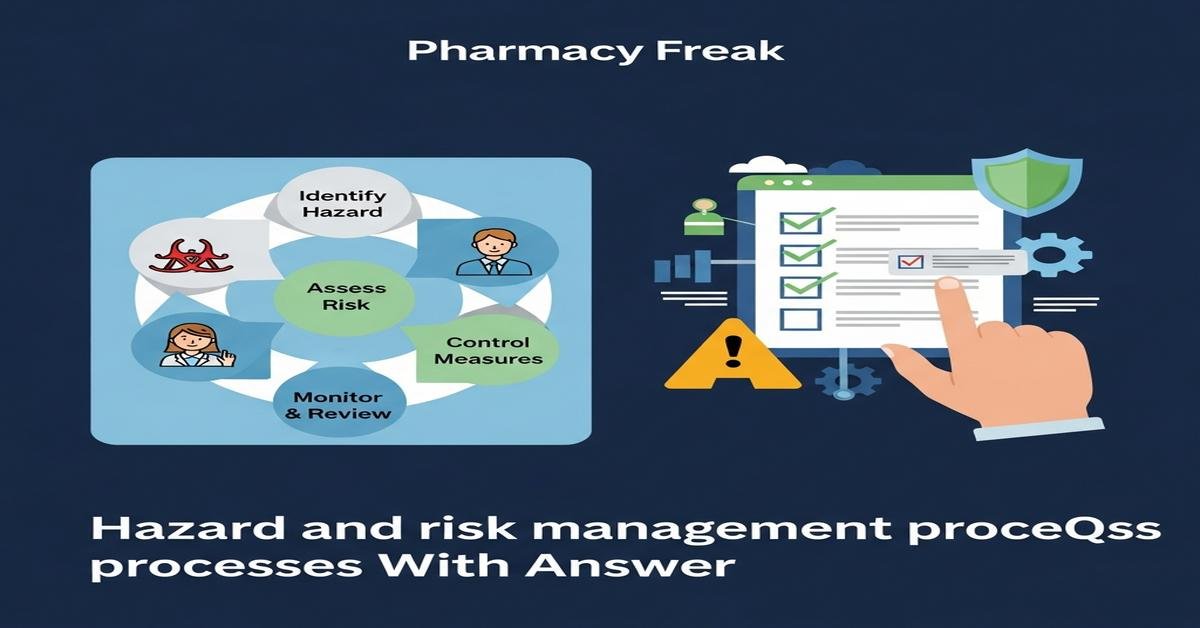
Introduction: Hazard and risk management processes MCQs With Answer is a focused quiz collection designed for M.Pharm students to deepen understanding of safety in pharmaceutical systems. These questions cover essential concepts such as hazard identification, risk assessment methods (qualitative and quantitative), industry tools like HAZOP, FMEA, HACCP and ICH Q9 principles, and practical controls used in manufacturing and clinical settings. Each item emphasizes application to pharma — contamination control, process deviations, toxic exposures and regulatory expectations — to help students prepare for exams and real-world problem solving. The set promotes critical thinking on risk prioritization, mitigation hierarchies, documentation and monitoring of residual risk.
Q1. What is the primary difference between a hazard and a risk?
- A hazard is the probability of harm; a risk is the source of potential harm
- A hazard is the source or situation with potential to cause harm; a risk is the likelihood and severity of that harm
- A hazard is always chemical; a risk is always physical
- A hazard is a documented control; a risk is the documented outcome
Correct Answer: A hazard is the source or situation with potential to cause harm; a risk is the likelihood and severity of that harm
Q2. Which international guidance specifically addresses quality risk management in pharmaceutical development and manufacturing?
- ISO 9001
- ICH Q9
- GMP Annex 1 only
- ISO 31000 exclusively
Correct Answer: ICH Q9
Q3. In a risk assessment matrix, what two dimensions are typically plotted to estimate risk?
- Cost and benefit
- Severity (impact) and likelihood (probability)
- Frequency and detectability only
- Time and resource availability
Correct Answer: Severity (impact) and likelihood (probability)
Q4. ALARP is a principle often applied in risk management. What does ALARP mean?
- As Low As Reasonably Practicable
- All Levels Assessed for Risk Potential
- Always Log And Record Processes
- Assess Likelihood And Rank Potential
Correct Answer: As Low As Reasonably Practicable
Q5. Which hazard analysis technique is structured around deviations using guidewords and process parameters?
- FMEA (Failure Mode and Effects Analysis)
- HAZOP (Hazard and Operability Study)
- Bow-tie analysis
- SWIFT (Structured What If Technique)
Correct Answer: HAZOP (Hazard and Operability Study)
Q6. In FMEA, which three numerical indices are typically combined to form the Risk Priority Number (RPN)?
- Severity, Occurrence, Detection
- Likelihood, Impact, Cost
- Probability, Exposure, Control
- Frequency, Duration, Visibility
Correct Answer: Severity, Occurrence, Detection
Q7. Which approach is most appropriate when quantitative data are limited but expert judgment is available?
- Quantitative risk assessment using probabilistic models only
- Qualitative risk assessment (e.g., risk matrix, expert scoring)
- Ignore the risk until data are available
- Automated sensor-based monitoring alone
Correct Answer: Qualitative risk assessment (e.g., risk matrix, expert scoring)
Q8. In pharmaceutical contamination control, which control is considered highest in the hierarchy of controls?
- Personal protective equipment (PPE)
- Administrative controls (training, procedures)
- Engineering controls (closed systems, containment)
- Substitution with a less hazardous compound
Correct Answer: Engineering controls (closed systems, containment)
Q9. What is the ‘top event’ in a bow-tie analysis?
- The ultimate consequence after all controls fail
- The initiating cause that starts a hazard chain
- The central undesired event linking threats and consequences
- An administrative action to mitigate risk
Correct Answer: The central undesired event linking threats and consequences
Q10. Which tool is most suitable for rapid, high-level review of potential risks and controls during early design?
- Detailed probabilistic risk assessment (PRA)
- SWIFT (Structured What If Technique)
- Full FMECA with RPN calculations
- Long-term epidemiological study
Correct Answer: SWIFT (Structured What If Technique)
Q11. What does residual risk refer to in a risk management process?
- The risk that remains after risk control measures have been implemented
- The initial risk before any controls are applied
- Theoretical risk that cannot occur in practice
- Risk that is transferred to a third party by contract
Correct Answer: The risk that remains after risk control measures have been implemented
Q12. Which of the following best represents a risk control hierarchy from most effective to least effective?
- PPE → Administrative → Engineering → Substitution → Elimination
- Elimination → Substitution → Engineering controls → Administrative controls → PPE
- Administrative → Engineering → Elimination → PPE → Substitution
- Substitution → PPE → Engineering → Administrative → Elimination
Correct Answer: Elimination → Substitution → Engineering controls → Administrative controls → PPE
Q13. For sterile manufacturing, which hazard analysis framework is commonly used to identify Critical Control Points to prevent contamination?
- HACCP (Hazard Analysis and Critical Control Points)
- Bow-tie analysis only
- ISO 9001 internal audit framework
- Root cause analysis (RCA) only
Correct Answer: HACCP (Hazard Analysis and Critical Control Points)
Q14. Which statement about risk communication is true?
- Risk communication is optional and limited to regulatory filings
- Effective risk communication should be clear, timely, and tailored to stakeholders
- Only technical staff should receive risk information
- Risk communication must always include quantitative probability values
Correct Answer: Effective risk communication should be clear, timely, and tailored to stakeholders
Q15. Which metric is most useful for monitoring the performance of a risk control program in a pharma plant?
- Number of safety posters displayed
- Key Performance Indicators (KPIs) such as number of near-misses reported, corrective actions closed, and deviation recurrence rate
- Total number of employees hired per year
- Annual budget size for the quality department
Correct Answer: Key Performance Indicators (KPIs) such as number of near-misses reported, corrective actions closed, and deviation recurrence rate
Q16. Which regulatory expectation relates to documenting risk assessments and decisions in pharmaceutical operations?
- Only verbal approval is sufficient for most risk decisions
- Regulators expect documented, science- and risk-based decisions (e.g., ICH Q9 and GMP guidance)
- Documentation is only needed when a recall occurs
- Risk assessments must be kept confidential from auditors
Correct Answer: Regulators expect documented, science- and risk-based decisions (e.g., ICH Q9 and GMP guidance)
Q17. What role does detectability play in FMEA scoring?
- Detectability represents how easy it is to find a failure mode before it reaches the customer or causes harm
- Detectability is a measure of the monetary cost of a failure
- Detectability is synonymous with severity
- Detectability only applies to biological hazards
Correct Answer: Detectability represents how easy it is to find a failure mode before it reaches the customer or causes harm
Q18. Which activity is essential after implementing risk controls to ensure ongoing effectiveness?
- Stopping monitoring once controls are in place
- Periodic review and monitoring, including trend analysis and management review
- Assuming the risk is eliminated permanently
- Only training new hires about the controls once
Correct Answer: Periodic review and monitoring, including trend analysis and management review
Q19. In a risk-based change control process, what should be evaluated before approving a process change?
- Only the cost implications of the change
- Potential impact on product quality, safety, and regulatory compliance, plus mitigation measures
- The change should be implemented immediately without review
- Whether the change will increase production speed only
Correct Answer: Potential impact on product quality, safety, and regulatory compliance, plus mitigation measures
Q20. Which of the following best describes a near-miss in safety management and its importance?
- A near-miss is a minor incident with no learning value
- A near-miss is an unplanned event that did not result in injury or damage but indicates a weakness; reporting helps prevent future incidents
- A near-miss is the same as a recorded non-conformance leading to product recall
- Near-misses should be ignored to avoid overburdening the quality system
Correct Answer: A near-miss is an unplanned event that did not result in injury or damage but indicates a weakness; reporting helps prevent future incidents

