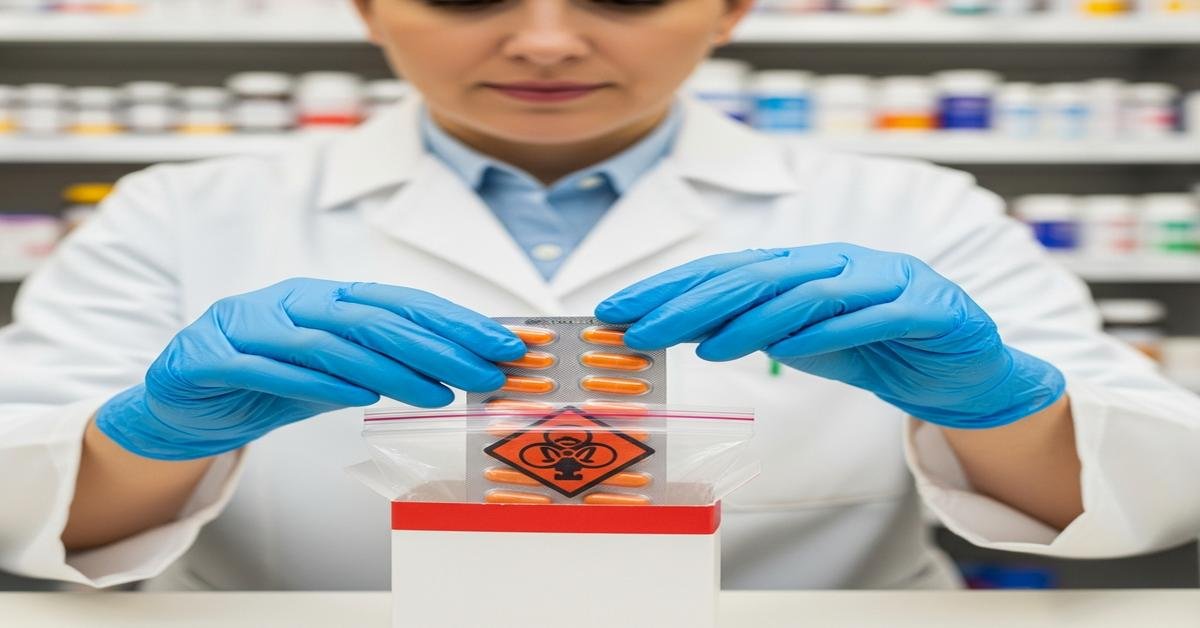
USP <800> is often treated as a “compounding rule.” That misses the point. The standard is about reducing exposure to hazardous drugs (HDs) wherever they are handled—receiving, storing, counting, packaging, transporting, cleaning, and disposing. If your community pharmacy touches antineoplastics, immunosuppressants, hormones, or other NIOSH-listed drugs, USP <800> applies. The risks are real: residue on bottle exteriors, powder during counting, and contaminated trays can expose staff and contaminate work areas. This article explains how to make retail workflows safer, using controls that are practical at the counter.
What USP <800> really covers—beyond compounding
USP <800> sets minimum practice and quality standards for handling hazardous drugs to protect workers, patients, and the environment. It references the NIOSH list of hazardous drugs, which groups them into:
- Group 1: Antineoplastics (for example, methotrexate, cyclophosphamide, capecitabine).
- Group 2: Non-antineoplastics that meet one or more hazard criteria (for example, carbamazepine, spironolactone, azathioprine, mycophenolate, methimazole).
- Group 3: Drugs posing reproductive risk (for example, finasteride, dutasteride, misoprostol, isotretinoin).
Retail tasks such as unpacking shipments, stocking, counting tablets/capsules, and cleaning are covered. Even “intact” tablets can shed dust, and bottle exteriors often carry residue. The law expects you to reduce that exposure with documented controls and training.
Where exposure happens at the retail counter
- Receiving: Bottles can arrive with contaminated exteriors. Damaged or leaking packages spread powder when opened.
- Storage: Jostling or leakage contaminates shelves and bins. Poorly contained storage increases spill risk.
- Counting: Pouring and tapping tablets creates dust. Shared trays transfer residue to non-HDs. Spatulas carry contamination forward.
- Packaging/Labeling: Handling bottles and vials transfers residue to hands and labels that patients touch.
- Returns and expired inventory: Handling open or compromised containers increases exposure.
- Cleaning: “Spray and wipe” can aerosolize particles. Using the wrong agents doesn’t deactivate drug.
- Spills: Cleanup spreads contamination if staff lack PPE and a plan.
Addressing these points is the fastest way to lower risk.
Build your store’s hazardous drug list and risk assessment
Start with a current NIOSH list and your dispensing data. Create a pharmacy-specific HD list that flags:
- Drug name and NIOSH group.
- Dosage form handled (tablet, capsule, liquid).
- Typical tasks (receiving, counting, returns).
- Controls you will apply (PPE, dedicated tools, cleaning).
For final dosage forms you only count and package, complete an Assessment of Risk (AoR). The AoR lets you use alternative strategies instead of full compounding containment, but only if you document how you’ll reduce exposure. Include the drug, dosage form, risk of dust/aerosol, packaging integrity, handling steps, and cleaning plan. Review and update at least annually or when you add new HDs.
Practical controls that work in community pharmacy
Controls fall into four buckets: engineering, administrative, PPE, and safe work practices. Most retail sites can implement these without renovations.
- Engineering/placement: Keep HD counting away from busy air currents. Use closed bins or lidded totes for storage. Place spill kits within reach of HD storage and the fill bench.
- Administrative: Maintain your HD list, AoR, SOPs, SDS access, and training records. Label HD shelves/bins. Post a simple “HD handling” quick guide at the bench.
- PPE: Wear chemotherapy-rated gloves (ASTM D6978 or equivalent) for all HD handling—receiving, counting, cleaning, and waste. Change gloves when torn, visibly contaminated, or at least every 30–60 minutes of continuous use. Consider double-gloving for antineoplastics or when handling multiple HD fills in a row. Add eye protection and a fit-tested N95 or better only if you risk dust or aerosol (for example, damaged bottles or spill cleanup). Gowns are generally not needed for intact tablets but are prudent for spill response.
- Dedicated tools: Use a HD-only counting tray and spatula, clearly labeled. Better yet, use disposable counting sheets or count inside a clean sealable plastic bag. Do not use your general tray for HDs.
- Work practices: Avoid crushing, splitting, compounding, or repackaging HDs in retail. If a patient insists on half tablets, contact the prescriber for an alternative strength or confirm if a non-HD alternative exists.
- Storage: Keep HDs in a designated, labeled area that prevents breakage and limits movement. Use bins with high sides and liners to contain leakage. Antineoplastics requiring manipulation beyond counting must be segregated in an externally ventilated, negative-pressure room; for final dosage forms you handle only to count and package, use your AoR to justify safer but simpler storage with strong spill controls.
- Labeling: Apply “Do not crush” and “Handle with care” as appropriate. Place a small “HD” icon on the stock bottle and in the software profile to cue PPE use.
- Waste: Place trace HD waste (gloves, wipes, empty vials/bottles that held HDs) in designated containers per your waste vendor’s guidance. Never put HD residues in regular trash. Treat liquid leaks and visibly contaminated materials as bulk HD waste and follow vendor/state rules.
Step-by-step: filling a hazardous tablet safely
- Perform hand hygiene. Don chemotherapy-rated gloves.
- Gather your HD-only tray and spatula or a fresh disposable counting surface. If using a bag, place the bag over the opening of the stock bottle and pour tablets into the bag to reduce dust.
- Open the stock bottle gently. Avoid tapping or “snapping” caps that flick particles.
- Count the dose on the dedicated surface or inside the bag. Minimize drops and sliding.
- Transfer to the patient vial using a funnel or by pouring from the bag. Cap promptly.
- Wipe the outside of the patient vial with a dedicated HD wipe. Apply labels and required auxiliary warnings.
- Return the stock bottle to the HD storage area.
- Decontaminate the tray/spatula or discard the disposable surface. See cleaning sequence below.
- Remove gloves, discard as HD waste, and perform hand hygiene.
Reasoning: Each step reduces the chance that particles spread to shared surfaces or your hands. Bag counting or disposable sheets limit cross-contamination and cut cleanup time.
Cleaning and decontamination that actually removes drug
Ordinary disinfectants do not neutralize chemotherapy agents or many HDs. Follow a four-step sequence on HD work areas, tools, and bins:
- Deactivation: Use a compatible agent (commonly a sodium hypochlorite solution) to chemically inactivate HD residue. If bleach isn’t compatible with your surface, use the agent recommended by your surface or product manufacturer.
- Decontamination: Wipe to physically remove residue using low-lint wipes. Work from clean to dirty, top to bottom. Wet wipes—do not spray—to avoid aerosolization.
- Cleaning: Use a detergent and water to remove remaining soil and deactivation residues.
- Disinfection: Where needed for patient safety (for example, if the area also handles sterile items), use an alcohol-based disinfectant after cleaning.
Neutralize bleach residues (for example, with sodium thiosulfate or water) to avoid corrosion. Clean the HD tray and spatula after each use. Wipe HD storage bins and nearby touch points at least daily and after any spill.
Spills and damaged bottles
A damaged HD bottle is a spill, even if you don’t see powder. Treat it with your spill protocol:
- Clear the area. Put on chemotherapy gloves, eye protection, a disposable gown, and an appropriate respirator if dust is visible.
- Use an HD spill kit: absorbent pads, wipes, scoop/scraper, and waste bags. Work from the outer edge inward to contain spread.
- Place all cleanup materials and debris into HD waste. Seal and label per your vendor’s instructions.
- Decontaminate the area using the four-step sequence. Document the incident and restock the spill kit.
- Exposure response: if skin contact occurs, wash with soap and water; for eyes, flush with water for at least 15 minutes. Report the exposure and seek medical evaluation as your policy directs.
Why this matters: quick, correct response limits contamination, protects coworkers, and avoids repeated low-level exposure from missed residue.
Protecting vulnerable workers and patients
- Personnel assignment: Provide alternative duties for staff who are pregnant, breastfeeding, or trying to conceive if they wish to avoid HD exposure. This is both a safety and staffing retention issue.
- Training and competency: Train all staff who may touch HDs before they handle them and reassess at least annually. Cover your HD list, PPE, counting procedure, cleaning, spill response, waste, and exposure reporting. Verify competency by observation.
- Patient counseling: Advise patients on safe home handling: keep drugs in original containers, avoid crushing or opening capsules, wash hands after handling, wear gloves if caregivers handle doses, store away from children and pets, and return unused meds per pharmacy instructions. For drugs with reproductive risk, caution pregnant caregivers.
Common pitfalls and how to fix them
- Myth: “Intact tablets are safe to count without gloves.” Reality: residue is common. Wear chemotherapy gloves and clean your tools.
- Myth: “One tray for everything is fine if we wipe sometimes.” Reality: cross-contamination is likely. Use a dedicated HD tray or disposable surfaces.
- Myth: “We don’t handle chemo, so USP <800> doesn’t apply.” Reality: many common drugs are on the NIOSH list (for example, finasteride, carbamazepine, methotrexate). Build your HD list and AoR.
- Myth: “Alcohol wipes are enough.” Reality: alcohol disinfects but doesn’t deactivate HDs. Use the four-step cleaning sequence.
- Myth: “Gloves go in regular trash.” Reality: contaminated PPE is HD waste; follow your vendor/state rules.
A simple retail-ready checklist
- We have a current pharmacy-specific HD list and an Assessment of Risk for each final dosage form we only count/package.
- HD areas and bins are labeled; HD icons appear on stock and in software.
- Chemotherapy-rated gloves are available at every HD touchpoint (receiving, storage, fill bench); staff use and change them correctly.
- There is a clearly labeled HD-only counting tray and spatula, or disposable counting sheets/bags, with SOPs posted at the bench.
- We follow the four-step cleaning sequence after each HD fill and at the end of the day; supplies are stocked and compatible with our surfaces.
- Spill kits are placed near HD storage and the bench; staff know the spill procedure and exposure response.
- Trace and bulk HD waste streams are set up with our vendor; staff know what goes where.
- Training, competencies, and incident reports are documented; policies address pregnant/breastfeeding staff.
USP <800> is about everyday exposure, not just compounding rooms. With a short list, a simple AoR, the right gloves, dedicated tools, and reliable cleaning, community pharmacies can meaningfully cut risk. The payoff is safer staff, cleaner counters, and fewer surprises when inspectors ask how you handle hazardous pills at the retail counter.

