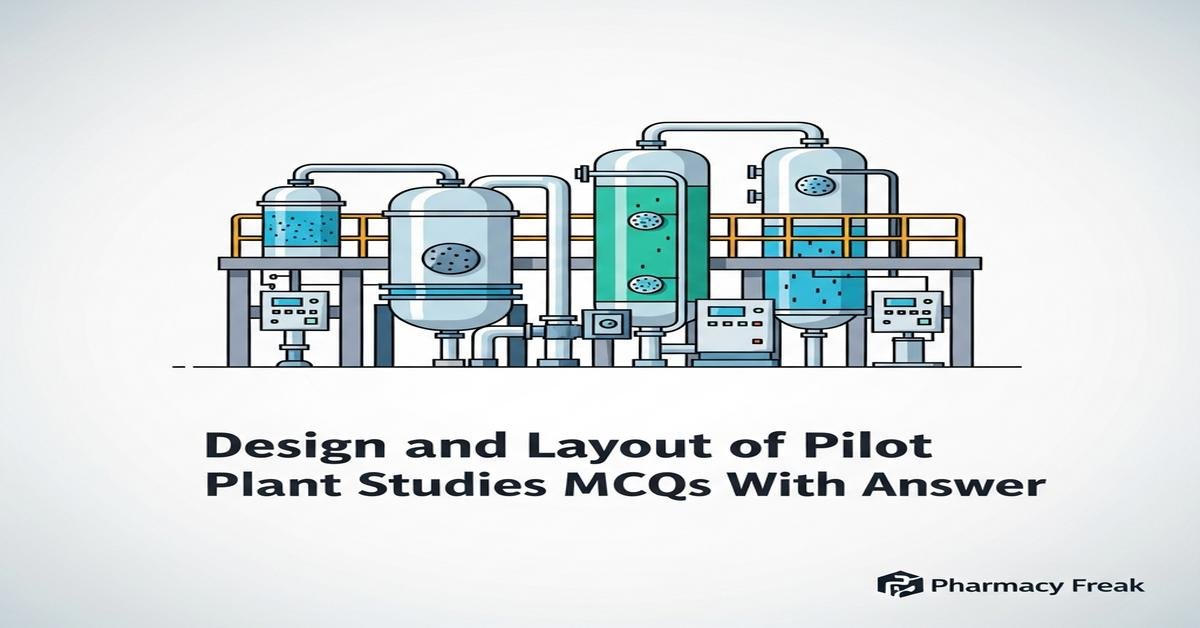
Introduction: Design and layout of pilot plant studies is a crucial topic for M.Pharm students preparing for roles in product development and technology transfer. A well-planned pilot plant bridges laboratory research and full-scale manufacturing by validating processes, equipment, utilities, material handling, and quality controls under scaled conditions. This blog presents targeted multiple-choice questions to test understanding of layout principles, flow patterns, safety zoning, GMP requirements, equipment selection, scale-up challenges, and documentation essential for successful tech transfer. These MCQs emphasize practical decision-making, regulatory compliance, and risk mitigation needed to design efficient, flexible, and regulatory-compliant pilot facilities that support robust process development.
Q1. Which principle is most important when determining the material flow in a pilot plant layout?
- Maximizing worker movement between units
- Ensuring product flows from dirty to clean areas
- Minimizing equipment footprint regardless of flow
- Locating utilities central to office spaces
Correct Answer: Ensuring product flows from dirty to clean areas
Q2. What is the primary purpose of a pilot plant study in pharmaceutical development?
- To produce commercial-scale batches for sale
- To validate process scalability and identify operational risks
- To reduce documentation required for regulatory filings
- To replace clinical trials with in-house testing
Correct Answer: To validate process scalability and identify operational risks
Q3. Which layout concept best supports multi-product flexibility in a pilot facility?
- Dedicated single-product rooms with fixed equipment
- Linear production flow with non-segregated utilities
- Modular islands with mobile/skid-mounted equipment
- Combined R&D and production spaces with shared drains
Correct Answer: Modular islands with mobile/skid-mounted equipment
Q4. In pilot plant design, which factor is critical for successful scale-up of a mixing operation?
- Color of the mixing vessel
- Turbulent Reynolds number and geometric similarity
- Operator preference for agitator type only
- Number of drains in adjacent areas
Correct Answer: Turbulent Reynolds number and geometric similarity
Q5. Which utility segregation is required to maintain product quality in a pilot plant?
- Combining steam and potable water lines for efficiency
- Dedicated purified water (PW) and clean steam systems for product contact
- Using building water for all non-critical rinses
- Routing compressed air through office HVAC
Correct Answer: Dedicated purified water (PW) and clean steam systems for product contact
Q6. What is the most appropriate zoning strategy to prevent cross-contamination in a multiproduct pilot plant?
- Random placement of products based on available bench space
- Segregation by risk with separate airlocks and directional airflow
- Shared open rooms with frequent cleaning between batches
- Locating high-risk products near waste collection points
Correct Answer: Segregation by risk with separate airlocks and directional airflow
Q7. For hazard control in a pilot plant handling flammable solvents, which design element is most essential?
- Installing carpet flooring to reduce slips
- Explosion-proof electricals and solvent-resistant ventilation
- Maximizing natural light through large windows
- Using plastic piping throughout the facility
Correct Answer: Explosion-proof electricals and solvent-resistant ventilation
Q8. Which documentation is central to transferring a process from pilot plant to commercial manufacturing?
- Operator personal diaries only
- Comprehensive technology transfer dossier including process description, critical parameters, scale-up data, and validation protocols
- Only batch records for pilot batches
- Marketing brochures and product images
Correct Answer: Comprehensive technology transfer dossier including process description, critical parameters, scale-up data, and validation protocols
Q9. What is a key consideration for sampling ports and in-process analytics in pilot plant layout?
- Place sampling ports only on the return side of vessels
- Ensure safe, representative, and accessible sampling points with PAT integration
- Avoid permanent sample ports to reduce cleaning requirements
- Locate PAT sensors in operator walkways for convenience
Correct Answer: Ensure safe, representative, and accessible sampling points with PAT integration
Q10. Which cleaning strategy is most practical for pilot plants that handle multiple formulations?
- Ad-hoc cleaning by operators without records
- Risk-based cleaning validation with documented cleaning procedures and swab limits
- Rinse only with tap water after each use
- Rely solely on single-use disposables for all processes
Correct Answer: Risk-based cleaning validation with documented cleaning procedures and swab limits
Q11. In terms of maintenance and process uptime, what layout feature improves accessibility?
- Clustered equipment with no service aisles
- Provision of adequate service aisles and clearances around equipment
- Installing fixed walls that permanently enclose equipment
- Placing heavy utilities directly above mixers without access
Correct Answer: Provision of adequate service aisles and clearances around equipment
Q12. Which factor best justifies using a pilot plant run to generate process validation data?
- Pilot runs are cheaper than analytical testing
- Pilot runs provide representative process performance and variability data to inform validation
- Pilot data can be omitted when lab data exists
- Pilot plant runs can replace stability studies
Correct Answer: Pilot runs provide representative process performance and variability data to inform validation
Q13. When selecting pumps and transfer lines for viscous formulations in pilot plants, what is crucial?
- Choosing the smallest diameter lines to save space
- Selecting pump types and line diameters that maintain laminar flow only
- Matching pump characteristics and line sizing to prevent excessive shear and ensure complete transfer
- Using flexible garden hoses for flexibility
Correct Answer: Matching pump characteristics and line sizing to prevent excessive shear and ensure complete transfer
Q14. What is the role of risk assessment (e.g., FMEA) in pilot plant design?
- To eliminate the need for process validation
- To proactively identify failure modes, prioritize mitigation measures and influence layout decisions
- To increase documentation without influencing design
- To serve only as an HR compliance checklist
Correct Answer: To proactively identify failure modes, prioritize mitigation measures and influence layout decisions
Q15. Which HVAC consideration is critical for a pilot plant producing sterile formulations?
- Use of recirculated air without HEPA filtration
- Strict control of air classification, HEPA filtration, positive pressure cascade, and validated air change rates
- Providing no air changes to minimize turbulence
- Relying on natural ventilation through windows
Correct Answer: Strict control of air classification, HEPA filtration, positive pressure cascade, and validated air change rates
Q16. For pilot plant safety, which feature helps manage chemical spills effectively?
- Sloped floors toward process areas without containment
- Provision of dedicated spill containment zones, bunding, and graded drainage to safe collection points
- Routing spills directly into storm drains
- Removing all floor drains to avoid contamination
Correct Answer: Provision of dedicated spill containment zones, bunding, and graded drainage to safe collection points
Q17. How should waste streams be handled in a pilot plant layout to ensure compliance?
- Mix hazardous and non-hazardous waste to simplify disposal
- Segregate waste streams, label collection points, and route to appropriate treatment or disposal systems
- Store waste indefinitely next to product areas
- Send all waste to the municipal sewer without pre-treatment
Correct Answer: Segregate waste streams, label collection points, and route to appropriate treatment or disposal systems
Q18. Which instrumentation strategy supports robust process characterization during pilot studies?
- Minimal instrumentation to reduce costs
- Comprehensive monitoring of critical parameters, inline sensors, and data logging for statistical analysis
- Manual readings only at the end of the run
- Only visual inspection of process conditions
Correct Answer: Comprehensive monitoring of critical parameters, inline sensors, and data logging for statistical analysis
Q19. What is an advantage of skid-mounted pilot equipment during technology transfer?
- Fixed installation increases complexity
- Skid units allow easier relocation, reproducible plumbing, and simpler scale-matching during transfer
- They prevent integration with existing utilities
- They are always more expensive with no operational benefit
Correct Answer: Skid units allow easier relocation, reproducible plumbing, and simpler scale-matching during transfer
Q20. When designing a pilot plant for biologics, which consideration is particularly critical compared with small-molecule facilities?
- Biologics require no segregation or sterile control
- Strict containment of biohazards, validated aseptic processing, and specialized cold chain and single-use options
- Standard HVAC and raw water are sufficient
- Use of solvent-proof materials is the only concern
Correct Answer: Strict containment of biohazards, validated aseptic processing, and specialized cold chain and single-use options

