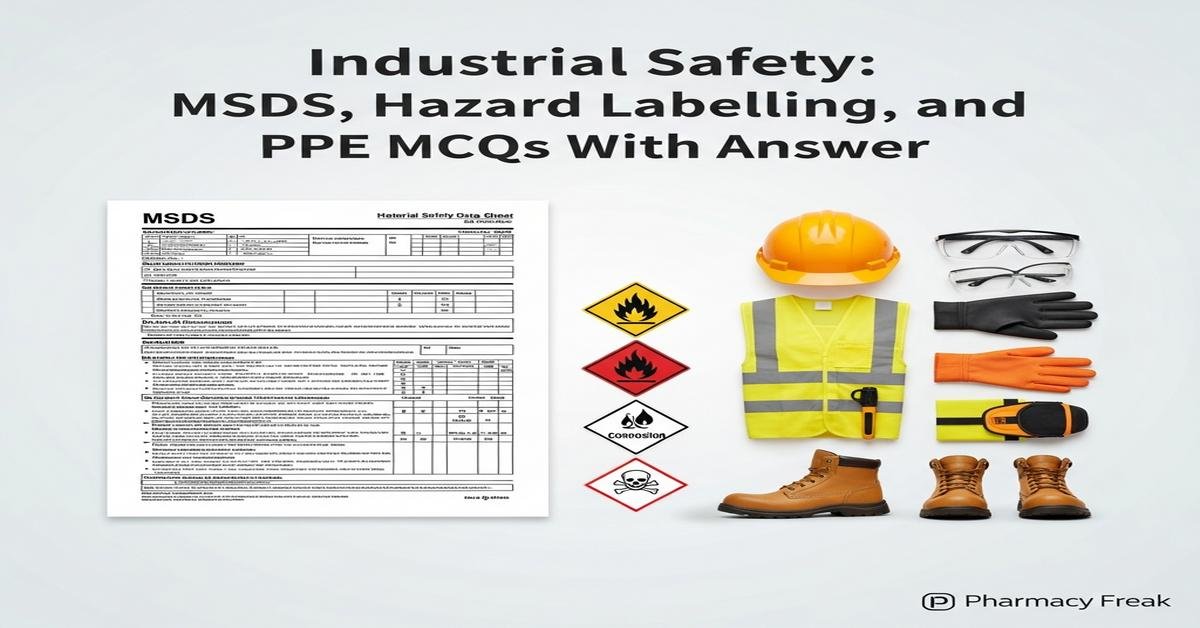
Introduction: This quiz set focuses on Industrial Safety topics relevant to M.Pharm students, emphasizing Material Safety Data Sheets (MSDS/SDS), hazard labelling under GHS, and personal protective equipment (PPE). Pharmaceutical process chemists must accurately interpret safety data, classify hazards, read and prepare correct labels, and select appropriate PPE for laboratory and production settings. These 20 carefully designed MCQs probe practical understanding — SDS structure and key sections, GHS pictograms and signal words, storage compatibility, exposure controls, emergency response, and respirator/PPE selection — to reinforce safe practices in pharmaceutical manufacturing and research environments. Answers include clear, authoritative choices to aid study and exam preparation.
Q1. What is the primary purpose of a Material Safety Data Sheet (MSDS) or Safety Data Sheet (SDS)?
- To provide sales and marketing information about the chemical
- To list regulatory citations only without practical guidance
- To provide detailed information on hazards, safe handling, storage, and emergency measures
- To record production batch data for quality control
Correct Answer: To provide detailed information on hazards, safe handling, storage, and emergency measures
Q2. According to the Globally Harmonized System (GHS), which element is NOT required on a workplace label for a hazardous chemical?
- Product identifier
- Supplier contact information
- Hazard pictogram(s)
- Manufacturing process flow diagram
Correct Answer: Manufacturing process flow diagram
Q3. How many standardized sections are in a GHS-compliant SDS and which section contains first aid measures?
- 12 sections; Section 3 contains first aid measures
- 16 sections; Section 4 contains first aid measures
- 20 sections; Section 5 contains first aid measures
- 10 sections; Section 2 contains first aid measures
Correct Answer: 16 sections; Section 4 contains first aid measures
Q4. Which GHS pictogram indicates acute toxicity (fatal or toxic)?
- Exclamation mark
- Corrosion
- Skull and crossbones
- Health hazard (silhouette with star)
Correct Answer: Skull and crossbones
Q5. Which GHS signal word is used for more severe hazards?
- Notice
- Warning
- Danger
- Caution
Correct Answer: Danger
Q6. The NFPA 704 diamond provides quick information on four hazard categories. What does the blue quadrant represent?
- Flammability
- Instability/Reactivity
- Special hazards such as oxidizers
- Health hazards
Correct Answer: Health hazards
Q7. Which of the following correctly ranks the hierarchy of controls for preventing chemical exposure from most to least preferred?
- PPE → Administrative controls → Engineering controls
- Engineering controls → Administrative controls → PPE
- Administrative controls → PPE → Engineering controls
- Substitution → PPE → Engineering controls
Correct Answer: Engineering controls → Administrative controls → PPE
Q8. For handling concentrated strong acids in a synthesis lab, which PPE combination is most appropriate?
- Cotton lab coat, latex gloves, safety glasses
- Flame-retardant coveralls, no gloves, face shield
- Acid-resistant gloves (e.g., neoprene or butyl), splash goggles plus face shield, chemical-resistant apron
- Nitrile gloves only and prescription glasses
Correct Answer: Acid-resistant gloves (e.g., neoprene or butyl), splash goggles plus face shield, chemical-resistant apron
Q9. Which storage practice best prevents a dangerous reaction in a chemical storeroom?
- Store oxidizers together with flammable organics on the same shelf
- Segregate oxidizers from organics and keep acids separate from bases
- Mix all waste chemicals to minimize inventory
- Store all chemicals alphabetically regardless of hazard class
Correct Answer: Segregate oxidizers from organics and keep acids separate from bases
Q10. In the event of a small corrosive acid spill on a bench, the first priority action is:
- Begin neutralization with a strong base immediately
- Evacuate the building and wait for emergency services
- Don appropriate PPE, stop the source if safe, and contain/absorb the spill
- Use bare hands to move containers away from the spill
Correct Answer: Don appropriate PPE, stop the source if safe, and contain/absorb the spill
Q11. Which SDS section provides information on appropriate personal protective equipment and exposure controls?
- Section 2: Hazard Identification
- Section 8: Exposure Controls / Personal Protection
- Section 12: Ecological Information
- Section 16: Other Information
Correct Answer: Section 8: Exposure Controls / Personal Protection
Q12. Which respiratory protection is most appropriate for an organic solvent vapor concentration slightly above the occupational exposure limit and with no oxygen deficiency?
- N95 disposable particulate respirator
- Half-face air-purifying respirator with appropriate organic vapor cartridges
- No respirator; rely on surgical mask
- Full chemical suit without a respirator
Correct Answer: Half-face air-purifying respirator with appropriate organic vapor cartridges
Q13. What is the Assigned Protection Factor (APF) typical for a properly fitted N95 filtering facepiece respirator according to OSHA guidance?
- APF = 2
- APF = 10
- APF = 50
- APF = 100
Correct Answer: APF = 10
Q14. Which pictogram would be used for a chemical classified as an irritant and skin sensitizer under GHS?
- Health hazard (silhouette with star)
- Exclamation mark
- Exploding bomb
- Gas cylinder
Correct Answer: Exclamation mark
Q15. Which statement best describes a chemical’s flashpoint?
- The temperature at which the chemical boils
- The temperature at which a liquid gives off enough vapour to ignite in air when an ignition source is present
- The temperature at which a chemical becomes nonflammable
- The maximum safe storage temperature for a chemical
Correct Answer: The temperature at which a liquid gives off enough vapour to ignite in air when an ignition source is present
Q16. Which SDS section provides guidance on disposal considerations for a chemical?
- Section 6: Accidental Release Measures
- Section 13: Disposal Considerations
- Section 10: Stability and Reactivity
- Section 1: Identification
Correct Answer: Section 13: Disposal Considerations
Q17. For peroxide-forming reagents (e.g., diethyl ether), safe management in a storage area includes which key practice?
- Store them in direct sunlight to keep them warm
- Never date or test; use oldest bottle first regardless of date
- Store in tightly sealed, dark containers, date upon receipt and test periodically for peroxides
- Mix them with strong oxidizers to stabilize
Correct Answer: Store in tightly sealed, dark containers, date upon receipt and test periodically for peroxides
Q18. Which PPE material is generally recommended over latex for organic solvent resistance in the pharmaceutical lab?
- Latex
- Nitrile
- Cloth
- Cotton
Correct Answer: Nitrile
Q19. Before entering a confined space in a pharmaceutical plant, which action is essential?
- Ensure continuous atmospheric monitoring for oxygen, flammable gases, and toxic vapours
- Enter quickly without PPE to save time
- Rely solely on handheld flashlights for lighting
- Assume the space is safe because it is indoors
Correct Answer: Ensure continuous atmospheric monitoring for oxygen, flammable gases, and toxic vapours
Q20. Which label element specifically communicates recommended preventative measures and actions to take in case of exposure under GHS?
- Product identifier
- Precautionary statements
- Supplier address
- Manufacturer batch number
Correct Answer: Precautionary statements

