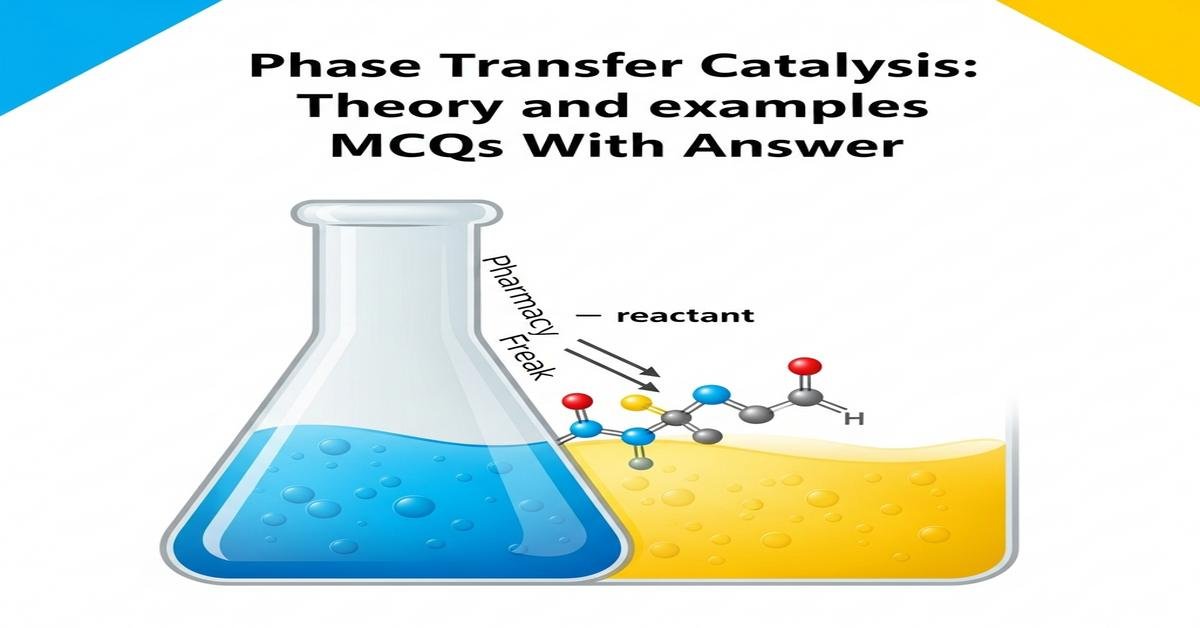
Phase Transfer Catalysis: theory and examples MCQs With Answer
Introduction: Phase-transfer catalysis (PTC) is a powerful strategy in organic synthesis that enables reactions between reagents located in different phases, typically an aqueous ionic phase and an organic phase. For M.Pharm students, understanding PTC is vital because it allows efficient alkylations, substitutions, and enolate reactions under mild conditions with improved yields and selectivity. This quiz focuses on the mechanistic basis of PTC, common catalysts (quaternary ammonium/phosphonium salts, crown ethers), reaction examples, kinetic and practical aspects, and limitations such as side reactions and catalyst deactivation. The questions are designed to deepen conceptual understanding and prepare you for advanced pharmaceutical synthesis problems.
Q1. What is the fundamental role of a phase-transfer catalyst in a biphasic reaction system?
- To transfer an ionic reagent from one phase into another, enabling reaction with an organic substrate
- To increase the temperature of the organic phase selectively
- To form covalent bonds with both reactants and act as a stoichiometric reagent
- To act as a homogeneous acid catalyst in the organic phase
Correct Answer: To transfer an ionic reagent from one phase into another, enabling reaction with an organic substrate
Q2. Which of the following are the most commonly used classes of phase-transfer catalysts?
- Quaternary ammonium salts (e.g., tetrabutylammonium bromide) and crown ethers
- Strong Brønsted acids and Lewis acids
- Transition-metal complexes like palladium and rhodium
- Enzymes and biological cofactors
Correct Answer: Quaternary ammonium salts (e.g., tetrabutylammonium bromide) and crown ethers
Q3. How do crown ethers act as phase-transfer catalysts?
- By complexing cations (e.g., K+) to solubilize corresponding anions in the organic phase
- By donating protons to activate nucleophiles in the aqueous phase
- By acting as oxidizing agents to generate radical intermediates
- By forming strong covalent bonds with the organic substrate
Correct Answer: By complexing cations (e.g., K+) to solubilize corresponding anions in the organic phase
Q4. Which type of organic reaction is most typically accelerated by phase-transfer catalysis?
- SN2 nucleophilic substitution reactions such as alkylation of phenoxides or enolates
- Pericyclic [4+2] cycloadditions
- Free-radical polymerizations initiated thermally
- Metal-catalyzed hydrogenations
Correct Answer: SN2 nucleophilic substitution reactions such as alkylation of phenoxides or enolates
Q5. Which description best fits a “solid–liquid” phase-transfer catalytic process?
- Reaction occurring at the solid–liquid interface where the catalyst facilitates transfer of ionic species from the solid into the liquid
- Homogeneous catalysis in a single-phase molten reactant
- Catalysis by soluble enzymes immobilized on supports
- Gas–liquid catalytic reactions using volatile phase-transfer agents
Correct Answer: Reaction occurring at the solid–liquid interface where the catalyst facilitates transfer of ionic species from the solid into the liquid
Q6. What is a primary practical advantage of using phase-transfer catalysis in pharmaceutical synthesis?
- Enables efficient reactions under mild, often aqueous-compatible conditions with reduced need for dry, aprotic solvents
- Always gives 100% conversion regardless of substrate structure
- Makes transition-metal catalysts unnecessary for all coupling reactions
- Eliminates the need for any reaction workup or purification
Correct Answer: Enables efficient reactions under mild, often aqueous-compatible conditions with reduced need for dry, aprotic solvents
Q7. Which of the following processes is least likely to be described as phase-transfer catalyzed?
- Hydrogenation of an alkene with Pd/C under H2 in a single organic phase
- Alkylation of an aqueous phenoxide using a quaternary ammonium catalyst
- Nucleophilic substitution of a haloalkane by acetate anion transferred into organic phase
- Base-promoted epoxidation where the base is shuttled into the organic phase by a crown ether
Correct Answer: Hydrogenation of an alkene with Pd/C under H2 in a single organic phase
Q8. What is the primary role of tetrabutylammonium bromide (TBAB) in a PTC reaction?
- To form a lipophilic ion pair with an anionic nucleophile and carry it into the organic phase
- To act as a radical initiator for oxidative coupling
- To chelate metal ions and deactivate them
- To protonate nucleophiles and make them less reactive
Correct Answer: To form a lipophilic ion pair with an anionic nucleophile and carry it into the organic phase
Q9. What distinguishes asymmetric (enantioselective) phase-transfer catalysis?
- Use of chiral quaternary ammonium (or related) catalysts to induce enantioselectivity in reactions like alkylation of glycine derivatives
- Use of metal catalysts to coordinate both reactants symmetrically
- Use of achiral tetrabutylammonium salts at very low temperature
- Enantioselectivity achieved by simply changing solvent polarity
Correct Answer: Use of chiral quaternary ammonium (or related) catalysts to induce enantioselectivity in reactions like alkylation of glycine derivatives
Q10. Which solvent system is most appropriate for a typical aqueous-organic PTC reaction?
- A biphasic system composed of water and a nonpolar organic solvent immiscible with water (e.g., toluene or dichloromethane)
- A single-phase mixture of water and methanol in all proportions
- A supercritical CO2 medium only
- Pure ionic liquid with no immiscibility
Correct Answer: A biphasic system composed of water and a nonpolar organic solvent immiscible with water (e.g., toluene or dichloromethane)
Q11. In many PTC-catalyzed SN2 reactions, which step is often rate-determining?
- Transfer of the nucleophilic anion from the aqueous phase into the organic phase (mass transfer across the interface)
- Diffusion of the organic substrate in the organic bulk
- Thermal decomposition of the catalyst
- Formation of covalent catalyst–substrate adducts
Correct Answer: Transfer of the nucleophilic anion from the aqueous phase into the organic phase (mass transfer across the interface)
Q12. What common side reaction can deactivate quaternary ammonium phase-transfer catalysts under strongly basic, high-temperature conditions?
- Hofmann elimination of the quaternary ammonium salt to give tertiary amine and an alkene
- Oxidative cleavage to yield carboxylic acids
- Diels–Alder polymerization of the catalyst
- Radical chain fragmentation of the catalyst backbone
Correct Answer: Hofmann elimination of the quaternary ammonium salt to give tertiary amine and an alkene
Q13. Why is 18-crown-6 particularly effective in promoting reactions of potassium salts under PTC conditions?
- Because it selectively complexes K+ to give a charge-separated pair, increasing solubility of the anion in organic solvents
- Because it directly protonates the substrate and increases acidity
- Because it oxidizes the potassium to K2O
- Because it acts as a strong Brønsted base in the organic phase
Correct Answer: Because it selectively complexes K+ to give a charge-separated pair, increasing solubility of the anion in organic solvents
Q14. How does catalyst concentration typically affect the rate of a PTC process?
- The rate increases with catalyst concentration up to a saturation point; beyond that additional catalyst gives little further rate enhancement
- Rate decreases linearly with increasing catalyst concentration
- Rate is completely independent of catalyst concentration at all levels
- Catalyst concentration only affects stereochemistry, not rate
Correct Answer: The rate increases with catalyst concentration up to a saturation point; beyond that additional catalyst gives little further rate enhancement
Q15. Which of the following is an illustrative example of a PTC reaction commonly used in pharmaceutical intermediate synthesis?
- Alkylation of diethyl malonate or glycine derivatives with alkyl halides under aqueous base and a quaternary ammonium catalyst
- Pd-catalyzed Suzuki coupling in a single organic phase
- Radical bromination with N-bromosuccinimide in benzene without any catalyst
- Biocatalytic reduction using whole cells
Correct Answer: Alkylation of diethyl malonate or glycine derivatives with alkyl halides under aqueous base and a quaternary ammonium catalyst
Q16. What kind of ion pair is typically formed when a quaternary ammonium PTC carries an anion into the organic phase?
- A lipophilic ion pair consisting of the quaternary ammonium cation and the anionic nucleophile (e.g., R4N+·X−)
- A covalent quaternary ammonium–substrate complex
- A metal–ligand coordination complex
- An uncharged hydrogen-bonded dimer
Correct Answer: A lipophilic ion pair consisting of the quaternary ammonium cation and the anionic nucleophile (e.g., R4N+·X−)
Q17. How does PTC often reduce the necessity for strictly anhydrous (dry) reaction conditions?
- Because the catalytic cycle shuttles ionic reactants between phases, reactions tolerate water and can use aqueous base directly
- Because PTC catalysts chemically remove water by dehydration
- Because PTC reactions occur only in nonpolar solvents that exclude water
- Because PTC catalysts react stoichiometrically with water to consume it
Correct Answer: Because the catalytic cycle shuttles ionic reactants between phases, reactions tolerate water and can use aqueous base directly
Q18. What operational parameter most directly increases the rate of phase-transfer catalyzed biphasic reactions by enhancing interfacial area?
- Agitation or stirring intensity to create smaller droplets and larger interfacial contact
- Lowering the reaction temperature to freeze one phase
- Adding excess salt to cause complete phase separation
- Using a catalyst that is completely insoluble in both phases
Correct Answer: Agitation or stirring intensity to create smaller droplets and larger interfacial contact
Q19. Compared with quaternary ammonium salts, what is a typical advantage of using quaternary phosphonium salts as PTCs?
- They are generally more thermally stable and less prone to Hofmann elimination under strongly basic conditions
- They always give higher enantioselectivity in asymmetric reactions
- They are more water-soluble and cannot transfer ions to organic phase
- They readily form covalent bonds with nucleophiles deactivating them
Correct Answer: They are generally more thermally stable and less prone to Hofmann elimination under strongly basic conditions
Q20. Which statement about enantioselective phase-transfer catalysis is false?
- It often employs chiral quaternary ammonium salts to induce stereocontrol in carbon–carbon bond-forming reactions
- High enantioselectivity can be achieved for alkylation of certain glycine or glycine-derivative enolates
- It frequently operates efficiently at low temperatures to enhance enantioselectivity
- It always requires a transition-metal co-catalyst to achieve any enantioselectivity
Correct Answer: It always requires a transition-metal co-catalyst to achieve any enantioselectivity

