Introduction
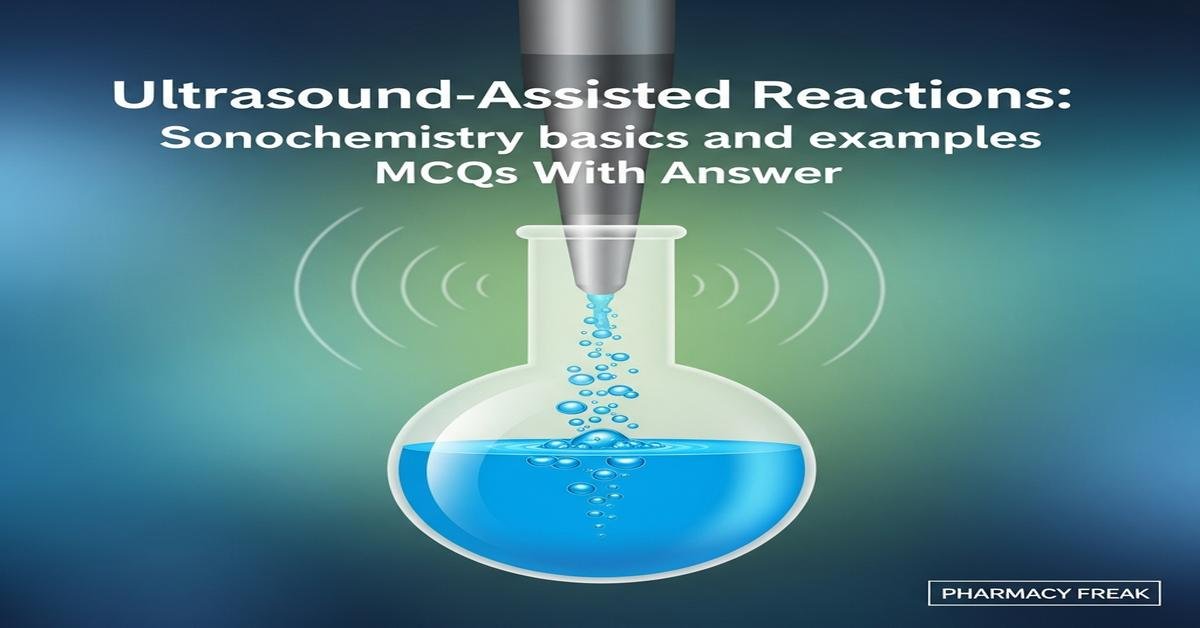
Ultrasound-assisted reactions (sonochemistry) use acoustic cavitation — the formation, growth and implosive collapse of bubbles in liquids — to create extreme local temperatures, pressures and shear forces that accelerate chemical transformations. For M.Pharm students, sonochemistry is important for greener synthesis, faster reaction rates, improved mass transfer in heterogeneous systems, nanoparticle and drug formulation, and enhanced extraction of bioactives. This quiz collection focuses on the physical basis of sonochemistry, key experimental parameters (frequency, amplitude, probe vs bath), radical-mediated pathways, representative reaction examples, scale-up and safety issues. These MCQs will help M.Pharm students apply sonochemical principles to pharmaceutical research and formulation development.
Q1. What is the primary phenomenon responsible for chemical effects in sonochemistry?
- The formation, growth and rapid collapse of microscopic bubbles (acoustic cavitation)
- Direct heating of the entire reaction vessel by ultrasound
- Generation of a uniform static electric field in solution
- Formation of long-lived stable micelles that catalyze reactions
Correct Answer: The formation, growth and rapid collapse of microscopic bubbles (acoustic cavitation)
Q2. Which frequency range is most commonly used for sonochemical reactions in synthetic laboratories?
- 20 kHz – 1 MHz
- 0.5 Hz – 50 Hz
- 10 MHz – 100 MHz
- Above 1 GHz
Correct Answer: 20 kHz – 1 MHz
Q3. Which reactive species are typically produced by sonolysis of water during cavitation?
- Hydroxyl radicals (OH•) and hydrogen atoms (H•)
- Peroxide anions (O2 2−) and molecular nitrogen (N2)
- Stable carbenes and nitrenes
- Chlorine radicals (Cl•) exclusively
Correct Answer: Hydroxyl radicals (OH•) and hydrogen atoms (H•)
Q4. Which of the following is NOT a typical advantage of applying ultrasound to chemical reactions?
- Enhanced mass transfer in heterogeneous systems
- Generation of short-lived reactive radicals
- Require substantially higher catalyst loading compared with silent conditions
- Reduction in reaction time and sometimes milder bulk temperatures
Correct Answer: Require substantially higher catalyst loading compared with silent conditions
Q5. Compared to an ultrasonic bath, a probe (horn) sonicator generally provides:
- Higher local energy density and more intense cavitation
- Lower cavitation intensity but better temperature uniformity
- Only sonic cleaning effects without chemical activation
- No difference in energy delivery for identical volumes
Correct Answer: Higher local energy density and more intense cavitation
Q6. Sonochemistry is particularly effective for which class of reactions often encountered in pharmaceutical labs?
- Heterogeneous reactions with poor mass transfer (e.g., solid-liquid condensations)
- Gas-phase thermal cracking reactions only
- Reactions that require cryogenic temperatures exclusively
- Photochemical reactions without light sources
Correct Answer: Heterogeneous reactions with poor mass transfer (e.g., solid-liquid condensations)
Q7. The extreme local conditions inside a collapsing cavitation bubble are best described as:
- Very high temperatures (thousands of K) and high pressures for microseconds
- Room temperature and atmospheric pressure sustained throughout the bulk
- A permanent plasma at ambient conditions
- Steady-state modest heating (10–20 °C) across the entire solution
Correct Answer: Very high temperatures (thousands of K) and high pressures for microseconds
Q8. Sonochemistry frequently facilitates the synthesis of nanoparticles primarily because:
- Cavitation produces localized hotspots and extreme shear that nucleate and fragment particles
- Ultrasound converts all solvents into ionic liquids suitable for nanoparticle growth
- It guarantees monodisperse particles without any stabilizer
- Ultrasound creates permanent covalent crosslinks between nanoparticles
Correct Answer: Cavitation produces localized hotspots and extreme shear that nucleate and fragment particles
Q9. Sonoluminescence observed in sonochemical experiments refers to:
- Emission of light from collapsing cavitation bubbles
- Conversion of ultrasound into electrical current
- Formation of luminescent dyes by sonication
- Permanent color change of solvents under sound
Correct Answer: Emission of light from collapsing cavitation bubbles
Q10. Which of the following pharmaceutical organic reactions has been frequently reported to benefit from ultrasound acceleration?
- Suzuki–Miyaura cross-coupling
- High vacuum pyrolysis of polymers
- Low-temperature enzymatic glycosylation in solid state without buffer
- Electrochemical plating without electrodes
Correct Answer: Suzuki–Miyaura cross-coupling
Q11. Which solvent property generally favors more intense cavitation and more violent bubble collapse?
- Low vapor pressure
- High vapor pressure
- Very high ionic conductivity alone
- Extremely high volatility causing immediate evaporation
Correct Answer: Low vapor pressure
Q12. Sonoelectrochemistry combines ultrasound with electrochemical methods primarily to:
- Enhance mass transport to the electrode and clean electrode surfaces
- Create magnetic fields that replace electrodes
- Eliminate the need for supporting electrolyte entirely
- Generate static pressure that suppresses redox reactions
Correct Answer: Enhance mass transport to the electrode and clean electrode surfaces
Q13. A primary practical safety concern when using high-power ultrasonic probes in the lab is:
- Hearing damage and generation of aerosols/splashes
- Permanent magnetization of solvents
- Spontaneous nuclear reactions
- Turning liquids into solids instantaneously
Correct Answer: Hearing damage and generation of aerosols/splashes
Q14. Which factor makes scale-up of sonochemical processes challenging for industrial use?
- Non-uniform energy distribution and changes in cavitation field with volume
- Ultrasound becomes chemically inactive above 10 mL volumes
- Ultrasound eliminates the need for process control altogether
- All solvents become explosive under scale-up
Correct Answer: Non-uniform energy distribution and changes in cavitation field with volume
Q15. Which operational parameter has the most direct control over cavitation intensity in an ultrasonic processor?
- Amplitude (power) of the probe
- Color of the reaction vessel
- Day of the week when the experiment is run
- Molecular weight of dissolved salts only
Correct Answer: Amplitude (power) of the probe
Q16. Radical formation in sonochemical reactions typically occurs through which mechanism?
- Homolytic cleavage of solvent or solute molecules induced by hotspot conditions
- Direct electron transfer from the ultrasonic generator to molecules
- Slow, thermal equilibrium cleavage at room temperature across the whole bulk
- Formation of stable cationic intermediates only
Correct Answer: Homolytic cleavage of solvent or solute molecules induced by hotspot conditions
Q17. Why is sonochemistry considered a green chemistry approach in certain pharmaceutical processes?
- It can reduce reaction times, lower bulk temperatures and improve yields, decreasing energy and solvent use
- It requires exotic, environmentally persistent solvents for activity
- It always increases hazardous waste generation
- It mandates the use of heavy-metal catalysts at higher loading
Correct Answer: It can reduce reaction times, lower bulk temperatures and improve yields, decreasing energy and solvent use
Q18. High-intensity ultrasound can negatively affect biocatalysts (enzymes) by:
- Denaturing protein structure through shear and localized heating
- Automatically enhancing enzyme specificity without change
- Converting enzymes into small molecule drugs
- Making enzymes immune to pH changes permanently
Correct Answer: Denaturing protein structure through shear and localized heating
Q19. The combined technique “sono-photocatalysis” refers to:
- Using ultrasound together with light-driven photocatalysis to achieve synergistic pollutant degradation or transformations
- Replacing light with ultrasound to perform classic photochemistry without photons
- Only using ultrasound in the dark to generate photons
- Electroplating metals by sonic vibrations alone
Correct Answer: Using ultrasound together with light-driven photocatalysis to achieve synergistic pollutant degradation or transformations
Q20. Which experimental observation is a direct indicator that cavitation is occurring in a sonochemical experiment?
- Detection of sonoluminescence (weak flashes of light) and audible noise/changes in solution behavior
- Complete disappearance of solvent within seconds
- Formation of a permanent gel without additives
- Instant crystallization of all solutes at room temperature
Correct Answer: Detection of sonoluminescence (weak flashes of light) and audible noise/changes in solution behavior

