Introduction
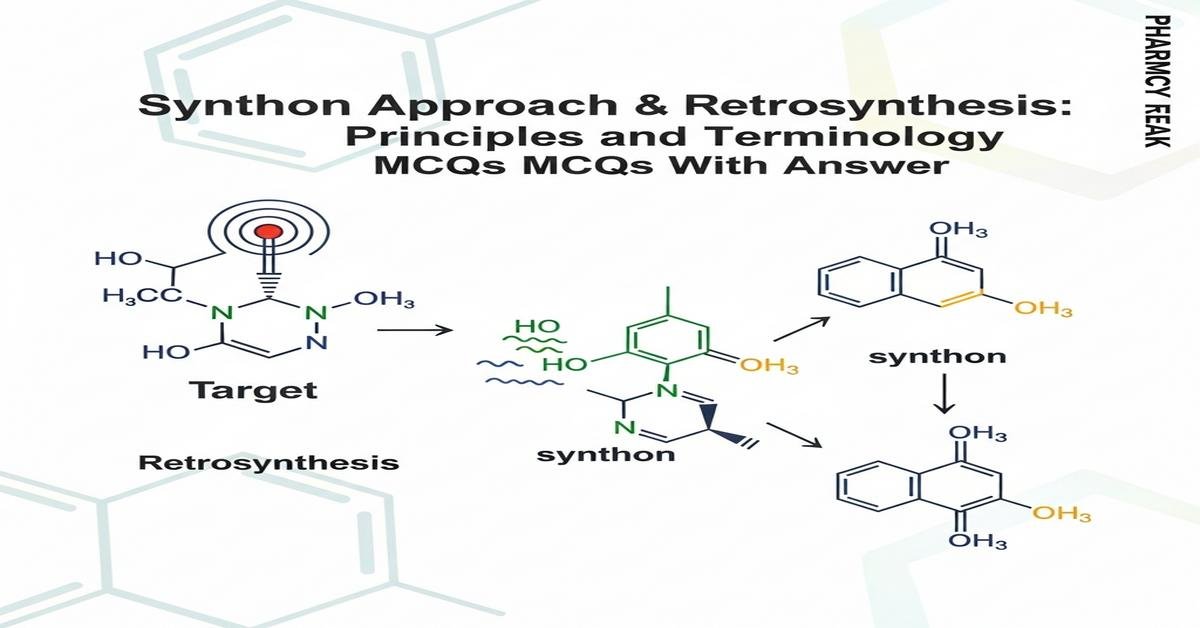
This quiz collection on Synthon Approach & Retrosynthesis: Principles and Terminology is designed for M.Pharm students preparing for MPC 102T Advanced Organic Chemistry I. It focuses on core retrosynthetic concepts — synthons, synthetic equivalents, disconnection strategies, retrons, and polarity (umpolung) — and develops the ability to plan syntheses backwards from complex targets. Questions emphasize practical reasoning: choosing strategic bonds for disconnection, recognizing functional group interconversions, and selecting appropriate synthetic equivalents and protecting-group strategies. The set includes conceptual and application-based MCQs to strengthen problem-solving skills required for designing efficient, chemoselective and convergent syntheses in pharmaceutical contexts.
Q1. Which statement best defines a “synthon” in retrosynthetic analysis?
- An actual reagent used in a laboratory synthesis
- A hypothetical ideal fragment generated by disconnection that indicates types of reagents needed
- A protecting group applied to a functional group
- A by-product formed during a reaction
Correct Answer: A hypothetical ideal fragment generated by disconnection that indicates types of reagents needed
Q2. What is a “synthetic equivalent” (or synthone equivalent)?
- A synonym for retrosynthetic disconnection
- A real reagent or reagent combination that implements a synthon in forward synthesis
- A theoretical bond not present in the target molecule
- An enzyme used in biocatalysis
Correct Answer: A real reagent or reagent combination that implements a synthon in forward synthesis
Q3. In retrosynthesis, what is a “retrons”?
- A fragment that remains unchanged during the synthesis
- A structural feature in the target molecule that suggests a possible disconnection or synthetic route
- A reagent that must be avoided due to hazard
- A protecting group strategy for multifunctional molecules
Correct Answer: A structural feature in the target molecule that suggests a possible disconnection or synthetic route
Q4. Which of the following is an example of an acyl anion synthetic equivalent used to perform umpolung of carbonyl compounds?
- DIBAL-H
- 1,3-dithiane (after lithiation) as in the Corey-Seebach reaction
- Sodium borohydride (NaBH4)
- PCC (pyridinium chlorochromate)
Correct Answer: 1,3-dithiane (after lithiation) as in the Corey-Seebach reaction
Q5. Which disconnection is described as “heteroatom-initiated” or “polar disconnection”?
- Breaking a C–C bond to reveal two radical synthons
- Breaking a bond adjacent to a heteroatom to give nucleophilic and electrophilic synthons
- Breaking only aromatic C–H bonds
- Disconnection of a bond without considering polarity
Correct Answer: Breaking a bond adjacent to a heteroatom to give nucleophilic and electrophilic synthons
Q6. Which of these best illustrates umpolung (polarity inversion) in organic synthesis?
- Converting an alcohol to an ester by acid catalysis
- Using cyanide to convert an aldehyde into a nucleophilic carbon center (as in benzoin-like chemistry)
- Oxidizing a primary alcohol to a carboxylic acid
- Hydrogenation of an alkene to an alkane
Correct Answer: Using cyanide to convert an aldehyde into a nucleophilic carbon center (as in benzoin-like chemistry)
Q7. Which of the following correctly classifies synthons?
- Synthons are classified only as electrophilic or nucleophilic, never as radical
- Synthons are classified as nucleophilic, electrophilic, or radical
- Synthons refer only to protecting groups in retrosynthesis
- Synthons are classified by color codes in retrosynthetic schemes
Correct Answer: Synthons are classified as nucleophilic, electrophilic, or radical
Q8. In retrosynthesis of a secondary alcohol from an alkene, which strategic disconnection is most common?
- Disconnection at an aromatic C–H bond
- Retrosynthetic cleavage to an alkene and a hydride source
- Disconnection to reveal a carbonyl plus a nucleophilic carbon (e.g., reduction of ketone)
- Disconnection into two radicals only
Correct Answer: Disconnection to reveal a carbonyl plus a nucleophilic carbon (e.g., reduction of ketone)
Q9. What is meant by a “strategic bond” in retrosynthetic analysis?
- A bond whose disconnection leads to simple, readily available synthons and simplifies synthesis design
- A bond that must never be broken during synthesis
- A bond formed only via photochemical reactions
- A bond that connects two protecting groups
Correct Answer: A bond whose disconnection leads to simple, readily available synthons and simplifies synthesis design
Q10. Which forward reagent is a common synthetic equivalent for a nucleophilic carbon synthon (C:-)?
- Diazomethane (CH2N2) for direct nucleophilic carbanion attacks in many contexts
- Water (H2O)
- Sodium chloride (NaCl)
- Molecular oxygen (O2)
Correct Answer: Diazomethane (CH2N2) for direct nucleophilic carbanion attacks in many contexts
Q11. Which retrosynthetic change is an example of functional group interconversion (FGI)?
- Disconnecting an ester into an alcohol and acyl synthon
- Changing an alcohol into an aldehyde in the retrosynthetic plan to allow a new disconnection
- Splitting a molecule into two radicals without changing functional groups
- Labeling a synthone as nucleophilic without any structural change
Correct Answer: Changing an alcohol into an aldehyde in the retrosynthetic plan to allow a new disconnection
Q12. Convergent synthesis in retrosynthetic planning is advantageous because:
- It builds the molecule in a strictly linear sequence of single-step operations
- Independent fragments are synthesized separately and coupled, often improving overall yield and speed
- It reduces the number of required reagents to one
- It always avoids the need for protecting groups
Correct Answer: Independent fragments are synthesized separately and coupled, often improving overall yield and speed
Q13. In retrosynthesis, what is the primary purpose of introducing a protecting group?
- To permanently change a functional group into another functional group
- To temporarily mask a reactive site so selective transformations can be performed elsewhere
- To increase the molecular weight of the target
- To oxidize a sensitive functional group
Correct Answer: To temporarily mask a reactive site so selective transformations can be performed elsewhere
Q14. Which disconnection would you choose to make a β-hydroxy ketone via an aldol reaction?
- Disconnection that reveals an alkyl radical and a halide
- Disconnection into an enolate (nucleophilic synthon) and an aldehyde or ketone (electrophilic synthon)
- Disconnection into two epoxides
- Disconnection to an acyl cation and an alkene
Correct Answer: Disconnection into an enolate (nucleophilic synthon) and an aldehyde or ketone (electrophilic synthon)
Q15. Which of the following is a correct example of a radical retrosynthetic disconnection?
- Cleaving an alkyl–alkyl bond to form two radical synthons that will be reformed by a radical coupling
- Disconnection of a carbonyl into hydride and oxygen synthons
- Converting an ester into an alcohol and acyl chloride
- Using a protecting group on an amine
Correct Answer: Cleaving an alkyl–alkyl bond to form two radical synthons that will be reformed by a radical coupling
Q16. Which of these best describes a “transform-based disconnection”?
- Disconnecting based purely on atom economy without regard to mechanism
- Choosing disconnections that correspond to known named reactions or reliable forward transforms
- Disconnecting only C–H bonds
- Using only enzymatic steps in the synthetic plan
Correct Answer: Choosing disconnections that correspond to known named reactions or reliable forward transforms
Q17. Which reagent pair is a classic example of implementing a nucleophilic acyl equivalent for an acylation reaction?
- Organolithium reagent reacting directly with carbon dioxide to give a carboxylic acid equivalent
- 1,3-dithiane (lithiated) followed by hydrolysis to reveal the carbonyl
- Pyridinium chlorochromate for oxidation of alcohols
- Sodium sulfate as a drying agent
Correct Answer: 1,3-dithiane (lithiated) followed by hydrolysis to reveal the carbonyl
Q18. When planning a retrosynthesis, why is consideration of chemoselectivity important?
- Chemoselectivity determines the speed of a reaction but not product distribution
- It ensures that the chosen forward reactions will selectively transform the intended functional group without undesirable side reactions
- Chemoselectivity only matters for photochemical reactions
- It allows elimination of all protecting groups from the plan
Correct Answer: It ensures that the chosen forward reactions will selectively transform the intended functional group without undesirable side reactions
Q19. Which retrosynthetic idea is illustrated by planning a route that first disconnects the molecule into two equally complex fragments to be coupled?
- Linear synthesis strategy
- Convergent synthesis strategy
- Protecting-group-first strategy
- Random fragmentation
Correct Answer: Convergent synthesis strategy
Q20. In designing a retrosynthetic plan for a substituted benzaldehyde, which disconnection commonly reveals a simple synthetic equivalent?
- Breaking an aromatic C–C bond to give two aliphatic fragments
- Retrosynthetic transformation of benzaldehyde to benzyl alcohol (FGI), or use of a formyl synthon such as DMF-DMA in forward synthesis
- Disconnection into two radical fragments only
- Converting benzaldehyde to an epoxide directly in retrosynthesis
Correct Answer: Retrosynthetic transformation of benzaldehyde to benzyl alcohol (FGI), or use of a formyl synthon such as DMF-DMA in forward synthesis

