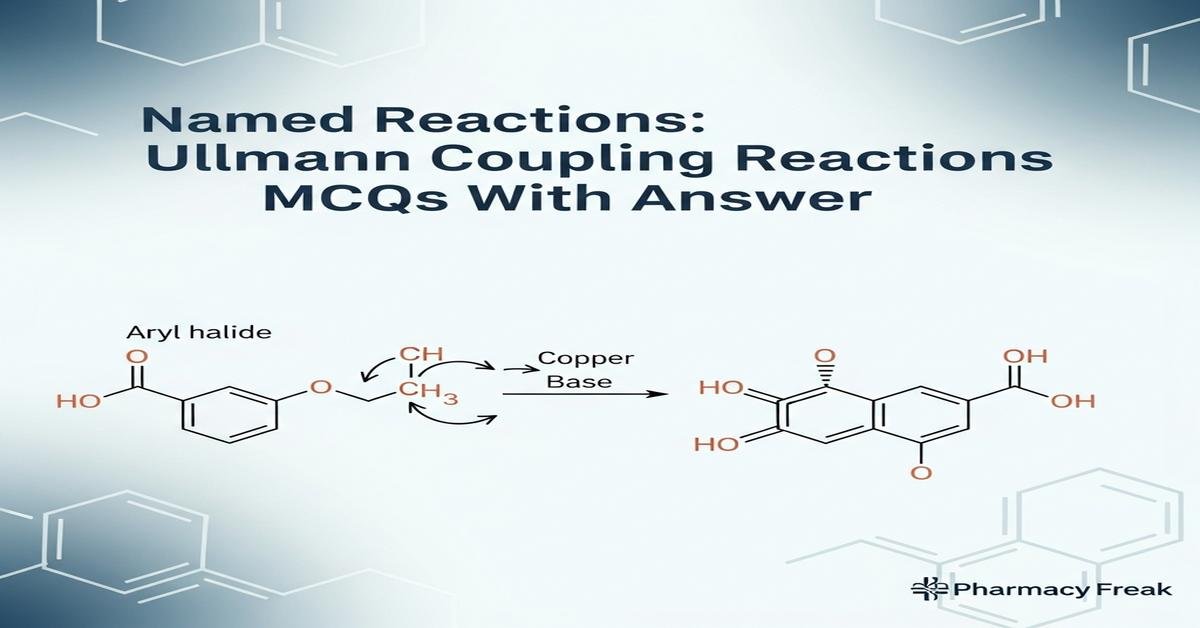
Introduction: Named reactions are cornerstones of advanced organic synthesis, and the Ullmann coupling family plays a vital role in constructing C–C, C–O and C–N bonds in pharmaceutical chemistry. This quiz collection focuses on Ullmann and Ullmann-type reactions, covering mechanistic concepts, catalysts, ligands, substrate scope, limitations and modern improvements that make these reactions relevant for M.Pharm students. Questions probe classical high‑temperature processes and contemporary ligand‑enabled, low‑temperature methods, emphasizing practical considerations such as choice of halide, bases, solvents and monitoring techniques. Working through these MCQs will strengthen understanding of when and how to apply Ullmann chemistry in medicinal and process chemistry contexts.
Q1. What is the primary bond-forming outcome of a classical Ullmann coupling between two aryl halides?
- Formation of a biaryl (C–C) bond
- Formation of an ether (C–O) bond
- Formation of an amide (C–N) bond
- Formation of an alkene (C=C) bond
Correct Answer: Formation of a biaryl (C–C) bond
Q2. Which metal is central to the traditional Ullmann coupling reaction?
- Copper
- Palladium
- Nickel
- Ruthenium
Correct Answer: Copper
Q3. Historically, what was a defining experimental requirement for classical Ullmann couplings?
- High temperature (often >150 °C)
- Low temperature (below 0 °C)
- Room temperature conditions
- Photochemical activation only
Correct Answer: High temperature (often >150 °C)
Q4. For reactivity in Ullmann couplings of aryl halides, which halide is generally most reactive?
- Aryl iodides are most reactive
- Aryl chlorides are most reactive
- Aryl bromides are most reactive
- All halides show equal reactivity
Correct Answer: Aryl iodides are most reactive
Q5. Which type of ligand has been widely used to accelerate and lower the temperature of Ullmann couplings?
- N,N‑diamines such as N,N‑dimethylethylenediamine (DMEDA)
- Triphenylphosphine
- N‑heterocyclic carbenes (NHCs) exclusively
- No ligand works for Ullmann reactions
Correct Answer: N,N‑diamines such as N,N‑dimethylethylenediamine (DMEDA)
Q6. Which mechanistic step in Ullmann-type couplings remains a subject of debate in the literature?
- Whether oxidative addition of an aryl halide to Cu(I) to form Cu(III) occurs
- Formation of carbonyl intermediates
- Involvement of a palladium co-catalyst in every case
- Direct nucleophilic aromatic substitution without metal
Correct Answer: Whether oxidative addition of an aryl halide to Cu(I) to form Cu(III) occurs
Q7. The Ullmann–Goldberg reaction specifically refers to which transformation?
- N‑Arylation to form aryl amines (C–N bond formation)
- O‑Arylation to form diaryl ethers (C–O bond formation)
- C–C homocoupling of alkenes
- Formation of alkyl halides from alcohols
Correct Answer: N‑Arylation to form aryl amines (C–N bond formation)
Q8. Which base is commonly employed in many Ullmann coupling protocols?
- Potassium carbonate (K2CO3)
- Hydrochloric acid (HCl)
- Sodium chloride (NaCl)
- Phenol
Correct Answer: Potassium carbonate (K2CO3)
Q9. How do strong electron-withdrawing substituents on the aryl halide typically affect Ullmann coupling rates?
- They accelerate the reaction
- They completely stop the reaction
- They have no effect
- They always reverse selectivity
Correct Answer: They accelerate the reaction
Q10. Intramolecular Ullmann couplings are especially useful for the synthesis of which structural motif?
- Biaryl rings leading to polycyclic or fused aromatic systems
- Simple aliphatic alcohols
- Symmetric alkanes
- Terminal alkynes
Correct Answer: Biaryl rings leading to polycyclic or fused aromatic systems
Q11. Which solvent is commonly used in Ullmann-type reactions due to its high polarity and ability to dissolve salts?
- Dimethylformamide (DMF)
- Hexane
- Diethyl ether
- Carbon tetrachloride
Correct Answer: Dimethylformamide (DMF)
Q12. Which modern catalyst form has been applied to lower reaction temperatures and improve activity in Ullmann couplings?
- Copper nanoparticles
- Bulk metallic silver
- Gold foils
- Mercury amalgam
Correct Answer: Copper nanoparticles
Q13. What is a historically significant limitation of classical Ullmann couplings that has prompted ligand development?
- Poor reactivity of aryl chlorides under unmodified conditions
- Inability to form C–C bonds
- Exclusive formation of polymers
- Complete lack of regioselectivity with monosubstituted arenes
Correct Answer: Poor reactivity of aryl chlorides under unmodified conditions
Q14. Which organocopper intermediate is commonly invoked in Ullmann reaction mechanisms?
- Aryl–Cu(I) species (arylcopper(I))
- Aryl–Pd(II) hydride
- Aryl–MgBr Grignard complex
- Aryl radical cation exclusively
Correct Answer: Aryl–Cu(I) species (arylcopper(I))
Q15. The coupling of an aryl halide with a phenol under Ullmann conditions to give diaryl ethers is known as:
- Ullmann ether synthesis
- Sandmeyer reaction
- Suzuki coupling
- Wittig reaction
Correct Answer: Ullmann ether synthesis
Q16. Which ligand class stabilizes copper intermediates and is widely credited with expanding substrate scope for Ullmann reactions?
- Diamine ligands
- Tertiary sulfides
- Carboxylic acids
- Aliphatic alcohols
Correct Answer: Diamine ligands
Q17. For milder Pd‑catalyzed alternatives to Ullmann N‑ and O‑arylation, which named methodology is most relevant?
- Buchwald–Hartwig amination
- Knoevenagel condensation
- Claisen rearrangement
- Wacker oxidation
Correct Answer: Buchwald–Hartwig amination
Q18. To favor a cross‑coupling product over homocoupling in Ullmann chemistry, which strategy is commonly used?
- Use an aryl halide and a distinct nucleophilic coupling partner (e.g., phenol or amine)
- Use two identical aryl halides in equal amounts
- Exclude any base from the reaction
- Perform the reaction under photochemical conditions only
Correct Answer: Use an aryl halide and a distinct nucleophilic coupling partner (e.g., phenol or amine)
Q19. Which analytical technique is especially useful for identifying and confirming formation of small-molecule biaryl products from Ullmann couplings?
- Gas chromatography–mass spectrometry (GC–MS)
- Polarimetry
- Flame photometry
- Paper chromatography only
Correct Answer: Gas chromatography–mass spectrometry (GC–MS)
Q20. What is a major advantage of modern ligand‑assisted Ullmann protocols compared with classical conditions?
- Lower reaction temperature and broader substrate scope
- They require larger excesses of metal powder
- They always require cryogenic conditions
- They eliminate the need for any base
Correct Answer: Lower reaction temperature and broader substrate scope

