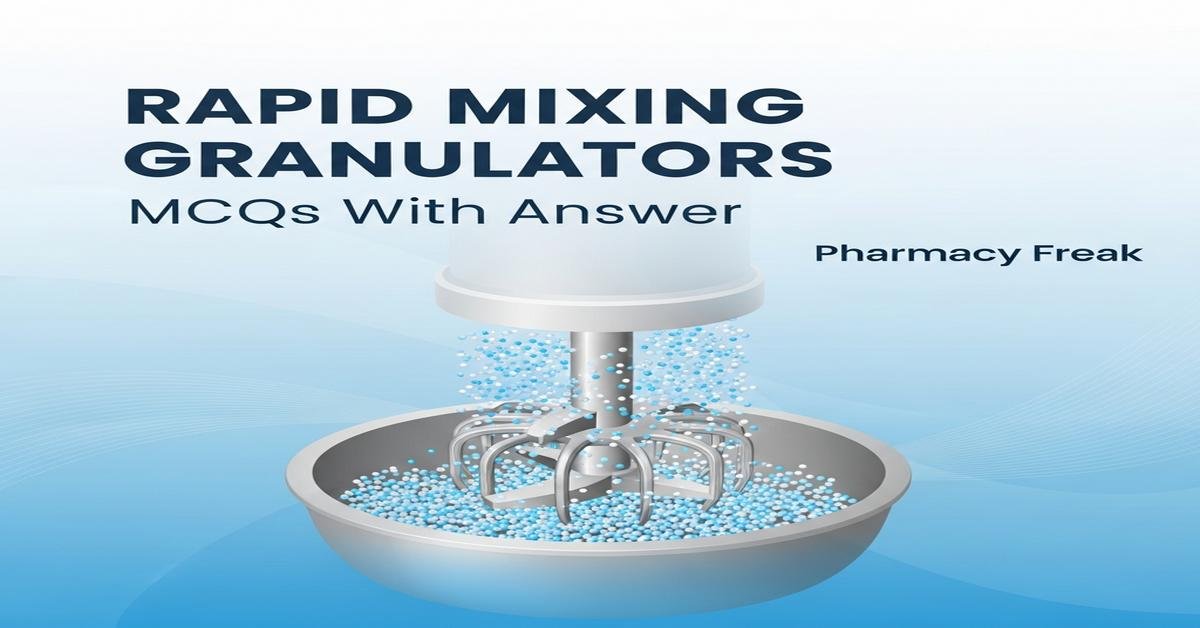
Introduction:
This quiz collection on Rapid Mixing Granulators MCQs With Answer is designed specifically for M.Pharm students studying MIP 203T – Pharmaceutical Production Technology. It focuses on the principles, equipment design, process parameters, granulation mechanisms, in-process controls and troubleshooting pertinent to rapid mixing (high-shear) granulation. Questions probe deeper than basics — covering binder addition strategies, torque/power endpoints, scale-up criteria, moisture monitoring, and quality attributes like granule strength and friability. Use these MCQs to test and reinforce understanding of how formulation variables and machine settings interact to produce robust granules suitable for downstream processing and quality assurance.
Q1. What is the primary function of a rapid mixing granulator (RMG) in pharmaceutical manufacture?
- Drying of granules to final moisture content
- Wet granulation / wet massing of powder mixtures
- Size reduction to produce ultrafine particles
- Coating tablets with polymer films
Correct Answer: Wet granulation / wet massing of powder mixtures
Q2. Which combination best describes the essential mechanical components inside a typical high-shear rapid mixing granulator?
- Rotating drum, vibratory deck, and aspirator
- Impeller, chopper, and spray nozzle inside a mixing bowl
- Conveyor screw, heated jacket, and static mixer
- Rotor-stator homogenizer and cyclone separator
Correct Answer: Impeller, chopper, and spray nozzle inside a mixing bowl
Q3. What is the main role of the chopper in an RMG during wet massing?
- Heat the mass to accelerate solvent evaporation
- Provide axial mixing and reduce segregation only
- Break large agglomerates and control overgrowth of granules
- Meter binder flow rate into the system
Correct Answer: Break large agglomerates and control overgrowth of granules
Q4. Which process parameter most directly influences the granule size distribution produced in a rapid mixing granulator?
- Impeller speed (shear)
- Drying temperature in the tray dryer
- Final tablet compression force
- Coating pan rotation speed
Correct Answer: Impeller speed (shear)
Q5. Which binder addition strategy in high-shear granulation generally improves binder distribution and reduces risk of localized overwetting?
- Single large bolus addition at start of run
- Adding binder only after drying is complete
- Split / staged binder addition during wet massing
- Mixing binder with solvent and spraying post-drying
Correct Answer: Split / staged binder addition during wet massing
Q6. Which in-process sign is commonly used to determine the granulation end-point in an RMG?
- A sudden drop in bowl temperature
- Plateau in impeller torque / power consumption
- Visual appearance only, without instrumentation
- Maximum chopper speed attainment
Correct Answer: Plateau in impeller torque / power consumption
Q7. Increasing binder concentration in the wet massing phase typically results in which set of effects on granule properties?
- Smaller granule size, reduced strength, increased friability
- Increased granule size and tensile strength, reduced porosity
- No change in granule properties but faster drying
- Reduced tensile strength and increased disintegration time
Correct Answer: Increased granule size and tensile strength, reduced porosity
Q8. Which sequence best describes the principal mechanisms of granule formation during wet high-shear granulation?
- Coalescence → nucleation → breakage → drying
- Nucleation → coalescence/growth → consolidation → attrition/breakage
- Drying → nucleation → consolidation → coating
- Compression → fragmentation → agglomeration → dissolution
Correct Answer: Nucleation → coalescence/growth → consolidation → attrition/breakage
Q9. For a heat-sensitive active ingredient processed in an RMG, which operational adjustment helps minimize thermal stress and degradation?
- Increase impeller speed and extend wet massing time
- Use higher spray temperature with organic solvent
- Reduce impeller speed and shorten wet massing duration
- Eliminate chopper operation to reduce shear
Correct Answer: Reduce impeller speed and shorten wet massing duration
Q10. Increasing chopper speed while keeping impeller speed constant most commonly causes which change in granulation outcome?
- Formation of larger, more porous granules
- Increased mean granule size and reduction in fines
- Reduced mean particle size due to enhanced deagglomeration
- No effect on granule properties, only on drying rate
Correct Answer: Reduced mean particle size due to enhanced deagglomeration
Q11. Which analytical technique is most suitable for real-time, in-line monitoring of moisture and binder distribution during RMG wet massing?
- High-performance liquid chromatography (HPLC)
- Near-infrared (NIR) spectroscopy
- Thermogravimetric analysis (TGA)
- Scanning electron microscopy (SEM)
Correct Answer: Near-infrared (NIR) spectroscopy
Q12. A common industrial scale-up strategy for maintaining similar mixing/shear conditions when increasing RMG bowl size is to keep which parameter constant?
- Impeller tip speed
- Bowl fill level as a percentage of maximum only
- Chopper power (W) per batch irrespective of mass
- Absolute impeller RPM irrespective of impeller diameter
Correct Answer: Impeller tip speed
Q13. Why is spray nozzle atomization quality critical during binder addition in an RMG?
- It solely determines the final drying temperature
- It controls droplet size distribution which affects nucleation and granule growth
- Atomization prevents any need for chopper operation
- It dictates tablet coating adhesion in the downstream process
Correct Answer: It controls droplet size distribution which affects nucleation and granule growth
Q14. How does increasing binder concentration generally affect granule friability?
- Increased binder concentration generally increases friability
- Increased binder concentration generally decreases friability (improves robustness)
- Binder concentration has no effect on friability
- Friability is only related to drying temperature, not binder
Correct Answer: Increased binder concentration generally decreases friability (improves robustness)
Q15. What is the primary objective of the drying stage immediately after high-shear granulation?
- To reduce residual solvent uniformly to a target level without case hardening
- To increase granule porosity to infinite levels
- To melt the binder and create a film-coating on granules
- To reduce particle size through thermal cracking
Correct Answer: To reduce residual solvent uniformly to a target level without case hardening
Q16. If a granulation run produces a sticky, over-wetted mass that clogs the discharge, which corrective action is most appropriate during the run?
- Increase binder spray rate and immediately raise impeller speed
- Stop binder addition, increase chopper speed and continue mixing to redistribute moisture
- Switch to a larger spray nozzle to increase droplet size
- Immediately apply high drying heat to the mixing bowl
Correct Answer: Stop binder addition, increase chopper speed and continue mixing to redistribute moisture
Q17. Which test is commonly used to quantify individual granule mechanical strength relevant to downstream handling?
- Loss on drying (LOD) measurement
- Granule tensile strength by diametral compression (crushing strength)
- Disintegration time in USP buffer
- pH measurement of granule surface
Correct Answer: Granule tensile strength by diametral compression (crushing strength)
Q18. How does the choice of granulation solvent (water vs organic solvent) influence granule properties in RMG processing?
- Solvent choice only affects smell and has no material effect
- Solvent affects binder solubility, droplet evaporation rate and thus granule porosity and internal structure
- Organic solvents always produce weaker granules than water
- Water always yields faster drying than volatile organics
Correct Answer: Solvent affects binder solubility, droplet evaporation rate and thus granule porosity and internal structure
Q19. What is the purpose of a pre-conditioning or pre-wetting step before high-shear wet massing in some RMG processes?
- To fully dry the powders so binder will not stick
- To uniformly distribute liquid binder and initiate nucleation before intense shear
- To sterilize the powder bed using hot solvent
- To eliminate the need for a chopper during wet massing
Correct Answer: To uniformly distribute liquid binder and initiate nucleation before intense shear
Q20. For cleaning-validation and cross-contamination control in an RMG, which area or component is often identified as most difficult to clean?
- Exterior paint of the machine
- Seals, impeller/chopper interfaces and crevices around shaft seals
- Simple flat surfaces of the bowl that are fully accessible
- Collection container used after complete disassembly only
Correct Answer: Seals, impeller/chopper interfaces and crevices around shaft seals

