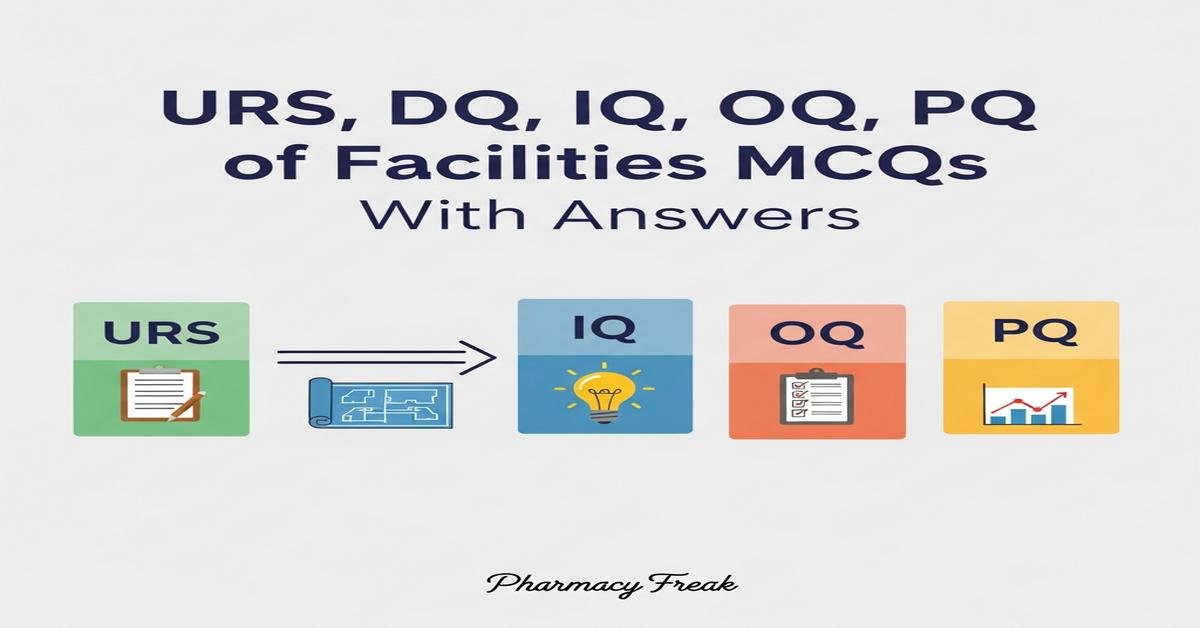
URS, DQ, IQ, OQ, PQ of Facilities MCQs With Answer offers a focused, exam-ready practice set for M. Pharm students studying Modern Pharmaceutics (MPH 103T). The lifecycle of pharmaceutical facilities and equipment—from defining user needs (URS) to demonstrating performance in routine use (PQ)—is central to GMP compliance and regulatory inspections. This quiz blends conceptual understanding with applied decision-making around EU GMP Annex 15, ICH Q9 risk management, ISPE guidance, environmental controls, and utilities (HVAC, purified water, WFI). You will encounter scenarios involving FAT/SAT leveraging, traceability, acceptance criteria, commissioning versus qualification, and data integrity. Use these MCQs to test your ability to design, execute, and defend qualification strategies that ensure “fitness for intended use” across pharmaceutical facilities.
Q1. Which statement best describes a User Requirement Specification (URS)?
- A vendor-supplied datasheet listing standard features
- A GMP document that defines what the user needs the facility/equipment to do, including performance, quality, and regulatory requirements
- A test script used during OQ to verify alarms and interlocks
- A post-qualification report summarizing deviations and CAPAs
Correct Answer: A GMP document that defines what the user needs the facility/equipment to do, including performance, quality, and regulatory requirements
Q2. What is the primary objective of Design Qualification (DQ)?
- Verify the installed equipment is level, tagged, and calibrated
- Demonstrate the design, drawings, and selected components will meet the URS and GMP requirements before build/installation
- Challenge the system at worst-case operating ranges
- Show routine production can meet CQAs lot-to-lot
Correct Answer: Demonstrate the design, drawings, and selected components will meet the URS and GMP requirements before build/installation
Q3. Which activity is MOST typical of Installation Qualification (IQ)?
- Verifying P&IDs are as-built, materials of construction, utilities connections, and calibration certificates
- Mapping process capability under routine loads
- Simulating operator errors to test interlocks
- Drafting the URS for capacity and throughput
Correct Answer: Verifying P&IDs are as-built, materials of construction, utilities connections, and calibration certificates
Q4. Which is in scope of Operational Qualification (OQ)?
- Developing the Validation Master Plan (VMP)
- Verifying alarms, interlocks, and software functions across operating ranges against approved acceptance criteria
- Establishing cleaning validation limits (MACO)
- Trending environmental monitoring over six months
Correct Answer: Verifying alarms, interlocks, and software functions across operating ranges against approved acceptance criteria
Q5. What does Performance Qualification (PQ) demonstrate?
- Equipment achieves ISO cleanroom classification in the as-built state
- System operates as intended under routine conditions with trained operators, SOPs, and typical loads, consistently meeting predefined acceptance criteria
- All critical instruments have current calibration certificates
- Vendor can supply spare parts within agreed lead times
Correct Answer: System operates as intended under routine conditions with trained operators, SOPs, and typical loads, consistently meeting predefined acceptance criteria
Q6. Identify the correct sequence for qualifying a new facility/equipment.
- IQ → DQ → OQ → PQ → URS
- DQ → URS → IQ → OQ → PQ
- URS → DQ → IQ → OQ → PQ
- URS → IQ → DQ → OQ → PQ
Correct Answer: URS → DQ → IQ → OQ → PQ
Q7. What is the best practice for leveraging FAT/SAT in qualification?
- Use FAT/SAT data to replace OQ entirely
- Ignore FAT/SAT results due to lack of GMP status
- Use FAT/SAT test results to reduce duplication in IQ/OQ through a documented, risk-based assessment when equivalence is demonstrated
- Use FAT only for mechanical checks and never for software
Correct Answer: Use FAT/SAT test results to reduce duplication in IQ/OQ through a documented, risk-based assessment when equivalence is demonstrated
Q8. The primary purpose of a URS-to-test traceability matrix is to:
- List the calibration due dates for critical instruments
- Link each URS requirement to design elements, test cases, acceptance criteria, and executed evidence
- Allocate budget across qualification stages
- Schedule operator training sessions
Correct Answer: Link each URS requirement to design elements, test cases, acceptance criteria, and executed evidence
Q9. Which guideline most directly defines the principles of DQ, IQ, OQ, and PQ for pharmaceutical facilities?
- EU GMP Annex 15
- ICH Q2(R1)
- ISO/IEC 17025
- 21 CFR Part 11
Correct Answer: EU GMP Annex 15
Q10. Which statement best differentiates commissioning from qualification?
- Commissioning is optional; qualification is illegal
- Commissioning verifies systems operate per design for start-up; qualification provides GMP evidence against URS/acceptance criteria to demonstrate fitness for intended use
- Commissioning is for QC labs; qualification is for manufacturing
- Commissioning is done by QA; qualification is done by vendors
Correct Answer: Commissioning verifies systems operate per design for start-up; qualification provides GMP evidence against URS/acceptance criteria to demonstrate fitness for intended use
Q11. Which test is most appropriately part of OQ for a cleanroom/HVAC system?
- Installation of HEPA filters with material certificates
- Airflow visualization (smoke) study under at-rest and operational conditions
- Six-month trend of viable counts during routine manufacturing
- Drafting the cleanroom URS
Correct Answer: Airflow visualization (smoke) study under at-rest and operational conditions
Q12. Which best describes PQ of a pharmaceutical water system (PW/WFI)?
- Single-day sampling at the point-of-generation
- Extended monitoring at representative use points over time to show consistent compendial quality under routine operations, including worst-case conditions
- Only chemical analysis at the storage tank outlet
- Only verification of loop velocities and pump curves
Correct Answer: Extended monitoring at representative use points over time to show consistent compendial quality under routine operations, including worst-case conditions
Q13. How should acceptance criteria for temperature mapping of a controlled room be established?
- Set after seeing preliminary data, to avoid failures
- Use vendor default limits irrespective of product risk
- Derive risk-based, pre-approved limits from product stability and regulatory requirements, documented in URS/specifications
- Copy limits from an unrelated facility to maintain consistency
Correct Answer: Derive risk-based, pre-approved limits from product stability and regulatory requirements, documented in URS/specifications
Q14. Which change most likely triggers full or partial requalification of a facility area?
- Replacing a like-for-like manometer
- Updating an SOP title
- Relocating a tunnel sterilizer to a different building with a new HVAC interface
- Reprinting batch records with new logo
Correct Answer: Relocating a tunnel sterilizer to a different building with a new HVAC interface
Q15. How should requalification frequency be determined?
- Fixed annual schedule for all systems
- Based on risk assessment, historical performance, change control, and periodic review per SOP
- Only when a deviation occurs
- Every five years regardless of use
Correct Answer: Based on risk assessment, historical performance, change control, and periodic review per SOP
Q16. Who typically grants final approval to release a qualified facility/equipment for GMP use?
- Engineering only
- Production only
- Quality Assurance, after cross-functional review of executed protocols and reports
- Vendor’s quality representative
Correct Answer: Quality Assurance, after cross-functional review of executed protocols and reports
Q17. What represents a worst-case challenge during PQ of a steam sterilizer (autoclave)?
- Empty chamber cycle with no indicators
- Minimum load with chemical indicators only
- Maximum validated load with biological indicators placed at identified cold spots per heat distribution studies
- Cycle at a lower F0 than specified
Correct Answer: Maximum validated load with biological indicators placed at identified cold spots per heat distribution studies
Q18. Which principle set best describes data integrity expectations during qualification testing?
- DMAIC
- PDCA
- ALCOA+
- Kaizen
Correct Answer: ALCOA+
Q19. What is the main purpose of a Validation Master Plan (VMP) in facility qualification?
- To replace individual qualification protocols
- To provide a high-level, risk-based roadmap of validation/qualification scope, responsibilities, timelines, and document structure
- To serve as the calibration schedule
- To function as the environmental monitoring SOP
Correct Answer: To provide a high-level, risk-based roadmap of validation/qualification scope, responsibilities, timelines, and document structure
Q20. Which statement best captures the relationship between qualification and validation?
- Validation is a subset of qualification focused on documents
- Qualification is a subset of validation focusing on facilities, utilities, and equipment
- They are unrelated concepts
- Qualification applies only to laboratories
Correct Answer: Qualification is a subset of validation focusing on facilities, utilities, and equipment

