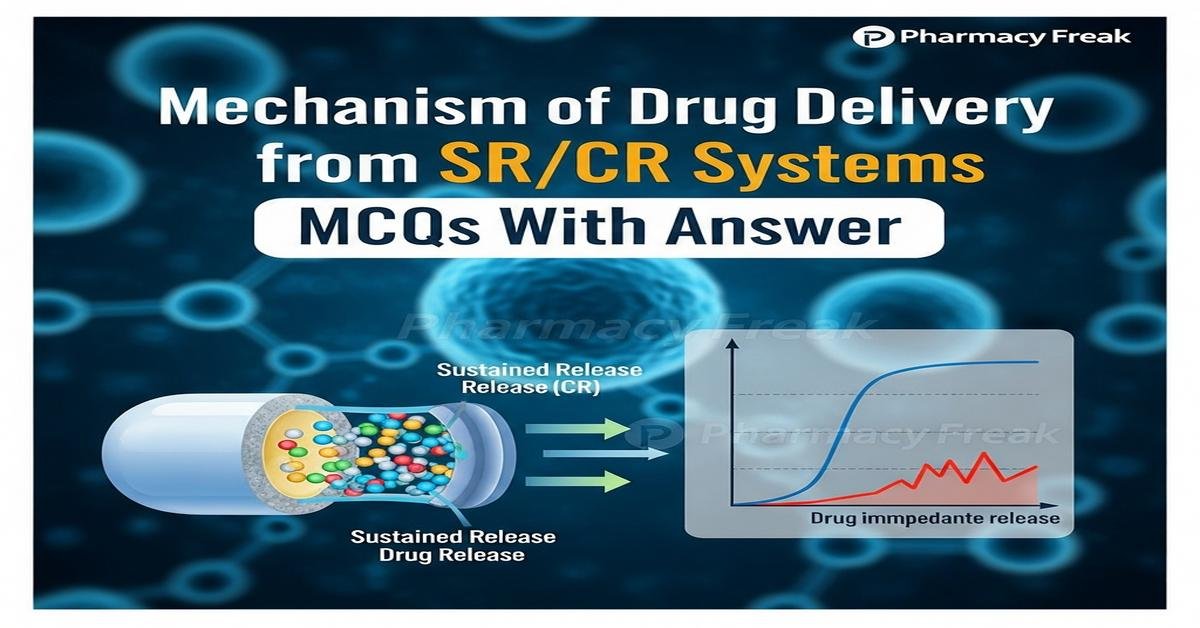
Mechanism of drug delivery from SR/CR systems MCQs With Answer is crafted to help M. Pharm students master how sustained-release (SR) and controlled-release (CR) formulations modulate drug input into the body. This quiz focuses on core mechanisms such as diffusion- and dissolution-control, osmotic pumping, swelling/erosion-controlled systems, ion-exchange, gastroretention, and transdermal rate control. You will also test your understanding of kinetic models (Higuchi, Korsmeyer–Peppas), membrane parameters (porosity, tortuosity, permeability), polymer behavior (gel layer dynamics, pH responsiveness, erosion mode), and design considerations that minimize burst, dose-dumping, and variability. Each MCQ is designed to probe mechanism-level thinking and practical implications for formulation design, scale-up, and in vitro–in vivo performance prediction relevant to MPH 102T.
Q1. In a reservoir-type diffusion-controlled SR system, the dominant mechanism governing drug release is:
- Fickian diffusion across a nonporous rate-controlling membrane
- Dissolution of the drug core at the membrane surface
- Convective flow driven by intestinal peristalsis
- Enzymatic cleavage of the polymer membrane
Correct Answer: Fickian diffusion across a nonporous rate-controlling membrane
Q2. The Higuchi model best describes drug release from which system under ideal assumptions?
- Planar, homogeneous matrix with C0 » Cs under sink conditions
- Spherical matrix undergoing significant surface erosion
- Reservoir membrane system exhibiting zero-order kinetics
- Elementary osmotic pump with laser-drilled orifice
Correct Answer: Planar, homogeneous matrix with C0 » Cs under sink conditions
Q3. In an elementary osmotic pump (EOP), the release rate is primarily governed by:
- Membrane water permeability and osmotic pressure gradient across a fixed membrane area
- Drug diffusion coefficient through the semipermeable membrane
- Dissolution rate of the drug in gastrointestinal fluids
- Hydrodynamic conditions in the gastrointestinal tract
Correct Answer: Membrane water permeability and osmotic pressure gradient across a fixed membrane area
Q4. A practical strategy to minimize initial burst release from hydrophilic matrix tablets is to:
- Apply a drug-free polymeric barrier coat over the compressed matrix
- Reduce polymer viscosity grade to speed up gel formation
- Increase initial drug loading to maintain sink conditions
- Use a highly porous filler to facilitate wetting
Correct Answer: Apply a drug-free polymeric barrier coat over the compressed matrix
Q5. In a dissolution-controlled reservoir system with a slowly dissolving coat, the rate-controlling step is:
- Dissolution of the coating polymer
- Diffusion of drug through the intact coating
- Permeation of water into the core
- Gastric emptying rate
Correct Answer: Dissolution of the coating polymer
Q6. Ion-exchange resin-based SR formulations release a bound cationic drug primarily by:
- Exchange with Na+/H+ ions present in gastrointestinal fluids
- Hydrolytic cleavage of ionic bonds by gastric enzymes
- Thermal activation of resin pores at body temperature
- Photolysis-driven desorption in the intestine
Correct Answer: Exchange with Na+/H+ ions present in gastrointestinal fluids
Q7. For swellable hydrophilic matrices (e.g., HPMC), increasing polymer viscosity grade most directly leads to:
- Thicker, more robust gel layer that slows diffusion and erosion
- Higher porosity and faster drug diffusion through the gel
- Instantaneous gel formation with no effect on release
- Drug–polymer complexation that accelerates release
Correct Answer: Thicker, more robust gel layer that slows diffusion and erosion
Q8. In the Korsmeyer–Peppas model for a slab geometry, an exponent n ≈ 1 indicates:
- Case II transport (zero-order, relaxation/erosion-controlled)
- Fickian diffusion
- Super Case II transport (n > 1)
- Pure dissolution control
Correct Answer: Case II transport (zero-order, relaxation/erosion-controlled)
Q9. Compared to matrix systems, a key risk specific to reservoir-controlled oral CR systems is:
- Dose dumping upon membrane rupture or defect
- Strong food effect due to density differences
- Inability to achieve zero-order release
- Excessive influence of tablet hardness on release
Correct Answer: Dose dumping upon membrane rupture or defect
Q10. Multi-particulate CR dosage forms (e.g., pellets) generally provide:
- Lower risk of dose dumping and reduced intersubject variability
- Higher sensitivity to gastric emptying than single-unit systems
- Less uniform distribution along the GI tract
- Greater susceptibility to local irritation
Correct Answer: Lower risk of dose dumping and reduced intersubject variability
Q11. Floating gastroretentive systems achieve prolonged gastric residence primarily by:
- Maintaining bulk density lower than gastric fluid via gas generation or porous matrices
- Irreversible mucoadhesion to gastric mucosa
- Rapid tablet disintegration into nanoparticles
- pH-dependent precipitation of the drug
Correct Answer: Maintaining bulk density lower than gastric fluid via gas generation or porous matrices
Q12. A pH-dependent polymer commonly used to delay release until the intestine (and then sustain it) by dissolving above pH ~6 is:
- Methacrylic acid–methyl methacrylate copolymer type L (Eudragit L)
- Cellulose acetate
- Ethylcellulose
- Polyvinyl alcohol
Correct Answer: Methacrylic acid–methyl methacrylate copolymer type L (Eudragit L)
Q13. In a membrane-controlled transdermal reservoir patch, the rate-limiting step for delivery is typically:
- Diffusion across the polymeric rate-controlling membrane
- Partitioning from adhesive into the stratum corneum
- Metabolism in the viable epidermis
- Sweat-induced convective flow
Correct Answer: Diffusion across the polymeric rate-controlling membrane
Q14. In porous matrices, increasing tortuosity (τ) at constant porosity (ε) will:
- Decrease the effective diffusivity and slow drug release
- Increase the effective diffusivity and speed drug release
- Have no effect on diffusional transport
- Primarily affect dissolution but not diffusion
Correct Answer: Decrease the effective diffusivity and slow drug release
Q15. For PLGA-based depot systems, which mechanistic sequence is most accurate?
- Initial surface-associated burst, diffusion through water-filled pores, then accelerated release from autocatalytic bulk erosion
- Zero-order diffusion only with no erosion contribution
- Pure surface erosion with no internal degradation
- Release only after complete polymer crystallization
Correct Answer: Initial surface-associated burst, diffusion through water-filled pores, then accelerated release from autocatalytic bulk erosion
Q16. Which variable least affects the release rate from a well-designed oral osmotic pump?
- Gastrointestinal hydrodynamics (agitation intensity)
- Semipermeable membrane thickness and permeability
- Osmotic pressure of the core relative to surrounding fluid
- Presence of a patent delivery orifice
Correct Answer: Gastrointestinal hydrodynamics (agitation intensity)
Q17. Reducing the particle size of a poorly soluble drug in a dissolution-controlled matrix will primarily:
- Increase surface area and enhance the release rate
- Decrease saturation solubility and slow release
- Have no effect on release kinetics
- Eliminate the need for wetting agents
Correct Answer: Increase surface area and enhance the release rate
Q18. In membrane-coated CR pellets, addition of a water-soluble pore-former (e.g., PEG) modulates release by:
- Leaching out to create micropores that increase membrane permeability
- Crosslinking the membrane to reduce permeability
- Neutralizing gastric acid to speed drug dissolution
- Complexing with drug to reduce its diffusivity
Correct Answer: Leaching out to create micropores that increase membrane permeability
Q19. In pulsatile release systems with a defined lag time, the lag is most commonly generated by:
- An erodible or swellable barrier layer that must dissolve/relax before core release
- Immediate diffusion through a thin membrane
- Rapid ion exchange in the stomach
- Ultrasound-triggered cavitation in vivo
Correct Answer: An erodible or swellable barrier layer that must dissolve/relax before core release
Q20. A Level A IVIVC for an oral ER product is most feasible when:
- In vitro release is the rate-limiting step and in vivo absorption is rapid relative to release
- Absorption is permeability-limited with no dissolution control
- Release is highly variable due to gastric motility
- There are multiple, shifting mechanisms across GI segments
Correct Answer: In vitro release is the rate-limiting step and in vivo absorption is rapid relative to release

