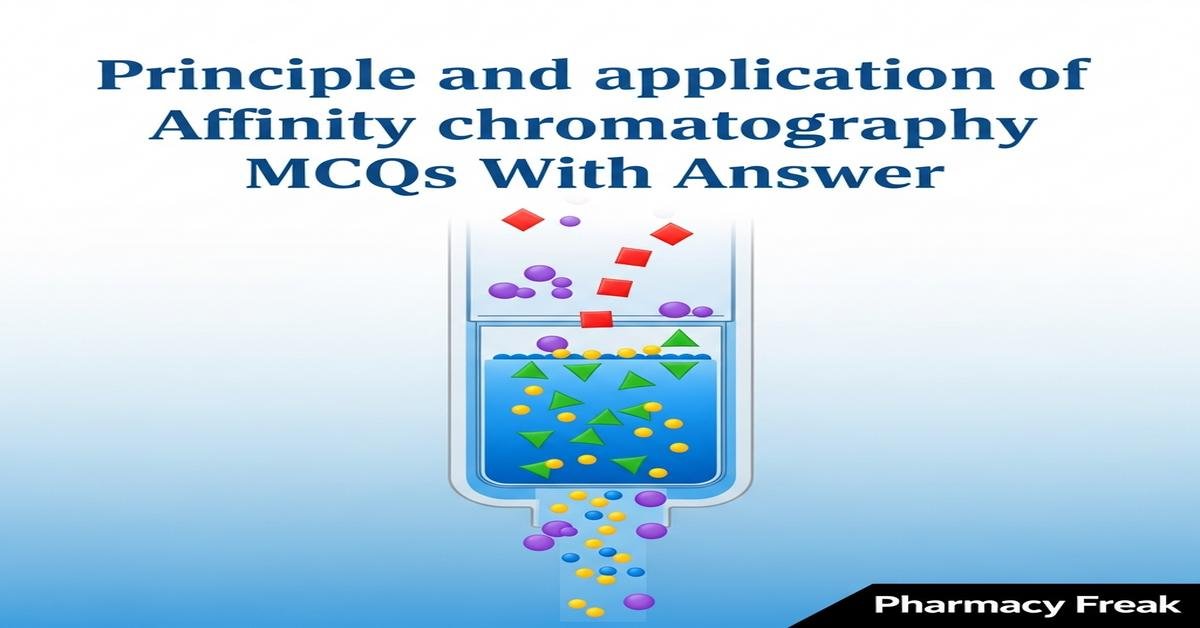
Principle and application of affinity chromatography MCQs With Answer
Affinity chromatography is a high-selectivity separation technique widely used in pharmaceutical analysis to isolate biomolecules based on specific, reversible biological interactions. From monoclonal antibody capture using Protein A/G to His-tagged protein purification via IMAC, this method enables high purity in a single step with gentle elution strategies. For M. Pharm students specializing in Modern Pharmaceutical Analytical Techniques, mastering ligand immobilization chemistries, binding thermodynamics (KD, specificity), column operation, elution mechanisms, and troubleshooting is essential. This MCQ set probes deeper concepts such as spacer arms, dynamic binding capacity, frontal affinity analysis, and pseudoaffinity systems (e.g., dye-ligand). Use these questions to test conceptual understanding and practical decision-making for analytical method development and bioprocess purification.
Q1. The fundamental principle of affinity chromatography is based on which interaction?
- Hydrophobic partitioning between nonpolar surfaces
- Size-dependent sieving through porous beads
- Electrostatic attraction between oppositely charged groups
- Reversible and highly specific binding between an immobilized ligand and a target biomolecule
Correct Answer: Reversible and highly specific binding between an immobilized ligand and a target biomolecule
Q2. A classic method for coupling ligands bearing primary amines to agarose matrices for affinity resins is:
- Carbodiimide-mediated coupling to sulfhydryl groups
- CNBr-activated Sepharose coupling
- Iodination of tyrosine residues
- Click chemistry via azide–alkyne cycloaddition without prior activation
Correct Answer: CNBr-activated Sepharose coupling
Q3. Which elution strategy is generally considered most gentle and preserves native protein activity the best?
- Competitive elution using a free ligand or analog
- Sharp pH drop to 2–3
- High salt (2–3 M) to disrupt all interactions
- High temperature elution
Correct Answer: Competitive elution using a free ligand or analog
Q4. In immobilized metal ion affinity chromatography (IMAC) for His-tagged proteins, the primary interaction involves:
- Hydrogen bonding between serine hydroxyls and Ni2+
- Coordination of histidine imidazole nitrogens to chelated metal ions
- Disulfide exchange with metal chelators
- Covalent linkage to NTA-modified agarose
Correct Answer: Coordination of histidine imidazole nitrogens to chelated metal ions
Q5. A common competitive agent used to elute His-tagged proteins from Ni-NTA IMAC columns is:
- Arginine
- Imidazole
- EDTA
- SDS
Correct Answer: Imidazole
Q6. Lectin affinity chromatography is most suitable for the purification of:
- Hydrophobic peptides lacking post-translational modifications
- Glycoproteins based on specific carbohydrate moieties
- DNA fragments by base-pair complementarity
- Small lipophilic drugs
Correct Answer: Glycoproteins based on specific carbohydrate moieties
Q7. Protein A/G affinity chromatography captures IgG primarily by binding to the:
- Fab variable region
- Fc region of the heavy chain
- Light chain constant region
- Hinge-region glycan only
Correct Answer: Fc region of the heavy chain
Q8. Dye-ligand affinity media containing Cibacron Blue F3G-A are often used to purify which of the following due to nucleotide-mimic interactions?
- Serum albumin and dehydrogenases
- Collagen and elastin
- Histones and DNA
- Polysaccharides and cellulose
Correct Answer: Serum albumin and dehydrogenases
Q9. Dynamic binding capacity (DBC) of an affinity resin is best defined as:
- Theoretical maximum ligand density measured by elemental analysis
- The amount of target bound at a specified breakthrough level under defined flow conditions
- The volume of buffer needed to equilibrate the column
- The mass of protein eluted per liter of mobile phase
Correct Answer: The amount of target bound at a specified breakthrough level under defined flow conditions
Q10. Reducing the dissociation constant (KD) of the ligand–target pair (stronger affinity) typically has what consequence for elution?
- Elution becomes easier with lower concentrations of competitor
- Elution requires harsher conditions or higher competitor concentration
- No effect on elution conditions
- Elution must be performed at higher temperatures only
Correct Answer: Elution requires harsher conditions or higher competitor concentration
Q11. Dye-ligand chromatography is often termed “pseudoaffinity” because:
- It uses covalent bonds instead of reversible interactions
- It relies on nonspecific hydrophobic partitioning
- The ligand mimics natural cofactors, providing selectivity without true biospecific recognition
- It separates only by size, not by binding
Correct Answer: The ligand mimics natural cofactors, providing selectivity without true biospecific recognition
Q12. Which technique is specifically employed to estimate binding constants and stoichiometry by analyzing breakthrough volumes in affinity systems?
- Size-exclusion chromatography
- Frontal affinity chromatography
- Gradient HIC
- Capillary electrophoresis without affinity modifiers
Correct Answer: Frontal affinity chromatography
Q13. Agarose-based supports are preferred for many bioaffinity applications primarily because they:
- Are strongly hydrophobic and denature proteins
- Offer high mechanical strength at very high pressures
- Provide a hydrophilic, low nonspecific adsorption environment compatible with biomolecules
- Are soluble, enabling homogeneous reactions
Correct Answer: Provide a hydrophilic, low nonspecific adsorption environment compatible with biomolecules
Q14. The main purpose of using a spacer arm during ligand immobilization is to:
- Increase resin particle size
- Reduce ionic strength of the mobile phase
- Minimize steric hindrance and improve target access to the ligand
- Covalently attach the target to the resin
Correct Answer: Minimize steric hindrance and improve target access to the ligand
Q15. Choose the correct sequence for a standard affinity chromatography cycle:
- Elution → Equilibration → Regeneration → Load
- Load → Regeneration → Wash → Elution
- Equilibration → Load → Wash → Elution → Regeneration
- Wash → Equilibration → Load → Elution → Storage
Correct Answer: Equilibration → Load → Wash → Elution → Regeneration
Q16. In pharmaceutical manufacturing, a hallmark application of affinity chromatography is:
- Primary capture of monoclonal antibodies using Protein A resin
- Final polishing of salts by ion-exchange
- Crystallization of small-molecule APIs
- Dialysis of buffer components
Correct Answer: Primary capture of monoclonal antibodies using Protein A resin
Q17. For calcium-dependent affinity interactions such as certain lectin bindings, a common elution approach is:
- Addition of EDTA to chelate Ca2+
- Increasing column temperature to 60°C
- Adding high concentrations of NaCl only
- Using SDS to disrupt protein structure
Correct Answer: Addition of EDTA to chelate Ca2+
Q18. When designing an affinity ligand for enzyme purification, which characteristic is most critical?
- Irreversible covalent inhibition for tight capture
- High specificity with reversible binding to avoid enzyme inactivation
- High hydrophobicity to increase resin capacity
- Large molecular weight to enhance pressure stability
Correct Answer: High specificity with reversible binding to avoid enzyme inactivation
Q19. Compared to packed-bead columns, affinity membranes/monoliths provide which practical advantage?
- Higher selectivity due to thicker diffusion layers
- Convective mass transfer enabling high binding at elevated flow rates
- Lower ligand density by necessity
- Exclusive suitability for small molecules only
Correct Answer: Convective mass transfer enabling high binding at elevated flow rates
Q20. During scale-up of an affinity capture step, which parameter is most important to keep constant to maintain performance?
- Column diameter regardless of flow rate
- Residence time (contact time) through the bed
- Eluent pH irrespective of binding strength
- Bed height minimized to reduce pressure
Correct Answer: Residence time (contact time) through the bed

