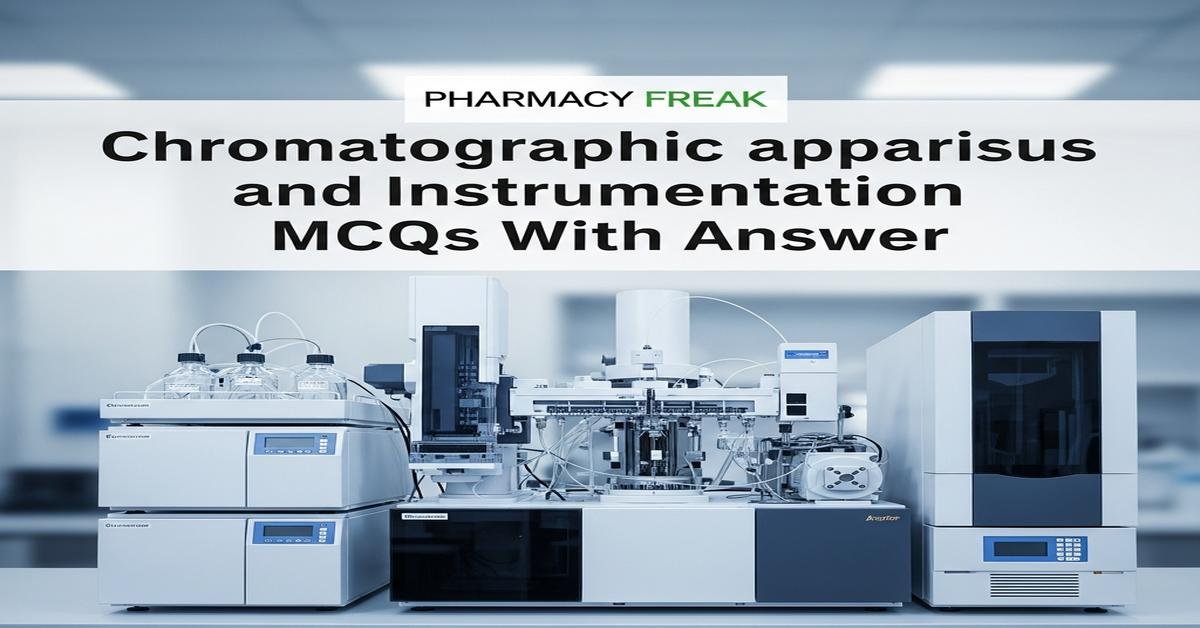
Chromatographic apparatus and instrumentation MCQs With Answer help M. Pharm students master the working principles and critical components behind modern separations. This quiz focuses on practical instrumentation used in HPLC, UHPLC, GC, IC, SFC, and HPTLC—covering pumps, injectors, columns, ovens, detectors, degassing, suppressors, dwell volume, and system suitability. Each question emphasizes applied understanding: why a detector is chosen, how a pump or back-pressure regulator affects performance, or how extra-column effects degrade resolution. By engaging with these MCQs, you will strengthen your ability to select, optimize, and troubleshoot chromatographic systems for pharmaceutical analysis, ensuring robust, reproducible, and regulatory-compliant methods. Answers are provided immediately for quick self-assessment.
Q1. In HPLC, what is the primary purpose of a guard column?
- To increase column efficiency by adding extra theoretical plates
- To protect the analytical column from particulates and strongly retained contaminants
- To function as an in-line filter for degassing
- To improve detector sensitivity by focusing the band
Correct Answer: To protect the analytical column from particulates and strongly retained contaminants
Q2. Which HPLC pump design is most commonly used for delivering accurate, high-pressure flow with minimal pulsation in modern systems?
- Peristaltic pump with pulse damper
- Dual-piston reciprocating pump with pulse damper
- Constant-pressure pneumatic pump
- Gear pump with back-pressure regulator
Correct Answer: Dual-piston reciprocating pump with pulse damper
Q3. Which detector is generally unsuitable for gradient HPLC due to baseline drift with changing mobile phase composition?
- Photodiode array detector
- Fluorescence detector
- Refractive index detector
- Electrochemical detector
Correct Answer: Refractive index detector
Q4. In an HPLC autosampler, the most effective strategy to minimize carryover is:
- Using a larger sample loop
- Performing thorough needle wash (inside and outside) with strong wash solvent
- Reducing injection speed
- Lowering column temperature
Correct Answer: Performing thorough needle wash (inside and outside) with strong wash solvent
Q5. The most common degassing technology integrated into modern HPLC/UHPLC systems is:
- Helium sparging
- In-line vacuum membrane degasser
- Ultrasonic bath degassing
- Freeze-pump-thaw cycles
Correct Answer: In-line vacuum membrane degasser
Q6. In HPLC, dwell volume (gradient delay volume) is best defined as:
- The volume inside the analytical column
- The volume from the pump inlet to the autosampler needle seat
- The volume from the point of gradient mixing to the head of the analytical column
- The volume of the detector flow cell
Correct Answer: The volume from the point of gradient mixing to the head of the analytical column
Q7. In GC, splitless injection is primarily used for:
- High concentration samples to avoid detector saturation
- Trace-level analytes to maximize analyte transfer onto the column
- Samples with high non-volatile residue to protect the column
- Permanent gases to improve thermal conductivity signal
Correct Answer: Trace-level analytes to maximize analyte transfer onto the column
Q8. The flame ionization detector (FID) in GC is best characterized by:
- High sensitivity to inorganic gases and water
- Universal response independent of carbon content
- Wide linear dynamic range and high sensitivity to most organic compounds
- Non-destructive, enabling direct coupling to MS
Correct Answer: Wide linear dynamic range and high sensitivity to most organic compounds
Q9. Which GC detector is universal and non-destructive, measuring changes in bulk gas properties?
- Thermal conductivity detector (TCD)
- Flame photometric detector (FPD)
- Electron capture detector (ECD)
- Nitrogen-phosphorus detector (NPD)
Correct Answer: Thermal conductivity detector (TCD)
Q10. The key advantage of a GC column oven is that it:
- Allows temperature programming for efficient separation across wide boiling ranges
- Eliminates the need for carrier gas flow control
- Increases detector response by heating the flame
- Prevents sample discrimination during injection
Correct Answer: Allows temperature programming for efficient separation across wide boiling ranges
Q11. The protective coating applied to fused-silica capillary GC columns is typically:
- Stainless steel
- Polyimide
- Teflon (PTFE)
- Alumina
Correct Answer: Polyimide
Q12. In UHPLC, reducing particle size from 3.0 μm to 1.5 μm will increase backpressure approximately by a factor of:
- 2
- 3
- 4
- 6
Correct Answer: 4
Q13. In UV-Vis HPLC detectors, a Z-shaped flow cell is preferred because it:
- Increases path length to 50 mm for all applications
- Reduces stray light and refractive index effects, improving baseline stability
- Allows measurements only at 254 nm
- Eliminates the need for reference channels
Correct Answer: Reduces stray light and refractive index effects, improving baseline stability
Q14. In ion chromatography, the suppressor unit is used to:
- Increase the flow rate of the eluent
- Reduce background eluent conductivity and enhance analyte signal
- Remove CO₂ from the mobile phase
- Trap non-ionic contaminants from the sample
Correct Answer: Reduce background eluent conductivity and enhance analyte signal
Q15. In supercritical fluid chromatography (SFC), the primary role of the back-pressure regulator (BPR) is to:
- Increase detector sensitivity by raising temperature
- Maintain a constant pressure to keep CO₂ in the supercritical state
- Remove dissolved gases from the mobile phase
- Split the flow between two columns
Correct Answer: Maintain a constant pressure to keep CO₂ in the supercritical state
Q16. Which instrumentation factor most significantly contributes to extra-column band broadening in HPLC?
- Short detector path length
- Use of long, large-ID connecting tubing and large detector cell volume
- Small injection volumes
- High detector sampling rate
Correct Answer: Use of long, large-ID connecting tubing and large detector cell volume
Q17. In HPTLC, chamber saturation (with a filter paper liner) prior to development primarily helps to:
- Increase plate temperature uniformly
- Equalize vapor phase composition, improving reproducibility and reducing edge effects
- Activate the silica gel by removing water
- Increase analyte fluorescence intensity
Correct Answer: Equalize vapor phase composition, improving reproducibility and reducing edge effects
Q18. A commonly recommended syringe filter pore size for routine HPLC sample preparation is:
- 5.0 μm
- 1.0 μm
- 0.45 μm
- 0.02 μm
Correct Answer: 0.45 μm
Q19. Peak purity assessment and spectral deconvolution in HPLC are primarily enabled by which detector?
- Variable wavelength UV detector
- Photodiode array (PDA/DAD) detector
- Refractive index detector
- Conductivity detector
Correct Answer: Photodiode array (PDA/DAD) detector
Q20. In GC, the split ratio during split injection is defined as:
- Column flow divided by total flow
- Split vent flow divided by column flow
- Total flow divided by split vent flow
- Injector pressure divided by oven temperature
Correct Answer: Split vent flow divided by column flow

