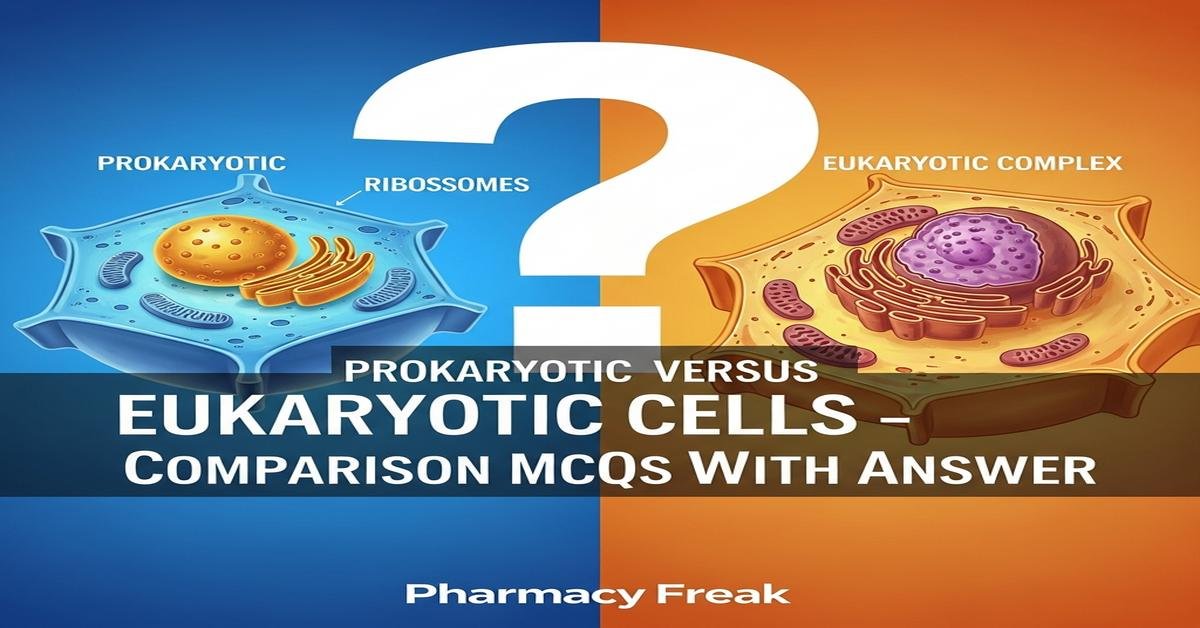
Prokaryotic versus eukaryotic cells is a foundational topic for B.Pharm students, covering cell structure, genetic organization, and biochemical pathways relevant to drug action. Prokaryotic cells (bacteria, archaea) lack a membrane-bound nucleus and organelles, have circular DNA, 70S ribosomes, and peptidoglycan-containing cell walls, while eukaryotic cells possess a nucleus, membrane-bound organelles (mitochondria, ER, Golgi), linear chromosomes with histones, and 80S ribosomes. Understanding these differences informs antibiotic targets, pharmacokinetics, resistance mechanisms, and microbial pathogenicity. This concise review emphasizes clinically relevant features—cell wall composition, ribosome targets, plasmids, transcription/translation differences, and membrane structures—essential for pharmacy practice and microbiology. Now let’s test your knowledge with 30 MCQs on this topic.
Q1. Which statement best distinguishes prokaryotic and eukaryotic cells?
- Prokaryotic cells have a membrane-bound nucleus while eukaryotic cells do not
- Eukaryotic cells have a membrane-bound nucleus
- Both cell types have identical membrane-bound organelles
- Only prokaryotic cells contain mitochondria
Correct Answer: Eukaryotic cells have a membrane-bound nucleus
Q2. How is genomic DNA typically organized in prokaryotic cells?
- Multiple linear chromosomes with telomeres
- Circular, supercoiled DNA localized in a nucleoid region
- Linear chromosomes packaged with histones into chromatin
- RNA genomes enclosed in a nucleus
Correct Answer: Circular, supercoiled DNA localized in a nucleoid region
Q3. What are the characteristic ribosome types in prokaryotes and eukaryotes?
- Prokaryotes 80S and eukaryotes 70S
- Both have exclusively 80S ribosomes
- Prokaryotes 70S and eukaryotes 80S
- Only prokaryotes have ribosomes; eukaryotes use ER enzymes
Correct Answer: Prokaryotes 70S and eukaryotes 80S
Q4. Which organelle is present in eukaryotic cells but absent in prokaryotic cells?
- Ribosome
- Mitochondrion
- Plasma membrane
- Cytoplasm
Correct Answer: Mitochondrion
Q5. What is the primary structural polymer of most bacterial cell walls?
- Chitin
- Cellulose
- Peptidoglycan (murein)
- Phospholipid bilayer
Correct Answer: Peptidoglycan (murein)
Q6. Which component is characteristic of the outer membrane of Gram-negative bacteria and acts as an endotoxin?
- Teichoic acid
- Lipopolysaccharide (LPS)
- Cholesterol
- Phosphatidylcholine
Correct Answer: Lipopolysaccharide (LPS)
Q7. Which feature describes gene expression coupling in prokaryotes?
- Transcription and translation are spatially separated by a nuclear membrane
- Translation precedes transcription
- Transcription and translation can occur simultaneously on the same mRNA
- mRNA is processed by splicing before translation
Correct Answer: Transcription and translation can occur simultaneously on the same mRNA
Q8. Which mRNA processing events are typical of eukaryotic pre-mRNA but absent in prokaryotic mRNA?
- Polycistronic transcription without 5′ cap
- Capping, splicing out introns, and polyadenylation
- Immediate translation without processing
- Formation of Shine-Dalgarno sequence
Correct Answer: Capping, splicing out introns, and polyadenylation
Q9. What is the typical mode of cell division in prokaryotes?
- Mitosis with spindle apparatus
- Binary fission
- Meiosis with recombination
- Budding from Golgi-derived vesicles
Correct Answer: Binary fission
Q10. Which statement about histone proteins is correct?
- Histones are abundant and package bacterial DNA
- Eukaryotic DNA associates with histones forming nucleosomes
- Only viral genomes use histones
- Prokaryotic chromosomes are wrapped around histones identical to eukaryotic ones
Correct Answer: Eukaryotic DNA associates with histones forming nucleosomes
Q11. What are plasmids and why are they clinically important?
- Membrane proteins that pump out antibiotics
- Extrachromosomal DNA in prokaryotes that can carry antibiotic resistance genes and mediate conjugation
- Eukaryotic organelles that generate ATP
- Linear viral DNA integrated into chromosomes
Correct Answer: Extrachromosomal DNA in prokaryotes that can carry antibiotic resistance genes and mediate conjugation
Q12. Beta-lactam antibiotics primarily inhibit which bacterial process?
- DNA replication by inhibiting DNA gyrase
- Protein synthesis by binding 30S ribosomal subunit
- Peptidoglycan crosslinking by inhibiting transpeptidases (PBPs)
- Folate synthesis by blocking dihydropteroate synthase
Correct Answer: Peptidoglycan crosslinking by inhibiting transpeptidases (PBPs)
Q13. Which antibiotics act on bacterial ribosomal subunits: aminoglycosides and macrolides respectively?
- Aminoglycosides 50S, macrolides 30S
- Aminoglycosides 30S, macrolides 50S
- Both target the eukaryotic 80S ribosome
- Neither targets ribosomes
Correct Answer: Aminoglycosides 30S, macrolides 50S
Q14. How do bacterial flagella differ from eukaryotic flagella/cilia?
- Bacterial flagella are microtubule-based with dynein arms
- Bacterial flagella are protein polymers (flagellin) driven by a rotary motor; eukaryotic flagella have a 9+2 microtubule structure
- Both are identical in structure and motor mechanism
- Only eukaryotes exhibit rotary flagellar motion
Correct Answer: Bacterial flagella are protein polymers (flagellin) driven by a rotary motor; eukaryotic flagella have a 9+2 microtubule structure
Q15. Which lipid is a common component of eukaryotic plasma membranes but generally absent in many bacterial membranes?
- Hopanoids
- Cholesterol
- Cardiolipin only
- Peptidoglycan
Correct Answer: Cholesterol
Q16. Which cellular system mediates post-translational modification and sorting of proteins in eukaryotes?
- Nucleoid region
- Endoplasmic reticulum and Golgi apparatus (vesicular trafficking)
- Ribosomes anchored to the bacterial plasma membrane
- Flagellar basal body
Correct Answer: Endoplasmic reticulum and Golgi apparatus (vesicular trafficking)
Q17. What is a hallmark of prokaryotic mRNA organization compared to eukaryotic mRNA?
- Prokaryotic mRNA is typically monocistronic with long half-life
- Prokaryotic mRNA is often polycistronic encoding multiple proteins from one transcript
- Eukaryotic mRNA always lacks a 5′ cap
- Prokaryotic mRNA is extensively spliced
Correct Answer: Prokaryotic mRNA is often polycistronic encoding multiple proteins from one transcript
Q18. Which theory explains the origin of mitochondria and chloroplasts in eukaryotic cells?
- Abiotic assembly in the Golgi
- Endosymbiotic theory: organelles originated from free-living prokaryotes
- Spontaneous generation inside the nucleus
- Viral endogenization only
Correct Answer: Endosymbiotic theory: organelles originated from free-living prokaryotes
Q19. Which structural feature is associated with linear eukaryotic chromosomes but not with most bacterial chromosomes?
- Origin of replication
- Telomeres and telomerase activity
- Promoters and terminators
- DNA double helix
Correct Answer: Telomeres and telomerase activity
Q20. Regarding cell size, which generalization is correct?
- Prokaryotic cells are generally larger (10–100 µm) than eukaryotic cells
- Eukaryotic cells are generally larger (10–100 µm) than prokaryotic cells (0.5–5 µm)
- Both cell types are typically the same size
- Only viruses are larger than eukaryotic cells
Correct Answer: Eukaryotic cells are generally larger (10–100 µm) than prokaryotic cells (0.5–5 µm)
Q21. What is the main polymer in fungal cell walls and how does it differ from bacterial walls?
- Fungal walls are peptidoglycan like bacteria
- Fungal walls are primarily chitin, whereas bacterial walls contain peptidoglycan
- Fungal walls are made of cellulose identical to plant walls
- Fungi lack cell walls entirely
Correct Answer: Fungal walls are primarily chitin, whereas bacterial walls contain peptidoglycan
Q22. Where is the bacterial genome localized within the cell?
- Within a membrane-bound nucleus
- Within a nucleoid region lacking a membrane
- Inside mitochondria in bacteria
- Encapsulated within the Golgi
Correct Answer: Within a nucleoid region lacking a membrane
Q23. Which RNA processing steps increase stability and translational efficiency in eukaryotic mRNA?
- 5′ capping and 3′ polyadenylation
- Removal of Shine-Dalgarno sequence
- Immediate ribosomal binding without modification
- Direct translation of intron sequences
Correct Answer: 5′ capping and 3′ polyadenylation
Q24. How do porins in Gram-negative bacteria influence antibiotic therapy?
- They actively pump antibiotics out using ATP
- Porins form channels in the outer membrane and affect uptake of hydrophilic antibiotics
- Porins synthesize peptidoglycan
- They degrade antibiotics enzymatically
Correct Answer: Porins form channels in the outer membrane and affect uptake of hydrophilic antibiotics
Q25. Which combination correctly describes the subunit composition of prokaryotic 70S ribosomes?
- 70S = 40S + 30S
- 70S = 30S + 50S
- 70S = 50S + 60S
- 70S = single-unit without subunits
Correct Answer: 70S = 30S + 50S
Q26. What are bacterial endospores and which genera commonly form them?
- Metabolically active reproductive cells produced by E. coli
- Highly resistant dormant structures formed by genera like Bacillus and Clostridium
- Membrane-bound organelles in eukaryotes
- Viral capsids that incorporate into bacterial chromosomes
Correct Answer: Highly resistant dormant structures formed by genera like Bacillus and Clostridium
Q27. Where does oxidative phosphorylation occur in prokaryotes versus eukaryotes?
- Both exclusively in mitochondria
- Prokaryotes: plasma membrane; Eukaryotes: inner mitochondrial membrane
- Prokaryotes: Golgi; Eukaryotes: chloroplasts only
- Neither performs oxidative phosphorylation
Correct Answer: Prokaryotes: plasma membrane; Eukaryotes: inner mitochondrial membrane
Q28. Which sugar components and unusual amino-acid features characterize peptidoglycan?
- Made of glucose polymers with L-amino acids only
- Contains N-acetylglucosamine (NAG) and N-acetylmuramic acid (NAM) with D-amino acids in peptide bridges
- Comprised of chitin with NAG only
- Contains cellulose and no amino acids
Correct Answer: Contains N-acetylglucosamine (NAG) and N-acetylmuramic acid (NAM) with D-amino acids in peptide bridges
Q29. What enzymatic activity is associated with penicillin-binding proteins (PBPs)?
- RNA polymerase activity during transcription
- Transpeptidase activity catalyzing peptidoglycan crosslinking
- DNA helicase activity during replication
- Lipopolysaccharide synthesis in Gram-positive bacteria
Correct Answer: Transpeptidase activity catalyzing peptidoglycan crosslinking
Q30. How does the stability of bacterial mRNA generally compare to eukaryotic mRNA?
- Bacterial mRNA is generally more stable with long half-lives
- Bacterial mRNA typically has a shorter half-life than eukaryotic mRNA
- Both have identical half-lives and stability mechanisms
- Eukaryotic mRNA is never polyadenylated and thus unstable
Correct Answer: Bacterial mRNA typically has a shorter half-life than eukaryotic mRNA


