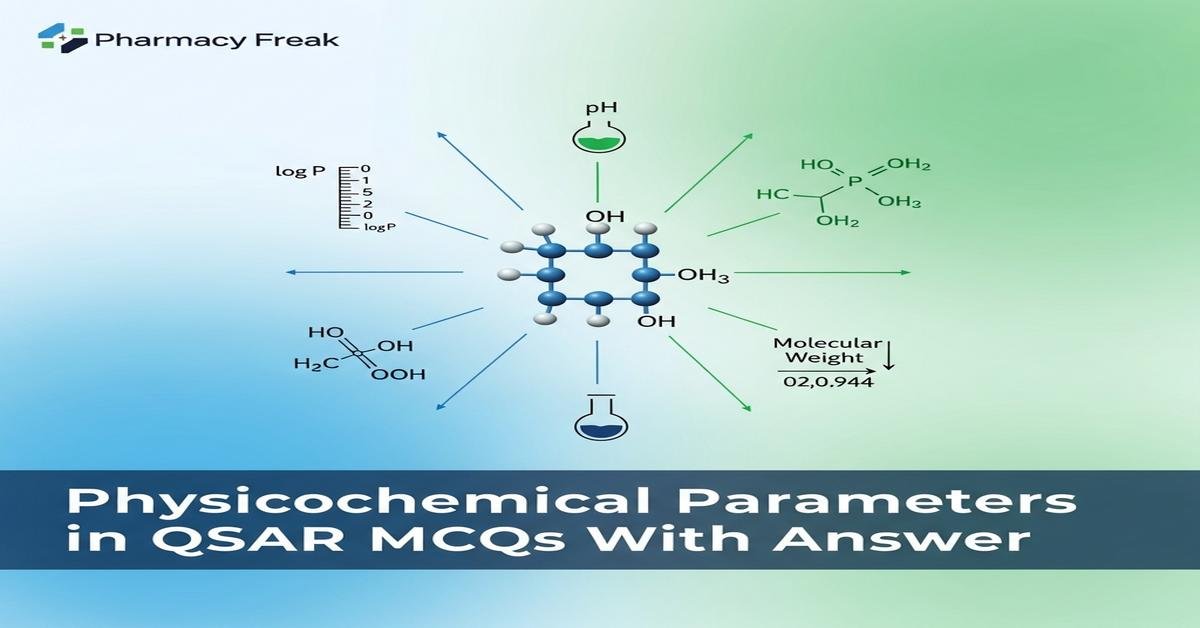
Understanding physicochemical parameters is essential for developing reliable QSAR (Quantitative Structure–Activity Relationship) models in pharmacy. This introduction covers key descriptors such as lipophilicity (LogP/LogD), pKa, aqueous solubility (LogS), molecular weight, hydrogen bond donors/acceptors, polar surface area (PSA), rotatable bonds, electronic (Hammett) and steric (Taft) parameters, and molecular refractivity. These parameters influence ADME properties, membrane permeability, distribution, metabolism, and drug‑likeness. Practical QSAR also requires descriptor calculation, multicollinearity control, model validation (r2, q2, R2pred) and applicability domain assessment. Clear knowledge of these concepts helps B.Pharm students link molecular features to pharmacokinetic behavior. ‘Now let’s test your knowledge with 30 MCQs on this topic.’
Q1. What are physicochemical parameters in QSAR primarily used to describe?
- Biological assay conditions such as temperature and incubation time
- Molecular features like lipophilicity, pKa, molecular weight and PSA that influence activity and ADME
- Manufacturing process variables for tablets
- Clinical trial patient demographics
Correct Answer: Molecular features like lipophilicity, pKa, molecular weight and PSA that influence activity and ADME
Q2. What does LogP represent in QSAR and pharmacokinetics?
- The logarithm of solubility in water
- The logarithm of the octanol–water partition coefficient for the un-ionized form
- The distribution coefficient at physiological pH
- The pH at which half the drug is ionized
Correct Answer: The logarithm of the octanol–water partition coefficient for the un-ionized form
Q3. How does LogD differ from LogP?
- LogD measures only neutral molecules while LogP includes ions
- LogD is the experimental measure and LogP is always calculated
- LogD is the pH-dependent distribution coefficient accounting for ionization; LogP is for the neutral species
- LogD is used for gases and LogP for liquids
Correct Answer: LogD is the pH-dependent distribution coefficient accounting for ionization; LogP is for the neutral species
Q4. Which of the following is a criterion included in Lipinski’s Rule of Five for oral druglikeness?
- Number of rotatable bonds ≤ 15
- Hydrogen bond donors ≤ 5
- Topological polar surface area ≥ 200 Ų
- Number of chiral centers ≤ 2
Correct Answer: Hydrogen bond donors ≤ 5
Q5. Which polar surface area (PSA) threshold is commonly associated with good oral absorption?
- PSA < 140 Ų
- PSA > 300 Ų
- PSA = 200–250 Ų
- PSA < 10 Ų
Correct Answer: PSA < 140 Ų
Q6. How do increased numbers of hydrogen bond donors and acceptors generally affect membrane permeability?
- They increase passive membrane permeability
- They decrease passive membrane permeability due to stronger aqueous interactions
- They have no effect on permeability
- They always increase oral bioavailability
Correct Answer: They decrease passive membrane permeability due to stronger aqueous interactions
Q7. What is the general effect of increasing lipophilicity (higher LogP) on aqueous solubility?
- It increases aqueous solubility
- It decreases aqueous solubility
- It has no predictable effect
- It converts the compound to an acid
Correct Answer: It decreases aqueous solubility
Q8. Which equation is used to calculate the fraction ionized of a compound at a given pH?
- Michaelis–Menten equation
- Henderson–Hasselbalch equation
- Arrhenius equation
- Beer–Lambert law
Correct Answer: Henderson–Hasselbalch equation
Q9. How does ionization state (unionized vs ionized) affect membrane permeation?
- The ionized form crosses lipid membranes more easily
- The unionized form crosses lipid membranes more easily
- Both forms cross equally well
- Ionic state only affects solubility, not permeation
Correct Answer: The unionized form crosses lipid membranes more easily
Q10. Which PSA value is often used as a heuristic cutoff suggesting potential blood–brain barrier (BBB) penetration?
- PSA < 90 Ų
- PSA > 300 Ų
- PSA = 150–200 Ų
- PSA = 0 Ų
Correct Answer: PSA < 90 Ų
Q11. Which descriptor is commonly used to represent molecular size and polarizability in QSAR?
- Hammett sigma constant
- Molecular refractivity (MR)
- pKa
- Topological polar surface area (PSA)
Correct Answer: Molecular refractivity (MR)
Q12. What do Hammett sigma (σ) constants quantify in QSAR studies?
- Steric hindrance of substituents
- Electronic (inductive and resonance) effects of substituents
- Hydrophobicity of a molecule
- Rotational flexibility
Correct Answer: Electronic (inductive and resonance) effects of substituents
Q13. The Taft steric parameter is primarily a measure of:
- Electronic donating ability
- Hydrogen bonding capacity
- Steric bulk or spatial hindrance of substituents
- Aqueous solubility
Correct Answer: Steric bulk or spatial hindrance of substituents
Q14. Which molecular feature is most often negatively correlated with oral bioavailability when present in high number?
- Low molecular weight
- High number of rotatable bonds
- Low LogP
- Low polar surface area
Correct Answer: High number of rotatable bonds
Q15. In QSAR descriptor sets, multicollinearity between descriptors can cause which problem?
- Improved external predictivity
- Inflated variance and unstable regression coefficients
- Increased number of experimental assays
- Guaranteed mechanistic interpretation
Correct Answer: Inflated variance and unstable regression coefficients
Q16. What does q² represent in QSAR model evaluation?
- The non‑validated fit to training data
- Cross‑validated predictive ability (usually leave‑one‑out or similar)
- Mean absolute deviation of predictions
- Number of descriptors used
Correct Answer: Cross‑validated predictive ability (usually leave‑one‑out or similar)
Q17. The applicability domain of a QSAR model defines:
- The maximum number of descriptors allowed in the model
- The chemical space where model predictions are considered reliable
- The list of experimental methods used to measure descriptors
- The clinical trial phases applicable to the drug
Correct Answer: The chemical space where model predictions are considered reliable
Q18. Which of the following is NOT a physicochemical descriptor used as input for QSAR models?
- LogP (lipophilicity)
- Topological polar surface area (PSA)
- pIC50 (negative log of biological potency)
- Number of hydrogen bond donors
Correct Answer: pIC50 (negative log of biological potency)
Q19. Which experimental method is the classical gold standard for determining octanol–water partition coefficient (LogP)?
- Shake‑flask method
- HPLC retention time without calibration
- pKa titration
- Dynamic light scattering
Correct Answer: Shake‑flask method
Q20. Which range of LogP is generally considered favorable for good passive membrane permeability without excessive lipophilicity?
- LogP 1–3
- LogP < −5
- LogP > 8
- LogP 5–7
Correct Answer: LogP 1–3
Q21. Which atoms contribute most directly to topological polar surface area (PSA)?
- Carbon and sulfur atoms
- Nitrogen and oxygen atoms and their attached polar hydrogens
- Halogens such as chlorine and bromine only
- All atoms equally regardless of polarity
Correct Answer: Nitrogen and oxygen atoms and their attached polar hydrogens
Q22. For an acidic drug (pKa = 4) at physiological pH 7.4, how does LogD@7.4 compare to LogP?
- LogD@7.4 will be substantially lower than LogP because the drug is mostly ionized
- LogD@7.4 will be the same as LogP
- LogD@7.4 will be substantially higher than LogP
- LogD@7.4 equals pKa
Correct Answer: LogD@7.4 will be substantially lower than LogP because the drug is mostly ionized
Q23. Which descriptor is commonly used to quantify molecular flexibility in QSAR?
- Number of rotatable bonds
- Topological polar surface area
- Hammett sigma constant
- Melting point
Correct Answer: Number of rotatable bonds
Q24. Which computational approach is most appropriate to calculate detailed electronic descriptors (e.g., partial charges, HOMO/LUMO) for QSAR?
- Quantum chemical calculations such as DFT
- Simple atom counting
- Shake‑flask experiments
- Clinical pharmacokinetic studies
Correct Answer: Quantum chemical calculations such as DFT
Q25. Which multivariate method is widely used in QSAR for dealing with many correlated descriptors?
- Partial least squares (PLS)
- Univariate linear regression
- Kaplan–Meier analysis
- Fourier transform
Correct Answer: Partial least squares (PLS)
Q26. A basic drug with pKa 9 at pH 7.4 will be predominantly in which form and how will that influence passive permeation?
- Predominantly unionized; increased passive permeation
- Predominantly ionized (protonated); decreased passive permeation
- Equally ionized and unionized; no net effect
- It will precipitate in solution
Correct Answer: Predominantly ionized (protonated); decreased passive permeation
Q27. How does increasing lipophilicity typically affect apparent volume of distribution (Vd)?
- Increases Vd due to greater tissue distribution
- Decreases Vd because drug stays in plasma
- No effect on Vd
- Causes immediate renal excretion only
Correct Answer: Increases Vd due to greater tissue distribution
Q28. Which single physicochemical parameter is most directly predictive of passive transcellular membrane permeability?
- LogP (lipophilicity)
- Melting point
- Color of the compound
- Vapor pressure
Correct Answer: LogP (lipophilicity)
Q29. Which computational method name is commonly used for calculating octanol–water partition coefficients (calculated lipophilicity)?
- Shake‑flask ClogP
- Experimental HPLC only
- ClogP (calculated LogP) algorithms
- pKa titration
Correct Answer: ClogP (calculated LogP) algorithms
Q30. Which validation metric specifically evaluates predictive performance on an external test set?
- q² (cross‑validated internal metric)
- R²pred or external R²
- Number of descriptors
- Training set SSE (sum of squared errors)
Correct Answer: R²pred or external R²


