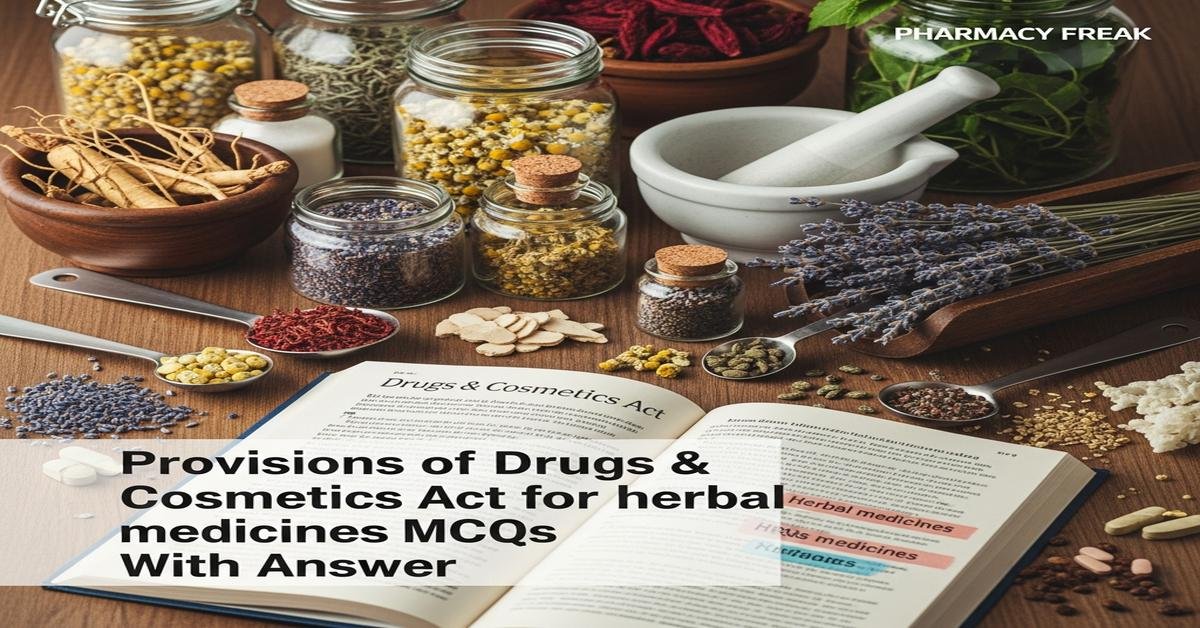
Introduction: The Drugs & Cosmetics Act and Rules provide the regulatory framework for manufacture, sale, labeling, quality and safety of herbal medicines in India. B.Pharm students must understand key provisions such as classification of herbal products, applicable pharmacopoeias (Ayurvedic, Unani, Siddha), GMP standards (Schedule T for traditional systems, Schedule M for modern pharmaceuticals), licensing and registration requirements, permissible claims, quality control tests, and pharmacovigilance for herbals. Knowledge of labeling, manufacturing inspections, and penalties for non-compliance is essential for ensuring patient safety and legal compliance. This focused review will reinforce regulatory principles, quality standards and practical compliance aspects for herbal therapeutics. Now let’s test your knowledge with 30 MCQs on this topic.
Q1. What primary legislation governs the regulation of herbal medicines in India?
- Food Safety and Standards Act
- The Drugs & Cosmetics Act, 1940
- Indian Medical Council Act
- Consumer Protection Act
Correct Answer: The Drugs & Cosmetics Act, 1940
Q2. Which pharmacopoeia is specifically used for standard monographs of Ayurvedic drugs?
- British Pharmacopoeia
- Indian Pharmacopoeia
- Ayurvedic Pharmacopoeia of India
- United States Pharmacopeia
Correct Answer: Ayurvedic Pharmacopoeia of India
Q3. Which Schedule of the Drugs & Cosmetics Rules addresses GMP requirements for Ayurvedic, Siddha and Unani medicines?
- Schedule M
- Schedule T
- Schedule H
- Schedule Y
Correct Answer: Schedule T
Q4. Under the Act, a product making therapeutic claims and containing herbal ingredients is most likely classified as what?
- Cosmetic
- Food supplement
- Drug
- Household chemical
Correct Answer: Drug
Q5. Which authority is primarily responsible for issuing manufacturing licenses for herbal medicines at the state level?
- Central Drugs Standard Control Organization (CDSCO)
- Food Safety Authority
- State Licensing Authority
- Ministry of Health and Family Welfare directly
Correct Answer: State Licensing Authority
Q6. Which schedule provides GMP requirements for modern pharmaceutical manufacturing?
- Schedule T
- Schedule M
- Schedule H
- Schedule D
Correct Answer: Schedule M
Q7. For traditional classical Ayurvedic formulations with monographs in API, what regulatory requirement is usually relaxed?
- No need for labeling
- Exemption from any quality testing
- Less stringent requirement for new drug clinical trials if classical and monographed
- Complete exemption from licensing
Correct Answer: Less stringent requirement for new drug clinical trials if classical and monographed
Q8. Which document lists standardized tests and specifications for herbal raw materials and formulations?
- Pharmacopoeia
- Clinical trial registry
- Schedule H list
- Import-export code
Correct Answer: Pharmacopoeia
Q9. What is a key labeling requirement for herbal products classified as drugs under the Act?
- They can make any therapeutic claim without evidence
- Label must not make unsubstantiated therapeutic claims and should list ingredients and manufacturer details
- Labeling is optional for traditional products
- Only the scientific name is required on the label
Correct Answer: Label must not make unsubstantiated therapeutic claims and should list ingredients and manufacturer details
Q10. Which regulatory concept ensures ongoing monitoring of safety of herbal medicines after marketing?
- Good Laboratory Practice
- Pharmacovigilance
- Clinical trial registration
- Patent surveillance
Correct Answer: Pharmacovigilance
Q11. Which of the following best describes a “proprietary Ayurvedic medicine” under regulatory practice?
- A classical formulation identical to texts in Ayurvedic pharmacopoeia
- A new or modified formulation marketed under a brand name not described in classical texts
- Any herbal tea sold as food
- A foreign herbal product with no changes
Correct Answer: A new or modified formulation marketed under a brand name not described in classical texts
Q12. Which body issues national-level approvals for new drugs and clinical trials, often relevant when herbal products claim new indications?
- State Health Department
- Central Drugs Standard Control Organization (CDSCO)
- Pharmacy Council of India
- Food Safety and Standards Authority
Correct Answer: Central Drugs Standard Control Organization (CDSCO)
Q13. What is the role of a pharmacopeial monograph for a herbal drug?
- To provide marketing strategies
- To set identity, purity, assay and reference standards for quality control
- To exempt the product from inspection
- To list retail prices
Correct Answer: To set identity, purity, assay and reference standards for quality control
Q14. Under regulatory inspection, which aspect is crucial for herbal manufacturing units?
- Color of packaging only
- GMP compliance including sanitation, personnel training and documentation
- Only the location of the factory
- Number of sales representatives
Correct Answer: GMP compliance including sanitation, personnel training and documentation
Q15. Which practice is essential when making therapeutic claims for a herbal formulation?
- Claims based on traditional use without any documentation
- Substantiation by evidence such as pharmacopoeial monographs, safety and efficacy data or accepted traditional references
- No claims allowed at all
- Using foreign advertisements only
Correct Answer: Substantiation by evidence such as pharmacopoeial monographs, safety and efficacy data or accepted traditional references
Q16. Which of these is a common quality concern unique to herbal medicines?
- Heavy metal contamination and adulteration
- Lack of active pharmaceutical ingredient (API) naming
- Excessive synthetic excipients only
- Too high sugar content
Correct Answer: Heavy metal contamination and adulteration
Q17. What does the term “standardization” mean in the context of herbal medicines?
- Creating uniform marketing slogans
- Establishing consistent identity, strength and quality through validated assays and specifications
- Using the same color for all labels
- Making every batch identical by composition to a synthetic drug
Correct Answer: Establishing consistent identity, strength and quality through validated assays and specifications
Q18. If a herbal product is adulterated with a scheduled synthetic drug, it is considered:
- Safe and compliant
- Spurious or adulterated and illegal under the Act
- Only a food matter
- Exempt from regulation
Correct Answer: Spurious or adulterated and illegal under the Act
Q19. Which component is recommended to be declared clearly on the label of a herbal medicinal product?
- Manufacturer’s personal phone number only
- Quantity of active herbal ingredients, batch number, manufacturing and expiry dates
- Only the brand logo
- Price of the product
Correct Answer: Quantity of active herbal ingredients, batch number, manufacturing and expiry dates
Q20. Which guideline helps in design and conduct of clinical trials for new drugs including herbal new entities?
- Schedule H
- Schedule Y
- Schedule M
- Schedule T only
Correct Answer: Schedule Y
Q21. Which of the following best describes “Good Agricultural and Collection Practices” (GACP) relevance to herbal drugs?
- GACP is irrelevant to herbal quality
- GACP ensures quality and traceability of raw herbal materials from cultivation and collection
- GACP only applies to synthetic drugs
- GACP is a marketing guideline
Correct Answer: GACP ensures quality and traceability of raw herbal materials from cultivation and collection
Q22. Who is responsible for reporting adverse events related to herbal medicines in a pharmacovigilance system?
- Only regulatory inspectors
- Healthcare professionals, manufacturers and patients
- Only the sales department
- Only foreign regulators
Correct Answer: Healthcare professionals, manufacturers and patients
Q23. What action can regulators take against manufacturers violating provisions for herbal medicines?
- Only issue a friendly reminder
- Cancel licenses, seize products, prosecute and impose penalties
- Promote their products
- Grant immunity from inspection
Correct Answer: Cancel licenses, seize products, prosecute and impose penalties
Q24. Which of the following is true about import of herbal medicines into India?
- No approvals are required
- Imports require compliance with Indian regulations, appropriate clearances and quality documentation
- They are exempt from labeling norms
- Only local manufacturers can import
Correct Answer: Imports require compliance with Indian regulations, appropriate clearances and quality documentation
Q25. In context of the Act, the term “drug” includes which of the following?
- Only allopathic chemical drugs
- Ayurvedic, Siddha, Unani and homoeopathic medicines when they carry therapeutic claims
- Only food items
- Only cosmetics
Correct Answer: Ayurvedic, Siddha, Unani and homoeopathic medicines when they carry therapeutic claims
Q26. For a proprietary herbal formulation claiming a new therapeutic indication, which is essential before marketing?
- No testing required at all
- Evidence of safety and efficacy or appropriate regulatory approval depending on claim
- Just attractive packaging
- Only celebrity endorsement
Correct Answer: Evidence of safety and efficacy or appropriate regulatory approval depending on claim
Q27. Which is an important laboratory test for identity and purity of herbal ingredients?
- Chromatographic fingerprinting and assay
- Only taste testing
- Counting packaging units
- Assessing color under sunlight
Correct Answer: Chromatographic fingerprinting and assay
Q28. What distinguishes a classical Ayurvedic medicine from a proprietary Ayurvedic medicine?
- Classical uses modern excipients only
- Classical is described in authoritative texts and monographs; proprietary is a newer marketed formulation
- Proprietary medicines have no active herbs
- Classical medicines are always synthetic
Correct Answer: Classical is described in authoritative texts and monographs; proprietary is a newer marketed formulation
Q29. Which practice helps prevent batch-to-batch variability in herbal drug production?
- No raw material testing
- Standardized extracts, validated processes and quality control specifications
- Changing sources of herbs randomly
- Ignoring shelf-life studies
Correct Answer: Standardized extracts, validated processes and quality control specifications
Q30. What is the role of accepted traditional references in regulatory assessment of herbal products?
- They have no regulatory value
- They can provide historical evidence of use and support safety/efficacy claims when combined with quality data
- They replace the need for any quality testing
- They automatically approve any new claim
Correct Answer: They can provide historical evidence of use and support safety/efficacy claims when combined with quality data


