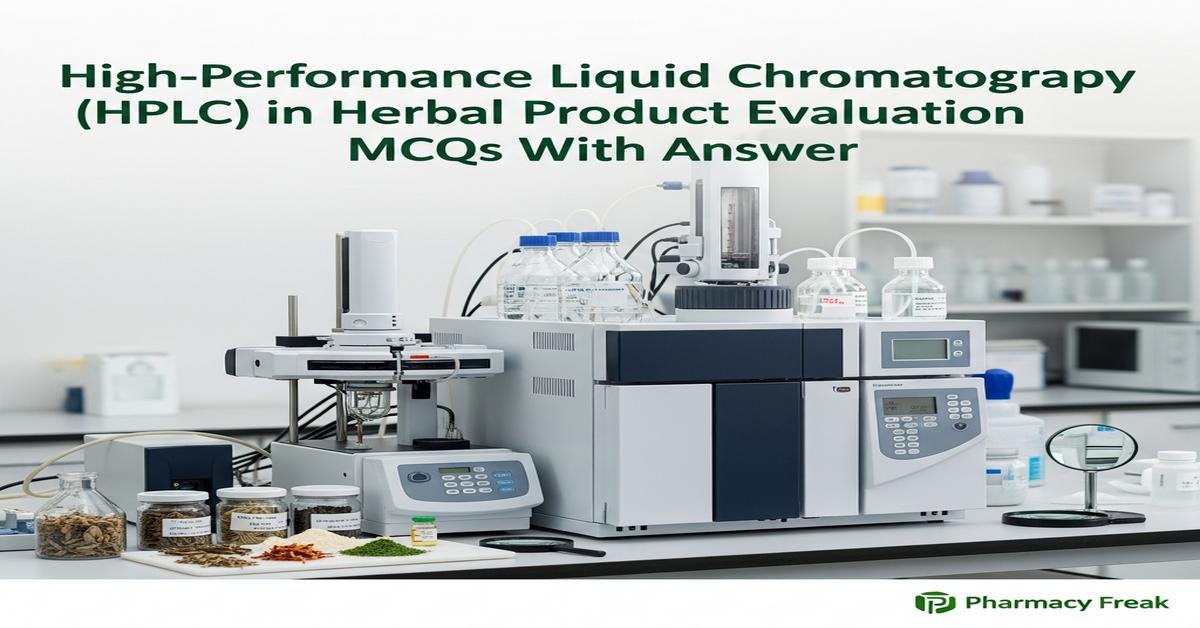
Introduction: High-performance liquid chromatography (HPLC) is a cornerstone analytical technique in herbal product evaluation, enabling precise separation, identification, and quantification of complex phytochemicals. B. Pharm students must master HPLC principles — mobile phase and stationary phase selection, retention time, peak shape, and detector choice — to assess herbal quality, potency, and purity. Practical skills include sample preparation, method development, system suitability, and method validation parameters (specificity, accuracy, precision, LOD/LOQ). Understanding reversed-phase versus normal-phase modes, gradient strategies, and common detectors (UV, PDA, MS) ensures reliable analysis of flavonoids, alkaloids, glycosides, and markers. Now let’s test your knowledge with 30 MCQs on this topic.
Q1. What is the primary role of the stationary phase in HPLC?
- To control the flow rate of the mobile phase
- To provide differential interactions with analytes for separation
- To detect analytes by producing a signal
- To evaporate solvent during analysis
Correct Answer: To provide differential interactions with analytes for separation
Q2. In reversed-phase HPLC commonly used for herbal constituents, which type of stationary phase is used?
- Polar silica without modification
- Hydrophobic C18-bonded silica
- Ion-exchange resin
- Size-exclusion gel
Correct Answer: Hydrophobic C18-bonded silica
Q3. Which detector provides spectral information across multiple wavelengths useful for identifying flavonoids?
- Refractive index detector (RID)
- Flame ionization detector (FID)
- Photo-diode array detector (PDA)
- Electrochemical detector (ECD)
Correct Answer: Photo-diode array detector (PDA)
Q4. What does retention time (tR) indicate in HPLC?
- Time for column equilibration
- Time an analyte spends in the detector cell only
- Time from injection until the peak maximum reaches the detector
- Time required to prepare the mobile phase
Correct Answer: Time from injection until the peak maximum reaches the detector
Q5. Which parameter describes column efficiency in HPLC?
- Tailing factor
- Theoretical plates (N)
- Retention factor (k’)
- Resolution (Rs)
Correct Answer: Theoretical plates (N)
Q6. In method validation for herbal analysis, which ICH parameter assesses the lowest concentration that can be reliably quantified?
- Specificity
- LOD (Limit of Detection)
- LOQ (Limit of Quantitation)
- Robustness
Correct Answer: LOQ (Limit of Quantitation)
Q7. Which mobile phase modifier is commonly used to improve peak shape for basic alkaloids?
- Trifluoroacetic acid (TFA) or formic acid
- Non-polar hydrocarbon
- EDTA
- Glycerol
Correct Answer: Trifluoroacetic acid (TFA) or formic acid
Q8. What is the purpose of system suitability tests before analyzing herbal samples?
- To calibrate the micropipettes
- To confirm chromatographic system performance (e.g., resolution, T, N)
- To sterilize the HPLC column
- To heat the mobile phase
Correct Answer: To confirm chromatographic system performance (e.g., resolution, T, N)
Q9. Which extraction technique is most suitable for thermolabile herbal constituents prior to HPLC?
- Refluxing with boiling solvent for several hours
- Soxhlet extraction with high temperatures
- Cold maceration or sonication at low temperature
- Dry ashing at 600°C
Correct Answer: Cold maceration or sonication at low temperature
Q10. In HPLC, what does a tailing factor greater than 1.5 indicate?
- Symmetric peak with ideal chromatography
- Peak fronting due to overloading
- Peak tailing indicating secondary interactions or column issues
- No analyte present
Correct Answer: Peak tailing indicating secondary interactions or column issues
Q11. Which calibration method compensates for matrix effects in complex herbal extracts?
- External standard calibration using solvent alone
- Standard addition method
- Single-point calibration with pure solvent
- No calibration is needed
Correct Answer: Standard addition method
Q12. Which mobile phase strategy helps separate compounds with a wide polarity range in herbal samples?
- Isocratic elution with a single solvent ratio
- Gradient elution increasing organic proportion over time
- Using only water as mobile phase
- Switching columns during run
Correct Answer: Gradient elution increasing organic proportion over time
Q13. What is the retention factor (k’) used to describe?
- Detector sensitivity
- Relative retention of an analyte compared to the unretained compound
- Column temperature stability
- Mobile phase viscosity
Correct Answer: Relative retention of an analyte compared to the unretained compound
Q14. Which HPLC detector is most sensitive for trace-level detection of non-UV absorbing phytochemicals when coupled with MS?
- UV detector alone
- Refractive index detector
- Mass spectrometer (MS) detector
- Conductivity detector
Correct Answer: Mass spectrometer (MS) detector
Q15. What does resolution (Rs) between two peaks quantify?
- The peak width at baseline only
- The degree of separation between two adjacent peaks
- The detector baseline noise
- The retention time reproducibility
Correct Answer: The degree of separation between two adjacent peaks
Q16. For ionizable herbal compounds, why is mobile phase pH control important?
- It only changes detector response but not retention
- It affects the ionization state, altering retention and selectivity
- It prevents pump cavitation
- It determines column particle size
Correct Answer: It affects the ionization state, altering retention and selectivity
Q17. Which sample clean-up technique removes pigments and lipids before HPLC analysis of herbal extracts?
- SPE (Solid-phase extraction)
- Direct injection without clean-up
- Lyophilization only
- Ultracentrifugation to 100,000 g
Correct Answer: SPE (Solid-phase extraction)
Q18. In HPLC, increasing the flow rate typically results in:
- Longer retention times and broader peaks
- Shorter run times but possible loss of resolution
- Increased column theoretical plates
- No change in chromatographic behavior
Correct Answer: Shorter run times but possible loss of resolution
Q19. Which metric assesses precision during method validation?
- System suitability only
- Repeatability expressed as percent relative standard deviation (RSD)
- Only visual inspection of chromatograms
- Specificity index
Correct Answer: Repeatability expressed as percent relative standard deviation (RSD)
Q20. Ion-pair chromatography is particularly useful for:
- Separating neutral volatile oils only
- Enhancing retention of ionic analytes by pairing with counter ions
- Size-based separations of macromolecules
- Direct coupling to GC detectors
Correct Answer: Enhancing retention of ionic analytes by pairing with counter ions
Q21. Which property of a column particle size improves separation efficiency but may increase backpressure?
- Larger particle size (e.g., 10 µm)
- Smaller particle size (e.g., sub-2 µm)
- Porosity elimination
- Using wooden packing material
Correct Answer: Smaller particle size (e.g., sub-2 µm)
Q22. What is the advantage of using a guard column in HPLC analysis of herbal extracts?
- It increases retention times significantly
- It protects the analytical column from particulates and strongly retained matrix components
- It replaces the need for detectors
- It lowers solvent consumption
Correct Answer: It protects the analytical column from particulates and strongly retained matrix components
Q23. Which approach helps resolve co-eluting peaks in complex herbal matrices?
- Decrease detector sensitivity
- Change stationary phase chemistry or adjust mobile phase composition/pH
- Inject larger sample volumes blindly
- Use water only as mobile phase
Correct Answer: Change stationary phase chemistry or adjust mobile phase composition/pH
Q24. In quantitative HPLC, why is peak area preferred over peak height?
- Peak area is less sensitive to peak broadening and more proportional to analyte quantity
- Peak height is always more accurate
- Peak area ignores baseline noise completely
- Peak height measures total analyte amount better
Correct Answer: Peak area is less sensitive to peak broadening and more proportional to analyte quantity
Q25. Which practice improves method robustness for herbal HPLC assays?
- Ignoring column temperature control
- Documenting and testing small deliberate changes (pH, flow, temperature)
- Using unfiltered mobile phase
- Never performing system suitability
Correct Answer: Documenting and testing small deliberate changes (pH, flow, temperature)
Q26. Which calculation uses baseline widths and retention times to quantify separation?
- Retention factor (k’)
- Resolution (Rs)
- Peak symmetry only
- Detector linearity
Correct Answer: Resolution (Rs)
Q27. When analyzing glycosides in herbal extracts, which mobile phase composition is often effective in reversed-phase HPLC?
- High percentage of non-polar solvent like hexane
- Mixture of water with methanol or acetonitrile, sometimes with acid modifier
- Pure strong acid without organic solvent
- Pure glycerin
Correct Answer: Mixture of water with methanol or acetonitrile, sometimes with acid modifier
Q28. Which HPLC parameter indicates the selectivity between two analytes?
- Retention time alone
- Column length
- Selectivity factor (α)
- Detector noise
Correct Answer: Selectivity factor (α)
Q29. For stability-indicating HPLC methods in herbal products, what must be demonstrated?
- Method detects only the parent compound with no degradation monitoring
- Method can separate analyte from its degradation products and excipients
- Only peak area reproducibility is needed
- Stability testing is not required for herbal products
Correct Answer: Method can separate analyte from its degradation products and excipients
Q30. Which international guideline is most relevant for validation of analytical procedures like HPLC?
- GMP Annex 1 only
- ICH Q2(R1) guideline on validation of analytical procedures
- Pharmacopoeia guidelines are irrelevant
- ISO 9001 unrelated to analytical validation
Correct Answer: ICH Q2(R1) guideline on validation of analytical procedures


